• Fri frakt över 249 kr
  • •
  • Snabba leveranser
  • •
  • Billiga böcker
Kundservice

Du är på sajten för privatpersoner.

Företag, bibliotek eller offentlig verksamhet?

Du handlar på classic.bokus.com, där alla dina funktioner finns intakta.
Till classic.bokus.com
Bokus logotyp. Gå till startsidan.
  • Erbjudanden
  • Nyheter
  • Student
  • Topplistor
  • Barn & ungdom
  • Bokus Play
  • E-böcker
  • Pocketböcker
  • Spel & pussel

10% rabatt på allt med kod: NYSTART10 →

Sidfot

Mina sidor

    Hjälp

    • Kundservice
    • Vanliga frågor och svar
    • Frakt och leverans
    • Retur vid ångerrätt
    • Reklamera vara
    • Betalning
    • Köpvillkor
    • Allmänna villkor
    • Information om webbplatsens tillgänglighet

    Om Bokus

    • Om oss
    • Pressrum
    • För studenter
    • För företag
    • För bibliotek och offentlig verksamhet
    • För leverantörer
    • Hållbarhet

    Populärt

    • Aktuella erbjudanden
    • Presentkort
    • Studentlitteratur
    • Nya böcker
    • Topplistor
    • Signerade böcker
    • Engelska böcker

    Inspiration

    • Boktips
    • BookTok
    • Populära bokserier
    • Barnbokskaraktärer
    • Populära författare
    Logotyp för Bokus
    Följ oss på Facebook (extern länk)Följ oss på Instagram (extern länk)Följ oss på YouTube (extern länk)Följ oss på TikTok (extern länk)
    bokus @ CookiesAnpassa cookiesIntegritetspolicyKöpvillkor
    Till Citymail hemsida (extern länk)Till Budbee hemsida (extern länk)Till Postnord hemsida (extern länk)Till Schenker hemsida (extern länk)Till Early Bird hemsida (extern länk)Till Walleys hemsida (extern länk)
    1. Samhälle och politik
    2. Samhälle och kultur
    3. Sociala och etiska frågor
    4. Migration

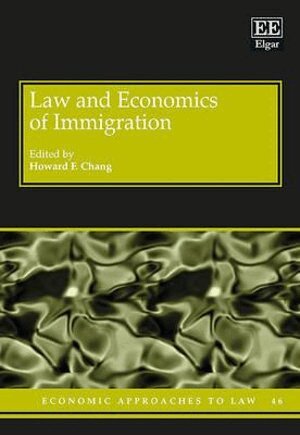
    Law and Economics of Immigration

    AvHoward F. Chang

    Inbunden, Engelska, 2015

    Del 46 i serien Economic Approaches to Law series

    6 388 kr

    Beställningsvara. Skickas inom 5-8 vardagar. Fri frakt över 249 kr.

    Beskrivning

    This volume compiles influential and diverse readings on the timely subject of immigration. This collection includes work published by leading economists, as well as a number of important contributions made by influential legal scholars, with a focus on economic issues that are salient in debates over immigration policy. Professor Chang’s introduction not only explains the contribution that each reading makes to our understanding of immigration, but also surveys the literature more broadly, putting the selected readings in context.

    Produktinformation

    • Utgivningsdatum:2015-05-29
    • Mått:169 x 244 x undefined mm
    • Format:Inbunden
    • Språk:Engelska
    • Serie:Economic Approaches to Law series
    • Förlag:Edward Elgar Publishing Ltd
    • ISBN:9781783474875

    Utforska kategorier

    • Migration inom Samhälle och politik
    • Migrations- och asylrätt inom Juridik
    • Ekonomisk politik inom Ekonomi och Ledarskap

    Mer om författaren

    Edited by Howard F. Chang, Earle Hepburn Professor of Law, University of Pennsylvania Law School, US

    Recensioner i media

    ‘It is almost impossible to underestimate the influence of economics upon immigration theory in today’s interconnected and globalized world. Howard F. Chang is one of the preeminent actors in this hybrid field of study, and has assembled a broad and deep cast in this volume, which usefully pulls together many studies and views. This will become an indispensable resource in the subject, as well as a detailed map of this important and growing academic area.’

    Innehållsförteckning

    • Contents;AcknowledgementsIntroductionHoward F. ChangPART ITHE ECONOMIC BENEFITS OF LABOUR MIGRATION 1. Jonathon W. Moses and Bjørn Letnes (2004), ‘The Economic Costs to International Labor Restrictions: Revisiting the Empirical Discussion’, World Development, 32 (10), October, 1609–262. Michael A. Clemens (2011), ‘Economics and Emigration: Trillion-Dollar Bills on the Sidewalk?’, Journal of Economic Perspectives, 25 (3), Summer, 83–1063. George J. Borjas (1995), ‘The Economic Benefits from Immigration’, Journal of Economic Perspectives, 9 (2), Spring, 3–22PART IITHE IMPACT OF IMMIGRATION IN THE LABOUR MARKET A Inferences from Cross-Section Data on Local Labour Markets4. Jean Baldwin Grossman (1982), ‘The Substitutability of Natives and Immigrants in Production’, Review of Economics and Statistics, 64 (4), November, 596–6035. George J. Borjas (1994), ‘The Economics of Immigration’, Journal of Economic Literature, XXXII (4), December, 1667–7176. Rachel M. Friedberg and Jennifer Hunt (1995), ‘The Impact of Immigrants on Host Country Wages, Employment and Growth’, Journal of Economic Perspectives, 9 (2), Spring, 23–447. David Card (1990), ‘The Impact of the Mariel Boatlift on the Miami Labor Market’, Industrial and Labor Relations Review, 43 (2), January, 245–578. David Card (2001), ‘Immigrant Inflows, Native Outflows, and the Local Labor Market Impacts of Higher Immigration’, Journal of Labor Economics, 19 (1), January, 22–64BModels of the National Labour Market9. George J. Borjas (2003), ‘The Labor Demand Curve is Downward Sloping: Reexamining the Impact of Immigration on the Labor Market’, Quarterly Journal of Economics, 118 (4), November, 1335–74 10. David Card (2009), ‘Immigration and Inequality’, American Economic Review: Papers & Proceedings, 99 (2), May, 1–21 11. Gianmarco I.P. Ottaviano and Giovanni Peri (2012), ‘Rethinking the Effect of Immigration on Wages’, Journal of the European Economic Association, 10 (1), February, 152–9712. George J. Borjas, Jeffrey Grogger and Gordon H. Hanson (2012), ‘Comment: On Estimating Elasticities of Substitution’, Journal of the European Economic Association, 10 (1), February, 198–210CImperfect Substitution between Immigrants and Natives13. Patricia Cortes (2008), ‘The Effect of Low-Skilled Immigration on U.S. Prices: Evidence from CPI Data’, Journal of Political Economy, 116 (3), June, 381–42214. Giovanni Peri and Chad Sparber (2009), ‘Task Specialization, Immigration, and Wages’, American Economic Journal: Applied Economics, 1 (3), July, 135–69DFemale Labour Supply and the Excess Burden of Protectionism15. Howard F. Chang (2009), ‘Immigration Restriction as Redistributive Taxation: Working Women and the Costs of Protectionism in the Labor Market’, Journal of Law, Economics and Policy, 5 (1), Spring, 1–2916. Patricia Cortés and José Tessada (2011), ‘Low-Skilled Immigration and the Labor Supply of Highly Skilled Women’, American Economic Journal: Applied Economics, 3 (3), July, 88–123PART III THE FISCAL IMPACT OF IMMIGRATION 17. Panel on the Demographic and Economic Impacts of Immigration, National Research Council (1997), ‘The Future Fiscal Impacts of Current Immigrants’, in James P. Smith and Barry Edmonston (eds), The New Americans: Economic, Demographic, and Fiscal Effects of Immigration, Chapter 7, Washington, DC: National Academy Press, 297–362PART VI IMMIGRATION LAW AND REFORMAAnalysing the Effects of Immigration Laws and Proposing Reforms18. Sherrie A. Kossoudji and Deborah A. Cobb-Clark (2002), ‘Coming out of the Shadows: Learning about Legal Status and Wages from the Legalized Population’, Journal of Labor Economics, 20 (3), July, 598–62819.Howard F. Chang (1998), ‘Migration as International Trade: The Economic Gains from the Liberalized Movement of Labor’, UCLA Journal of International Law and Foreign Affairs, 3, 371–41420. Michael J. Trebilock (2003), ‘The Law and Economics of Immigration Policy’, American Law and Economics Review, 5 (2), August, 271–31721. Anu Bradford (2013), ‘Sharing the Risks and Rewards of Economic Migration’, University of Chicago Law Review, 80 (1), Winter, 29–5622. Howard F. Chang (2007), ‘Cultural Communities in a Global Labor Market: Immigration Restrictions as Residential Segregation’, University of Chicago Legal Forum, 2007, 93–130BEconomic Accounts of Immigration Laws and Institutions23. Adam B. Cox and Eric A. Posner (2009), ‘The Rights of Migrants: An Optimal Contract Framework’, New York University Law Review, 84 (6), December, 1403–6324. Alan O. Sykes (2013), ‘International Cooperation on Migration: Theory and Practice’, University of Chicago Law Review, 80 (1), Winter, 315–39