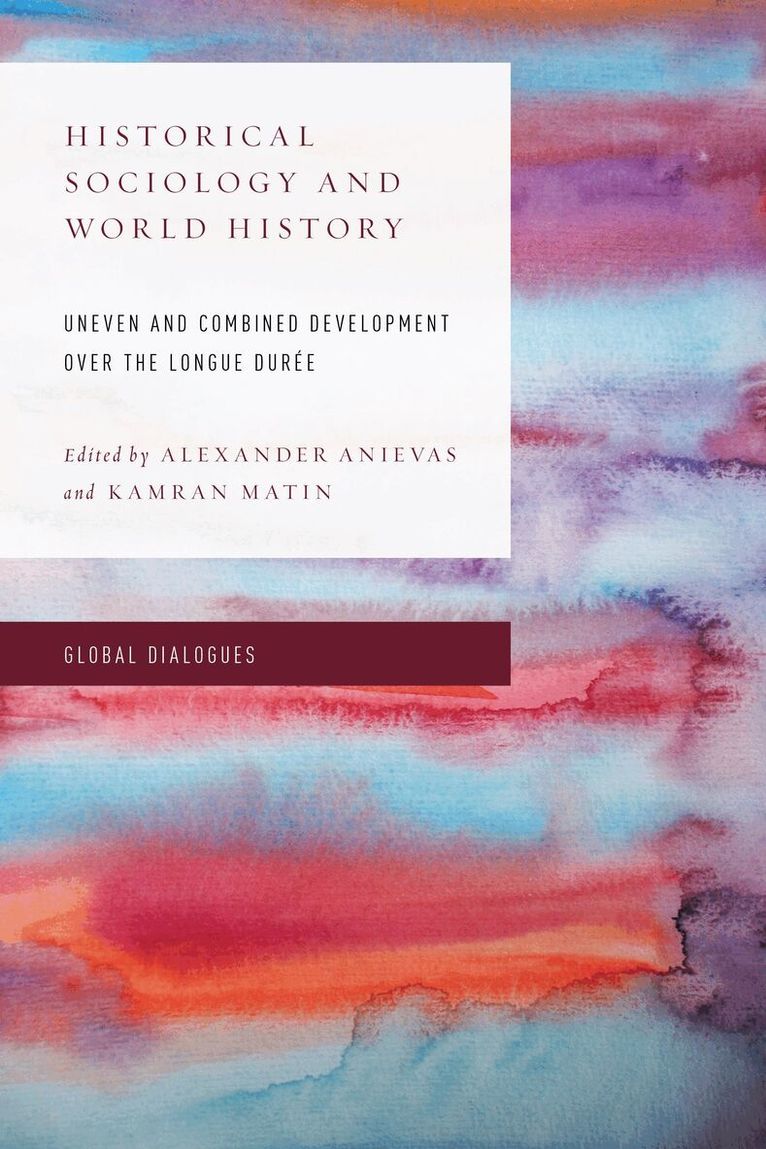
Häftad, Engelska, 2016
Historical Sociology and World History
Uneven and Combined Development over the Longue Durée
Av Alexander Anievas, Kamran Matin
Del i serien Global Dialogues: Non Eurocentric Visions of the Global
711 kr
Beställningsvara. Skickas inom 10-15 vardagar. Fri frakt över 249 kr.
Beskrivning
Produktinformation
- Utgivningsdatum: 2016-09-12
- Mått: 152 x 227 x 22 mm
- Vikt: 458 g
- Format: Häftad
- Språk: Engelska
- Serie: Global Dialogues: Non Eurocentric Visions of the Global
- Antal sidor: 318
- Förlag: Bloomsbury Publishing PLC
- ISBN: 9781783486823
Utforska kategorier
Mer om författaren
Alexander Anievas is an Early Career Leverhulme Fellow at the Department of Politics and International Studies, University of Cambridge where he also obtained his PhD. He has published in various journals including European Journal of International Relations, Politics, Review of International Studies, International Politics and Capital & Class. He is the author of Capital, the State, and War: Class Conflict and Geopolitics in the Thirty Years’ Crisis, 1914-1945 (2014) and co-author of How the West Came to Rule: The Geopolitical Origins of Capitalism (2015). He has also edited, co-edited and contributed to Marxism and World Politics (2010), Race and Racism in International Relations ( 2014), Cataclysm 1914: The First World War and the Making of Modern World Politics (2014), and The Longue Durée of the Far Right (2014). He is a member of the editorial collective Historical Materialism: Research in Critical Marxist Theory.Kamran Matin is Senior Lecturer in International Relations at Sussex University, a management committee member of Centre for Advanced International Theory, and a co-founder and co-director of Sussex Uneven and Combined Development Working Group. His publications on historical sociology and premodern state-formation, postcolonial theory, political Islam, and modern Iranian history have appeared in European Journal of International Relations, Journal of international Relations and Development, and Middle East Critique. He is the author of Recasting Iranian Modernity: International Relations and Social Change (2013).
Recensioner i media
In recent years, a growing number of international relations scholars have used the idea of uneven and combined development to fashion social theories of “the international.” First proposed by the Russian Marxist revolutionary Leon Trotsky to describe the trajectory of the Russian Revolution, uneven and combined development as a theoretical framework has been employed to avoid Eurocentrism and highlight cross-society interactions. Anievas (Univ. of Connecticut) and Matin (Sussex Univ., UK) have assembled an impressive array of experts to extend such an idea to historical sociology. Aside from the charge of marginalizing non-European societies, mainstream historical sociology has mostly focused on single nation-states. Uneven and combined development, on the contrary, provides a pluralist perspective on the development of global capitalism over the long term. This edited volume is rich in empirical case studies, ranging from the Ottoman Empire to the Opium War, with no shortage of insights on the different paths of capital accumulation and market integration. While uneven and combined development may not achieve the status of a theoretical paradigm, this insightful book certainly fulfills its goals in bringing extra-European societies into the discussion of world history and in bridging the fields of historical sociology and world history. Summing Up:Highly recommended. Faculty.
Betyg & recensioner
0 recensioner
Inga recensioner tillgängliga.