• Fri frakt över 249 kr
  • •
  • Snabba leveranser
  • •
  • Billiga böcker
Kundservice

Du är på sajten för privatpersoner.

Företag, bibliotek eller offentlig verksamhet?

Du handlar på classic.bokus.com, där alla dina funktioner finns intakta.
Till classic.bokus.com
Bokus logotyp. Gå till startsidan.
  • Erbjudanden
  • Nyheter
  • Student
  • Topplistor
  • Barn & ungdom
  • Bokus Play
  • E-böcker
  • Pocketböcker
  • Spel & pussel

10% rabatt på allt med kod: NYSTART10 →

Sidfot

Mina sidor

    Hjälp

    • Kundservice
    • Vanliga frågor och svar
    • Frakt och leverans
    • Retur vid ångerrätt
    • Reklamera vara
    • Betalning
    • Köpvillkor
    • Allmänna villkor
    • Information om webbplatsens tillgänglighet

    Om Bokus

    • Om oss
    • Pressrum
    • För studenter
    • För företag
    • För bibliotek och offentlig verksamhet
    • För leverantörer
    • Hållbarhet

    Populärt

    • Aktuella erbjudanden
    • Presentkort
    • Studentlitteratur
    • Nya böcker
    • Topplistor
    • Signerade böcker
    • Engelska böcker

    Inspiration

    • Boktips
    • BookTok
    • Populära bokserier
    • Barnbokskaraktärer
    • Populära författare
    Logotyp för Bokus
    Följ oss på Facebook (extern länk)Följ oss på Instagram (extern länk)Följ oss på YouTube (extern länk)Följ oss på TikTok (extern länk)
    bokus @ CookiesAnpassa cookiesIntegritetspolicyKöpvillkor
    Till Citymail hemsida (extern länk)Till Budbee hemsida (extern länk)Till Postnord hemsida (extern länk)Till Schenker hemsida (extern länk)Till Early Bird hemsida (extern länk)Till Walleys hemsida (extern länk)
    1. Samhälle och politik
    2. Politik och statsskick
    3. Centralt styre och förvaltning

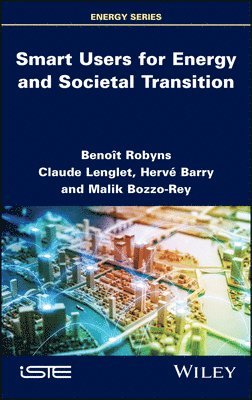
    Smart Users for Energy and Societal Transition

    AvBenoît Robyns,Claude Lenglet

    Inbunden, Engelska, 2023

    1 731 kr

    Beställningsvara. Skickas inom 5-8 vardagar. Fri frakt över 249 kr.

    Beskrivning

    Climate change and the loss of biodiversity are now realities. Their causes and origins stem from the energy, goods and resources relied upon by the lifestyle of a growing part of humanity.Smart Users for Energy and Societal Transition presents this much needed transition, as well as the scenarios and paths essential to mitigating the impacts of climate change. It deals with transitions experimented in the form of ecosystems in universities, cities and territories, as well as with concepts of smart buildings, smart grids and smart cities, addressed to smart users – or not – in an interdisciplinary research context. Sociological issues related to the role of smart building users are discussed, ranging from acceptance to the appropriation of the technologies made available to them.The book highlights the ethics of this essential transition and the importance of individual behaviors in safeguarding humanity on a preserved planet.

    Produktinformation

    • Utgivningsdatum:2023-08-24
    • Mått:161 x 240 x 19 mm
    • Vikt:653 g
    • Format:Inbunden
    • Språk:Engelska
    • Antal sidor:272
    • Förlag:ISTE Ltd and John Wiley & Sons Inc
    • ISBN:9781786307354

    Utforska kategorier

    • Centralt styre och förvaltning inom Samhälle och politik
    • Miljövetenskap och miljöpolitik inom Naturvetenskap och teknik
    • Energiindustri inom Ekonomi och Ledarskap

    Mer om författaren

    Benoît Robyns is deputy scientific director at Junia, Graduate School of Engineering, vice-president of energy and societal transition at the Université catholique de Lille and researcher at L2EP, France.Claude Lenglet is an engineer. He is involved in work on climate-related transitions.Hervé Barry is a sociologist at the FGES of the Université catholique de Lille, France.Malik Bozzo-Rey is research director in ethics at the ETHICS laboratory of the Université catholique de Lille, France.

    Innehållsförteckning

    • Foreword by Pierre Giorgini ixForeword by Xavier Bertrand xiiiIntroduction xviiChapter 1 The Necessary Transition of the 21st Century 11.1 Introduction 11.2 Connection of energy and social issues 21.2.1 Living energy 21.2.2 Fossil fuel, deforestation, cattle rearing and climate 21.2.3 Renewable energies, or almost renewable energies 51.2.4 Energy and economy 81.2.5 Energy and meaning 121.3 Opinions surrounding climate change 151.3.1 Denial and inaction 151.3.2 Faith in technosciences 161.3.3 Saving through economy 171.3.4 The reason for sustainable development 181.4 Scenarios and possible solutions 201.4.1 Scenarios, so many stories of a desirable future? 201.4.2 Renewable energies and sobriety 211.4.3 From 100% renewable energies to a mix of solutions 251.4.4 The Third Industrial Revolution 271.4.5 Smart due to digital technology 281.4.6 From global to local 291.4.7 All actors 301.4.8 Small steps to start 321.4.9 The need for demonstrators and transdisciplinary approaches 33Chapter 2 The Transition: Concept or Reality? 372.1 Introduction 372.2 The limits of a development model 372.2.1 An outdated observation 372.2.2 Having the courage to face reality 402.2.3 The intrinsic fragility of our systems 422.3 Attempts to “repair” the model in the 20th century 452.3.1 Too strong a temptation 452.3.2 The other temptation: the technological answer 472.3.3 The great forgotten issue 492.4 Cities and territories in transition 502.4.1 Two inspiring studies 512.4.2 European cities and territories 552.4.3 Rev3, the Hauts-de-France project 602.4.4 Some lessons learned 652.5 Create a systemic approach 672.5.1 Building blocks 682.5.2 The unavoidable transversalities 692.5.3 Buildings, one of the hearts of the transition 71Chapter 3 University: The Ideal Place for Research and Implementation 753.1 Introduction 753.2 Universities and transition: from university to univer’city 763.3 Five universities moving toward carbon neutrality 773.3.1. A reference framework for greenhouse gases emission sources 773.3.2 University of Manchester 793.3.3 Stockholm University 813.3.4 Boston University 833.3.5 University of Reading 863.3.6 The University of British Colombia 893.3.7 Summary 913.4 The Live TREE program from the Université Catholique de Lille 923.4.1 The specificities of the university 923.4.2 The meaning of a program 943.4.3 Carbon neutrality: a difficult equation to solve 953.4.4 Demonstrators 1013.4.5 Campus and zen district 1223.4.6 Involving the students 1263.4.7 Research 1283.5 Acknowledgments 131Chapter 4 Smart Building Nodes in Smart Energy Networks: Components of a Smart City 1334.1 Introduction 1334.2 Smart buildings as nodes of smart grids 1344.2.1 Smart grids 1344.2.2 The digital dimension 1354.2.3 Intersection between buildings and energy networks 1364.2.4 Transformation of buildings 1374.3 Interdisciplinary R&D to move toward a smart city 1394.3.1 The smart city 1394.3.2 Interdisciplinary R&D 140Chapter 5 An Energy-Efficient Smart Building with or without the Cooperation of Its Occupants? 1455.1 Introduction 1455.2 Construction methods for energy performance 1485.2.1 The time to satisfy basic needs 1485.2.2 Construction methods to improve energy and environmental performance 1505.2.3 Controlling the intensity of energy consumption 1525.3 Determinants of energy use in the world of work 1585.3.1 Determinants linked to business activity 1595.3.2 Sociological determinants of energy practices 1605.3.3 Modeling the belief-behavior relationship 1675.4 High-performance buildings abused by uses 1705.4.1 The philosophy and equipment of the building 1705.4.2 Feedback from uses in smart buildings 1755.5 Lessons to be learnt from the two pieces of feedback 1885.5.1 Do not confuse intelligence, performance and quality of use 1885.5.2 Having an accurate understanding of occupations and uses 1905.5.3 Informing users about the importance of their role 1915.5.4 Developing organizational regulations 1915.6 Conclusion 1935.7 Acknowledgments 194Chapter 6 Ethics of Energy and Societal Transition 1956.1 Introduction: ethical challenges associated with the energy and societal transition 1956.2 Some arguments in favor of the energy and societal transition 1976.2.1 Assign a value to the environment 1986.2.2 Responsibility toward future generations 1996.2.3 Individual or institutional responsibility? 2016.3 From theory to action: the question of influence 2046.3.1 Individual and societal values, which will act in favor of the energy transition? 2046.3.2 Developing the use of nudges in public policies 2066.4 Nudges: ethical issues raised by the use of behavioral sciences to influence behavior 2096.4.1 Conceptual framework and definition 2096.4.2 Elements of a critique of nudges 2136.4.3 What place is there for nudges in the energy and societal transition? 2156.5 Conclusion: the necessary political dimension of ethics 217Postface 219References 225Index 235