• Fri frakt över 249 kr
  • •
  • Snabba leveranser
  • •
  • Billiga böcker
Kundservice

Du är på sajten för privatpersoner.

Företag, bibliotek eller offentlig verksamhet?

Du handlar på classic.bokus.com, där alla dina funktioner finns intakta.
Till classic.bokus.com
Bokus logotyp. Gå till startsidan.
  • Erbjudanden
  • Nyheter
  • Student
  • Topplistor
  • Barn & ungdom
  • Bokus Play
  • E-böcker
  • Pocketböcker
  • Spel & pussel

10% rabatt på allt med kod: NYSTART10 →

Sidfot

Mina sidor

    Hjälp

    • Kundservice
    • Vanliga frågor och svar
    • Frakt och leverans
    • Retur vid ångerrätt
    • Reklamera vara
    • Betalning
    • Köpvillkor
    • Allmänna villkor
    • Information om webbplatsens tillgänglighet

    Om Bokus

    • Om oss
    • Pressrum
    • För studenter
    • För företag
    • För bibliotek och offentlig verksamhet
    • För leverantörer
    • Hållbarhet

    Populärt

    • Aktuella erbjudanden
    • Presentkort
    • Studentlitteratur
    • Nya böcker
    • Topplistor
    • Signerade böcker
    • Engelska böcker

    Inspiration

    • Boktips
    • BookTok
    • Populära bokserier
    • Barnbokskaraktärer
    • Populära författare
    Logotyp för Bokus
    Följ oss på Facebook (extern länk)Följ oss på Instagram (extern länk)Följ oss på YouTube (extern länk)Följ oss på TikTok (extern länk)
    bokus @ CookiesAnpassa cookiesIntegritetspolicyKöpvillkor
    Till Citymail hemsida (extern länk)Till Budbee hemsida (extern länk)Till Postnord hemsida (extern länk)Till Schenker hemsida (extern länk)Till Early Bird hemsida (extern länk)Till Walleys hemsida (extern länk)
    1. Filosofi och religion
    2. Religion och tro
    3. Religion: allmänt

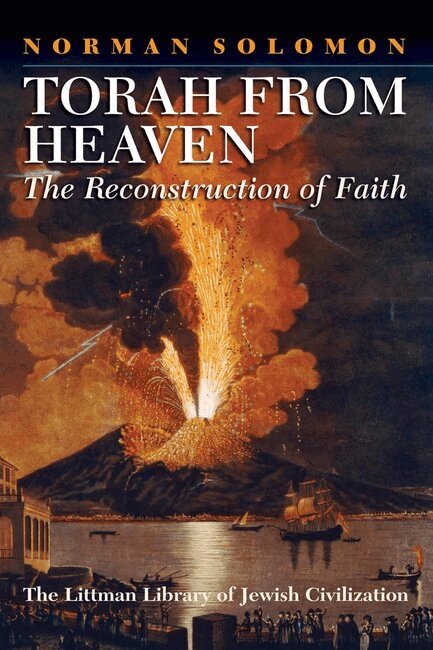
    Torah from Heaven

    The Reconstruction of Faith

    AvNorman Solomon

    Häftad, Engelska, 2018

    Del i serien Littman Library of Jewish Civilization

    404 kr

    Beställningsvara. Skickas inom 5-8 vardagar. Fri frakt över 249 kr.

    Fler format och utgåvor

    Inbunden

    702 kr

    Beskrivning

    Traditional Jewish religious belief speaks of a divinely revealed, perfect text, authoritatively expounded. The question this book addresses is one with which the author has struggled all his life: in the light of historical criticism, advances in knowledge, and changing moral attitudes, is the traditional notion of divine revelation and authoritative interpretation still valid? The focus is on Judaism and the examples are mostly drawn from that tradition, but the arguments are easy to transpose to other religions. Norman Solomon's discussion will appeal to those who seek to identify with a religious community but who are troubled by the claim of divine authority made for the scriptures of that community. Ranging across several academic disciplines, it is addressed to people of all religions who find their heads and their hearts are not in accord with each other. It is accessible to a general readership interested in the relationship of scripture, interpretation, and religious authority, though scholars will find original observations and historical interpretations in many areas.It should find a ready place in university and popular programmes in Jewish studies, general theology, and philosophy of religion.

    Produktinformation

    • Utgivningsdatum:2018-02-19
    • Mått:155 x 235 x 41 mm
    • Vikt:771 g
    • Format:Häftad
    • Språk:Engelska
    • Serie:Littman Library of Jewish Civilization
    • Antal sidor:412
    • Förlag:Liverpool University Press
    • ISBN:9781786940858

    Utforska kategorier

    • Religion: allmänt inom Filosofi och religion
    • Judendom inom Filosofi och religion

    Mer om författaren

    Norman Solomon retired in 2001 from the Oxford Centre for Hebrew and Jewish Studies, where he was Fellow in Modern Jewish Thought. He remains a member of Wolfson College, Oxford, and of the Oxford University Unit for Hebrew and Jewish Studies. He was previously Director of the Centre for the Study of Judaism and Jewish/Christian Relations at the Selly Oak Colleges, Birmingham.Dr Solomon was born in Cardiff, and educated there and at St John’s College, Cambridge. He has been rabbi to Orthodox Congregations in Manchester, Liverpool, London and Birmingham. He is a Past President of the British Association for Jewish Studies, Vice President of the World Congress of Faiths, and a Patron of the International Interfaith Centre. He has participated in Interfaith Dialogue in over twenty countries on five continents; in 2004 he was Scholar in Residence at Mandelbaum House, University of Sydney. Awards he has received include the Sir Sigmund Sternberg CCJ Award in Christian-Jewish Relations (1993) and the Distinguished Service Medal of the University of San Francisco (2000).His publications include Judaism and World Religion (1991), The Analytic Movement: Hayyim Soloveitchik and his School (1993), A Very Short Introduction to Judaism (1996), Historical Dictionary of Judaism (1998), and The Talmud: A Selection (2009), as well as numerous articles and reviews. From 1985-91 he was Editor of the quarterly Christian Jewish Relations.

    Recensioner i media

    'In this refreshingly fair, sophisticated, and engaging analysis of the doctrine of Torah from Heaven (the Jewish belief in the inerrancy and divinity of scripture), Solomon surveys the history of Jewish biblical interpretation, and concludes that every prior conception of this doctrine is lacking in either intellectual honesty or in its capacity to foster religious conviction. [He] concludes that the only religiously meaningful and intellectually coherent conception of this notion is that of myth . . . can be read by members of any religion whose faith in scripture is challenged by modern archaeological, literary, and scientific evidence . . . The book is sorely needed in Orthodox circles; it should be required reading for all Jewish seminary students, and is highly recommended for any religious individual seeking to establish intellectually stable grounds for belief in the sanctity of scripture.' Daniel Goodman, Religious Studies Review

    Innehållsförteckning

    • Note on TransliterationIntroduction OrientationOrientation Where I Come From - The Seduction of ‘True Belief’ - What Does It All Mean? - Philosophical Beginnings - Facing the Questions - Pulpit and Prejudice - Interfaith Dialogue - Academic Detachment?Part I RevelationTorah from Heaven: Growth of a Tradition 1 Holy Books What is ‘Torah’? - The ‘Sacred Canon’ - Why the Five Books are Special - Philo on Moses and the Ancestral Books - Conclusion 2 Two Torahs? Scripture and the Rabbis Divine Revelation: The Story - Mythic accounts of Torah - The Written Torah and the Oral Torah - Rules of Interpretation - Interpretation Against the Plain Meaning - Conclusion 3 Mystics and Kabbalists Pythagoras, Numerology, and the Book of Creation - Mystical Significance of the Mitzvot - Prophets after the Bible - Nahmanides (Ramban) the Mystic - Conclusion 4 The Great Chain of Being: Philosophers and Kabbalists Platonists and Aristotelians - The Ascent of the Soul - The Descent and the ‘Shells’ - Reasons for the Mitzvot - Conclusion 5 Maimonides: The ‘Classical’ Position Revelation as History - The Oral Torah - Torah and Dogma - Conclusion: Maimonides the Minimalist 6 Oral Torah: What Does It Contain? Does the Torah Teach Science? - The Torah of Kabbalists and Rationalists - Conclusion Summary of Part IPart II AttackThe Counter-Tradition: Hard Questions 7 The Counter-Tradition The Alexandrians - Sadducees and Pharisees - Pagan Philosophical Critiques - Gnosticism - Later Developments - Conclusion 8 The Original Torah How Texts Were Written - Evidence of the Scrolls and the Ancient Versions - The Severus Scroll - Can the Original Text be Recovered? - The Masoretes - Rabbinic Responses to Textual Variation - Modern Editions of the Bible - Conclusion 9 Contradictions, Moral Problems, Factual Errors The Reconciling Hermeneutic - Interpreting Aggadah - Historical and Archaeological Problems - Moral Issues - Scientific Inaccuracy - Fantasy, Arbitrariness, Superstition - Conclusion 10 The Rise of Historical Criticism The Beginnings of Biblical Criticism - Deists and Sceptics - The Bible as Literature - From History to Myth - Source Theory - Archaeology - Higher Criticism = Higher Antisemitism? - ConclusionSummary of Part IIPart III Defenders of the FaithRepairing the Breach: In Defence of Tradition 11 Defenders of the Faith What Must Be Defended - Ancient Wisdom Restored: The Renaissance - Jewish Bible Commentary Rekindled - Conclusion 12 The Transformation of Judaism: Interpretation, Interpretation, Interpretation Elijah, the ‘Vilna Gaon’ (1720–1799) - Moses Mendelssohn (1729–1786) - Torah— Mystical Code, or Source of Values? 13 Mendelssohn’s Influence I. S. Reggio (1784–1855) - S. D. Luzzatto (1800–1865) - Heinrich Graetz (1817–1891) - Umberto Cassuto (1883–1951) 14 Independents Jacob Zevi Mecklenburg (1785–1865) - Samson Raphael Hirsch (1808–1888) - Meir Loeb ben Yehiel Michael Malbim (1809–1879) 15 In the Steps of the Gaon: Written and Oral Torah Are One N. Z. Y. Berlin (1816–1893) - Meir Simha Ha-Kohen of Dvinsk (1843–1926) - Barukh Ha-Levi Epstein (1860–1942) 16 Hoffman and German Orthodoxy David Hoffman (1843–1921) - Hayyim Hirschenson (1857–1935) - Benno Jacob (1862–1945) and A. S. Yahuda (1877–1951) - Isaac Breuer (1883–1946) - Yehiel Jacob Weinberg (1885–1966) - J. H. Hertz (1872–1946)Summary of Part IIIPart IV New FoundationsTorah from Heaven: The Reconstruction of Belief 17 Non-Orthodox Reconstructions Moses Mendelssohn (1729–86): Revealed Legislation - S. L. Steinheim (1789–1866): Empiricist of Revelation - Samuel Holdheim (1806–1860) - Progressive Revelation: Krochmal, Formstecher, Hirsch, Cohen - Leo Baeck (1873–1956) - Martin Buber (1878–1965) - Franz Rosenzweig (1886–1929) - A. J. Heschel (1907–1972) - Emmanuel Levinas (1905/6-1995) - Review 18 Joseph Dov Soloveitchik and the a priori Torah The Hermeneutics of ‘Torah’ - Historical Criticism - The Oral Torah Problem - Conclusion 19 Feminist Critiques The Sinai Covenant - Language and Gender - Images of God - Equality before the Law - The Need for Change 20 Four Defences of Traditional Belief Halivni: The Maculate Torah - Jacobs: Liberal Supernaturalism - Kellner: Rejection of the Dogmatic Approach - Ross: Cumulative Revelation - Strengths of the Four Approaches 21 Divided by a Common Scripture The Reform Torah - The Orthodox Torah - The Conservative Torah - Go Compare DenominationsSummary of Part IVPart V Torah from Heaven 22 Options Justifications - The Community: Costs and Benefits of Belief - The Individual: Costs and Benefits of Belief 23 What Is Truth? What Is Truth? - Excursus: Consistency and ‘Double Truth’ - In What Sense Is ‘Torah from Heaven’ True? - On ‘Narrative Theology’ - Conclusion. ‘Torah from Heaven’: A Myth of Origin 24 Myth of Origin: Opportunities and Dangers What ‘Torah from Heaven’ May Signify - History and Myth Do Not Conflict - ‘Torah from Heaven’: Uses and Abuses - Benefits of Understanding ‘Torah from Heaven’ as Mythos Rather than Logos - Dangers from Understanding ‘Torah from Heaven’ as Logos Rather than Mythos - Things That Worry People 25 Demography versus Reason: The Future of Jewish Religion Does Reason Matter? - ‘Authentic Judaism’ - Survival of the Fittest - Conclusion 26 Confronting Change A Meditation at the Mountains of Fire (January 2004) - Coming to Terms with Modernity - Intellectual Violence - Who Decides? - What I Have Dealt With - What I Have Not Dealt WithBibliography Index