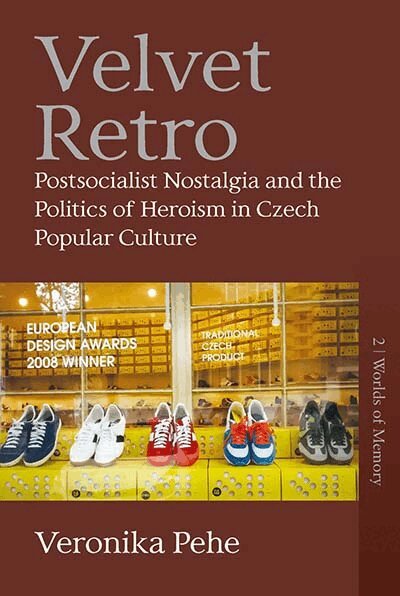
Velvet Retro
Postsocialist Nostalgia and the Politics of Heroism in Czech Popular Culture
1 697 kr
Beställningsvara. Skickas inom 5-8 vardagar. Fri frakt över 249 kr.
Du är på sajten för privatpersoner.
1 697 kr
Beställningsvara. Skickas inom 5-8 vardagar. Fri frakt över 249 kr.
Veronika Pehe is a researcher at the Institute of Contemporary History of the Czech Academy of Sciences, where she leads the Research Group for Historical Transformation Studies.
“…a tightly argued and well written book.” • Slavic Review“Velvet Retro insightfully contextualizes, and complicates our understanding of, post-socialist nostalgia in Czech popular culture, and offers a prescription for similar work across the former Soviet bloc… Representations of the communist past in film, literature, and consumer culture both reflected and inflected memory politics, as well as individuals’ efforts to situate themselves in both past and present. Pehe shows us that nostalgia isn’t always what we think it is. Nor was the communist past. Our rose-colored glasses shift shades, and meanings, as time passes.” • Journal of Modern History“Veronika Pehe’s Velvet Retro is a highly sophisticated contribution to the understanding of how post-communist Czech Republic relates to the last period of the communist era. Usefully, the author reminds us that our understanding of our past is always influenced by the present. She also rightly warns us that our constructions of the past are always subjective, and this is why a pluralist view of history is necessary.” • Studies in Eastern European Cinema“Pehe’s velvet retro argument is a compelling new take on memory politics in postsocialist Eastern Europe, and the book is very much a work of cultural studies…a well-argued book that scholars of postsocialism will find of great interest.” • Journal of Contemporary History“[The volume] constitutes a highly valuable contribution to the literature on the memory of the socialist past and the elements of nostalgia and retro in this memory. It also offers a new, more reflective, analytical reading of nostalgia by introducing an analytical understanding of ‘retro’ and the ‘remains of socialism’.” • H-Soz-Kult“Velvet Retro draws surprising and illuminating connections between various aspects of postsocialist culture and politics. It innovatively combines the history of popular culture, film and literary studies, memory studies, and comparative nationalism to establish a novel connection between retro aesthetics and postsocialist political culture.” • Pavel Kolář, University of Konstanz“A wide-ranging record of the cultural causes célèbres in the Czech Republic since the fall of Communism, this book studies what they show about how Czech artistic and media elites and the general public have chosen to commemorate the Communist period. It usefully resonates with the perceived disconnect—currently widespread internationally—between a metropolitan elite and the masses.” • Rajendra Chitnis, University College, Oxford
Du är på sajten för privatpersoner.
1 697 kr
Beställningsvara. Skickas inom 5-8 vardagar. Fri frakt över 249 kr.
Veronika Pehe is a researcher at the Institute of Contemporary History of the Czech Academy of Sciences, where she leads the Research Group for Historical Transformation Studies.
“…a tightly argued and well written book.” • Slavic Review“Velvet Retro insightfully contextualizes, and complicates our understanding of, post-socialist nostalgia in Czech popular culture, and offers a prescription for similar work across the former Soviet bloc… Representations of the communist past in film, literature, and consumer culture both reflected and inflected memory politics, as well as individuals’ efforts to situate themselves in both past and present. Pehe shows us that nostalgia isn’t always what we think it is. Nor was the communist past. Our rose-colored glasses shift shades, and meanings, as time passes.” • Journal of Modern History“Veronika Pehe’s Velvet Retro is a highly sophisticated contribution to the understanding of how post-communist Czech Republic relates to the last period of the communist era. Usefully, the author reminds us that our understanding of our past is always influenced by the present. She also rightly warns us that our constructions of the past are always subjective, and this is why a pluralist view of history is necessary.” • Studies in Eastern European Cinema“Pehe’s velvet retro argument is a compelling new take on memory politics in postsocialist Eastern Europe, and the book is very much a work of cultural studies…a well-argued book that scholars of postsocialism will find of great interest.” • Journal of Contemporary History“[The volume] constitutes a highly valuable contribution to the literature on the memory of the socialist past and the elements of nostalgia and retro in this memory. It also offers a new, more reflective, analytical reading of nostalgia by introducing an analytical understanding of ‘retro’ and the ‘remains of socialism’.” • H-Soz-Kult“Velvet Retro draws surprising and illuminating connections between various aspects of postsocialist culture and politics. It innovatively combines the history of popular culture, film and literary studies, memory studies, and comparative nationalism to establish a novel connection between retro aesthetics and postsocialist political culture.” • Pavel Kolář, University of Konstanz“A wide-ranging record of the cultural causes célèbres in the Czech Republic since the fall of Communism, this book studies what they show about how Czech artistic and media elites and the general public have chosen to commemorate the Communist period. It usefully resonates with the perceived disconnect—currently widespread internationally—between a metropolitan elite and the masses.” • Rajendra Chitnis, University College, Oxford
Du är på sajten för privatpersoner.
1 697 kr
Beställningsvara. Skickas inom 5-8 vardagar. Fri frakt över 249 kr.
Veronika Pehe is a researcher at the Institute of Contemporary History of the Czech Academy of Sciences, where she leads the Research Group for Historical Transformation Studies.
“…a tightly argued and well written book.” • Slavic Review“Velvet Retro insightfully contextualizes, and complicates our understanding of, post-socialist nostalgia in Czech popular culture, and offers a prescription for similar work across the former Soviet bloc… Representations of the communist past in film, literature, and consumer culture both reflected and inflected memory politics, as well as individuals’ efforts to situate themselves in both past and present. Pehe shows us that nostalgia isn’t always what we think it is. Nor was the communist past. Our rose-colored glasses shift shades, and meanings, as time passes.” • Journal of Modern History“Veronika Pehe’s Velvet Retro is a highly sophisticated contribution to the understanding of how post-communist Czech Republic relates to the last period of the communist era. Usefully, the author reminds us that our understanding of our past is always influenced by the present. She also rightly warns us that our constructions of the past are always subjective, and this is why a pluralist view of history is necessary.” • Studies in Eastern European Cinema“Pehe’s velvet retro argument is a compelling new take on memory politics in postsocialist Eastern Europe, and the book is very much a work of cultural studies…a well-argued book that scholars of postsocialism will find of great interest.” • Journal of Contemporary History“[The volume] constitutes a highly valuable contribution to the literature on the memory of the socialist past and the elements of nostalgia and retro in this memory. It also offers a new, more reflective, analytical reading of nostalgia by introducing an analytical understanding of ‘retro’ and the ‘remains of socialism’.” • H-Soz-Kult“Velvet Retro draws surprising and illuminating connections between various aspects of postsocialist culture and politics. It innovatively combines the history of popular culture, film and literary studies, memory studies, and comparative nationalism to establish a novel connection between retro aesthetics and postsocialist political culture.” • Pavel Kolář, University of Konstanz“A wide-ranging record of the cultural causes célèbres in the Czech Republic since the fall of Communism, this book studies what they show about how Czech artistic and media elites and the general public have chosen to commemorate the Communist period. It usefully resonates with the perceived disconnect—currently widespread internationally—between a metropolitan elite and the masses.” • Rajendra Chitnis, University College, Oxford