• Fri frakt över 249 kr
  • •
  • Snabba leveranser
  • •
  • Billiga böcker
Kundservice

Du är på sajten för privatpersoner.

Företag, bibliotek eller offentlig verksamhet?

Du handlar på classic.bokus.com, där alla dina funktioner finns intakta.
Till classic.bokus.com
Bokus logotyp. Gå till startsidan.
  • Erbjudanden
  • Student
  • Topplistor
  • Barn & ungdom
  • Bokus Play
  • E-böcker
  • Ljudböcker
  • Pocketböcker
  • Spel och pussel

Pocketfynda! Hundratals böcker för 49 kr/st →

Sidfot

Mina sidor

    Hjälp

    • Kundservice
    • Vanliga frågor och svar
    • Frakt och leverans
    • Retur vid ångerrätt
    • Reklamera vara
    • Betalning
    • Köpvillkor
    • Allmänna villkor
    • Information om webbplatsens tillgänglighet

    Om Bokus

    • Om oss
    • Pressrum
    • För studenter
    • För företag
    • För bibliotek och offentlig verksamhet
    • För leverantörer
    • Hållbarhet

    Populärt

    • Aktuella erbjudanden
    • Presentkort
    • Studentlitteratur
    • Nya böcker
    • Topplistor
    • Signerade böcker
    • Engelska böcker

    Inspiration

    • Boktips
    • BookTok
    • Barnbokskaraktärer
    • Populära författare
    Logotyp för Bokus
    Följ oss på Facebook (extern länk)Följ oss på Instagram (extern länk)Följ oss på YouTube (extern länk)Följ oss på TikTok (extern länk)
    bokus @ CookiesAnpassa cookiesIntegritetspolicyKöpvillkor
    Till Citymail hemsida (extern länk)Till Budbee hemsida (extern länk)Till Postnord hemsida (extern länk)Till Schenker hemsida (extern länk)Till Early Bird hemsida (extern länk)Till Walleys hemsida (extern länk)
    1. Filosofi och religion
    2. Filosofi
    3. Filosofiska discipliner

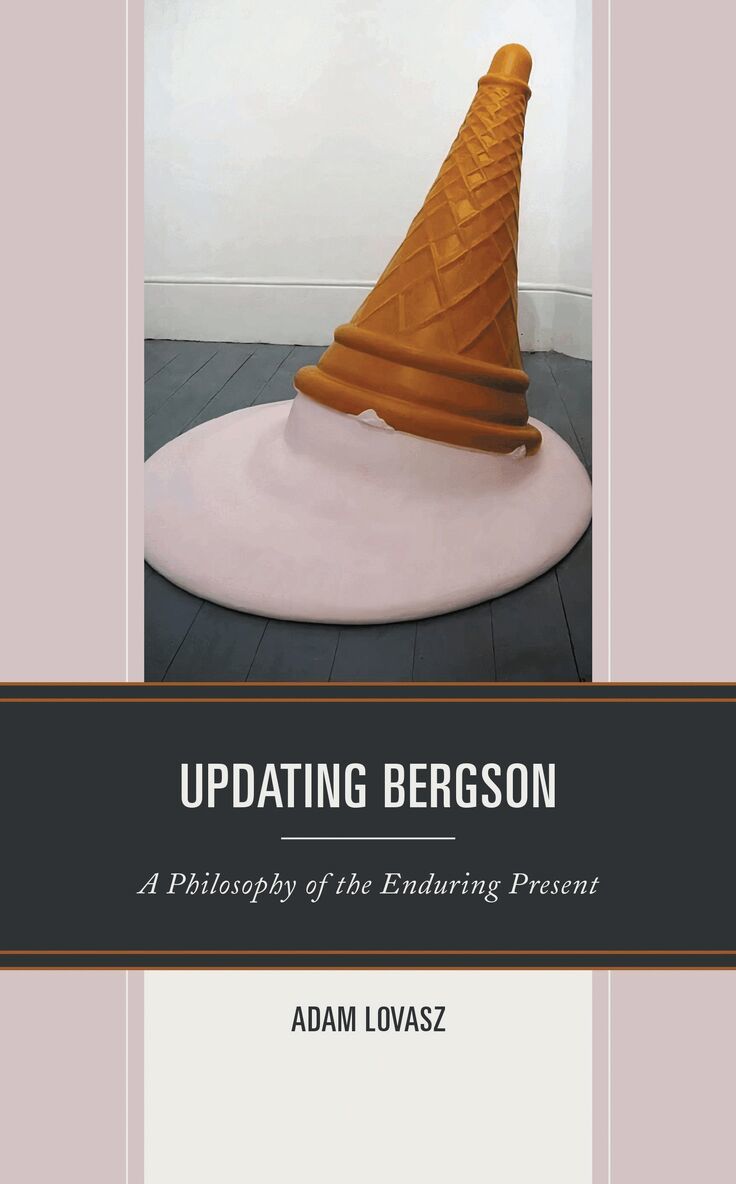
    Updating Bergson

    A Philosophy of the Enduring Present

    AvAdam Lovasz

    Inbunden, Engelska, 2021

    1 756 kr

    Beställningsvara. Skickas inom 10-15 vardagar. Fri frakt över 249 kr.

    Beskrivning

    Over the past few decades, there has been a renewal of scholarly interest in the work of Henri Bergson (1859–1941). At once a commentary and a stark re-evaluation of Bergson’s philosophy, Updating Bergson: A Philosophy of the Enduring Present argues that time should be thought of as a hierarchy of simultaneous durations, the shifting reality of which can be revealed by the philosophical method of intuition. A duration is a perpetually dynamic flow situated in the now. Put simply, for Bergson, change is the substance of things. Nothing exists apart from alteration. Adam Lovasz analyzes Bergson’s philosophy of time, encompassing the three basic types of duration—material, organic, and subjective—and also touches on themes such as relativity, evolution, the problem of materialism and idealism, and the topic of free will. Lovasz connects key questions addressed by Bergson to contemporary scientific debates and paradigms. Shedding new light on the various aspects of Bergson's philosophy, this book is both a provocation and an invitation to think in terms of the enduring present, rather than committing ourselves to a dead past or an absent future.

    Produktinformation

    • Utgivningsdatum:2021-05-25
    • Mått:164 x 228 x 31 mm
    • Vikt:671 g
    • Format:Inbunden
    • Språk:Engelska
    • Antal sidor:332
    • Förlag:Bloomsbury Publishing Plc
    • ISBN:9781793640819

    Utforska kategorier

    • Filosofiska discipliner inom Filosofi och religion
    • Litteraturvetenskap inom Skönlitteratur
    • Naturvetenskapens historia inom Naturvetenskap och teknik

    Mer om författaren

    Adam Lovasz is a researcher affiliated with Eötvös Loránd University, Budapest.

    Recensioner i media

    Reading Bergson’s philosophical texts is a challenge. Lacking clarity and uniformity in his discourse and deliberately avoiding definitions, Bergson nevertheless aims to persuade the reader to think about reality in a different way than he or she has done before. The French philosopher asks us to stop relying on concepts because they channel our thoughts and make us disregard reality per se, which is richer than the aggregation of notions. Accordingly, a Bergson reader learns that the analytical approach falsifies the object of inquiry because analysis allegedly dismantles and misrepresents its essentially dynamic nature. The only way one can access subject matter adequately is via intuition, according to Bergson. That said, the knowledge acquired in an intuitive grasp is incommunicable, because communicating a thought requires breaking it down into verbalized segments thus jeopardizing its unity and integrity. However, if philosophers want to overcome the limitations of a human approach to reasoning and understand what unperceived reality is, they must integrate the intuitive grasp into the philosophical discourse—somehow. Over a century passed since Bergson set this intellectual challenge, and commentators, critics, and followers have produced a substantial body of research clarifying, cataloging, attacking, and developing Bergson’s theory. Scholars’ interest in Bergson has had its highs and lows, but if the twenty-first century philosophy readers and commentators turn to Bergsonism with a renewed enthusiasm, I would not be surprised to find that Adam Lovasz’s Updating Bergson played a significant part in this.Unlike other scholars who engage with Bergson by working through his texts chronologically, Lovasz negotiates them in reverse order. Accordingly, beginning with Bergson’s later writings, he leaves Time and Free Will, the philosopher’s initial discussion of time and being, till the end. This original and simple move achieves a great deal. Bergson’s theory is not consistent throughout his books because his ideas developed over time and his arguments became modified accordingly. Therefore, until now, Bergson readers shared his intellectual journey following the same path of tentative discovery, rewarding and full of exciting revelations, but at times fatiguing and frustrating due to puzzling inconsistencies. By examining Bergson’s last book, The Creative Mind,in the first chapter, Lovasz offers the summary of Bergson’s philosophy saving new Bergson readers from having to make the same journey as their predecessors. With Bergson’s important ideas condensed and synopsized in this way, the readers will find following Bergson easier, as they will get a much clearer vision of the entire project, prefaced by its outcome. In his writing, Lovasz achieves the high level of control over Bergson’s entire pool of texts, effortlessly navigating between ideas that cut across various themes, successfully disengaging from Bergson’s vocabulary and thus avoiding the trap of the circularity of argumentation.Successfully resisting the gravitational pull of Bergson’s original conceptual framework but remaining faithful to the core idea of Bergson’s project allowed Lovasz to make a serious attempt at resolving Bergson’s epistemological contradiction. Whilst Bergson seems to have been unable to reconcile intuitive insight and communication (since the communication requires concepts, which are unable to convey intuitions), as Lovasz engages with the ideas of duration, image, and matter he deploys terse and punchy metaphors that immediately become more than metaphors but a methodological device effectively conveying Bergson-inspired vision of reality that lies beyond our habitual cognition. Undoubtedly, as the readers become acquainted with Lovasz’s clear and tightly argued discourse, they will be convinced that by ‘excavat[ing] … the radical potential of Bergsonism’ it may be eventually possible to ‘break[…] out of the cage of restricted, anthropomorphic thought’ and engage with ‘nonlinear dynamics of ontological consistency’—the effort that will be rewarded by acquiring the mental vision of ‘raw brute being,’ using Lovasz’s words. After all, this is the challenge that Bergson sets his reader and which Lovasz urges us to accept.

    Innehållsförteckning

    • List of FiguresAcknowledgementsList of AbbreviationsIntroductionChapter 1. Destabilizing ThoughtChapter 2. Completing RelativityChapter 3. Being Becoming Chapter 4. Leaping into MaterialityChapter 5. Getting Back to Duration ConclusionBibliography