• Fri frakt över 249 kr
  • •
  • Snabba leveranser
  • •
  • Billiga böcker
Kundservice

Du är på sajten för privatpersoner.

Företag, bibliotek eller offentlig verksamhet?

Du handlar på classic.bokus.com, där alla dina funktioner finns intakta.
Till classic.bokus.com
Bokus logotyp. Gå till startsidan.
  • Erbjudanden
  • Nyheter
  • Student
  • Topplistor
  • Barn & ungdom
  • Bokus Play
  • E-böcker
  • Pocketböcker
  • Spel & pussel

10% rabatt på allt med kod NYSTART10 →

Sidfot

Mina sidor

    Hjälp

    • Kundservice
    • Vanliga frågor och svar
    • Frakt och leverans
    • Retur vid ångerrätt
    • Reklamera vara
    • Betalning
    • Köpvillkor
    • Allmänna villkor
    • Information om webbplatsens tillgänglighet

    Om Bokus

    • Om oss
    • Pressrum
    • För studenter
    • För företag
    • För bibliotek och offentlig verksamhet
    • För leverantörer
    • Hållbarhet

    Populärt

    • Aktuella erbjudanden
    • Presentkort
    • Studentlitteratur
    • Nya böcker
    • Topplistor
    • Signerade böcker
    • Engelska böcker

    Inspiration

    • Boktips
    • BookTok
    • Populära bokserier
    • Barnbokskaraktärer
    • Populära författare
    Logotyp för Bokus
    Följ oss på Facebook (extern länk)Följ oss på Instagram (extern länk)Följ oss på YouTube (extern länk)Följ oss på TikTok (extern länk)
    bokus @ CookiesAnpassa cookiesIntegritetspolicyKöpvillkor
    Till Citymail hemsida (extern länk)Till Budbee hemsida (extern länk)Till Postnord hemsida (extern länk)Till Schenker hemsida (extern länk)Till Early Bird hemsida (extern länk)Till Walleys hemsida (extern länk)
    1. Psykologi och pedagogik
    2. Psykologi
    3. Psykologiska teorier och skolor
    4. Freudiansk psykologi

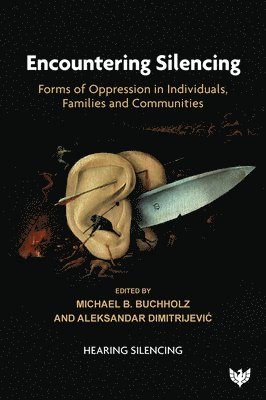
    Encountering Silencing

    Forms of Oppression in Individuals, Families and Communities

    AvMichael B. Buchholz,Aleksandar Dimitrijevic

    Häftad, Engelska, 2024

    Del i serien Hearing Silencing

    396 kr

    Skickas . Fri frakt över 249 kr.

    Beskrivning

    Editors Michael B. Buchholz and Aleksandar Dimitrijević are joined by Ana Altaras Dimitrijević, Uta Blohm, Roger Frie, Stephen Frosh, Babette Gekeler, Gail A. Hornstein, and Hans-Christoph Ramm to share their knowledge, research, and experience on these dark issues.Encountering Silencing is an invitation to closely observe the very practices and processes of silencing used by perpetrators of abuse and totalitarian institutions alike. A carefully selected group of contributors reveal the dark side of communication that silences victims, witnesses, and perpetrators: women, religious heretics, gifted children, victims of racism, psychoanalytic dissidents, and psychiatric patients; individuals and groups, total strangers and one’s family members, as well as one own self. All of these forms of silencing are analysed with the help of literature, historiography, interviewing, archival research, and psychoanalytic and family therapy.This book helps us to face the seemingly inevitable conclusion that silencing is everywhere in our individual and social lives, and that it is the silencing of trauma that leads to mental disorders more than trauma itself. The hope is that by opening up these topics in a considered, containing, and thoughtful way, the underlying mechanisms of trauma-related disorders will be better understood and help victims to overcome them.Encountering Silencing is the first in a series of three books on this vital but overlooked subject.

    Produktinformation

    • Utgivningsdatum:2024-04-18
    • Mått:152 x 229 x 12 mm
    • Vikt:376 g
    • Format:Häftad
    • Språk:Engelska
    • Serie:Hearing Silencing
    • Antal sidor:272
    • Förlag:Karnac Books
    • ISBN:9781800132412

    Utforska kategorier

    • Freudiansk psykologi inom Psykologi och pedagogik
    • Våld och övergrepp inom Samhälle och politik

    Mer om författaren

    Prof. Dr. Michael B. Buchholz studied psychology and social sciences, fully trained as a psychoanalyst, training analyst in Göttingen (Germany), taught social psychology at International Psychoanalytic University (IPU) in Berlin until retirement in autumn 2020. His main interests are to combine psychoanalysis and the study of psychotherapeutic conversation, thus the application of conversation analysis as a method of microscopic observation applicable in social situations, including of violence. He has published more than 25 books and more than 300 papers on family therapy, treatment technique, supervision, conversation analysis, and violence.Aleksandar Dimitrijević, Ph.D., is a clinical psychologist and psychoanalyst. He works as a lecturer at the International Psychoanalytic University and in private practice in Berlin. He has given lectures, seminars, university courses, and conference presentations throughout Europe and in the US. He is the author of many conceptual and empirical papers about attachment theory and research, psychoanalytic education, and psychoanalysis and the arts, some of which were translated into German, Hungarian, Italian, Slovenian, Spanish, and Turkish. He has also edited or co-edited eleven books or special journal issues, the most recent of which are Ferenczi’s Influence on Contemporary Psychoanalytic Traditions (with Gabriele Cassullo and Jay Frankel, 2018) and Silence and Silencing in Psychoanalysis (with Michael B. Buchholz, 2020).

    Recensioner i media

    ‘Following their brilliant book From the Abyss of Loneliness: to the Bliss of Solitude, in which they teased out the silence in which loneliness tends to germinate, the writers and co-editors Buchholz and Dimitrijevic turn their magnifying glass and sound amplifiers into the eye of the storm and encounter silencing. Gathering an impressive list of contributors in their new co-edited book, Encountering Silencing, they examine meticulously the intricacies of active silencing of victims, perpetrators, and witnesses – the triad of participants in traumatic events – spreading from self-silencing to the denial and disavowal in socio-political groups and institutions of the truth about traumatic experiences. They do not shy away from facing the long tradition of silencing creative voices in the history of psychoanalysis as well. In this book, with the help of their contributors, Buchholz and Dimitrijevic recognize that silencing is a human form of communication, inspired by the malignant consequence of power. They emphasize that it is the act of silencing and not the trauma per se that leads to emotional suffering and mental pain. This book does more than paint the roadmap of the processes and mechanisms involved in silencing and its consequences so we can recognize them as clinicians. It is also an invitation for all of us to sharpen our skills and expertise and nurture the courage that is needed in the important battle against acts of silencing. At the end of this book, I was left with the sensation that there is already another book in the making by this duo, a book about power that I'm already eager to read.’

    Innehållsförteckning

    • AcknowledgementsAbout the editors and contributorsIntroduction: silencing the traumatised and hearing silencingAleksandar Dimitrijević and Michael B. Buchholz1. Silencing victims, witnesses, and perpetratorsMichael B. Buchholz, Aleksandar Dimitrijević, and Hans-Christoph Ramm2. “But break, my heart, for I must hold my tongue”: examples of self-silencing in classical and contemporary literatureAleksandar Dimitrijević and Michael B. Buchholz3. Traumatic disclosures and failures of listeningStephen Frosh4. Racial massacres and silencing in the Deep SouthRoger Frie5. Silencing of female voices in medical history: the silenced girl who cried painBabette S. Gekeler6. Silencing the voices of heretics and other religionsUta Blohm, Aleksandar Dimitrijević, and Michael B. Buchholz7. Silence in the classroom: suppressing (gifted) students’ curiosity and creativity Ana Altaras Dimitrijević8. Censorship and silencing artistic creativityAleksandar Dimitrijević9. Silencing creative voices in the history of psychoanalysis Aleksandar Dimitrijević10. Examples of silencing in the psychotherapy office Aleksandar Dimitrijević11. Dream-telling in family therapy sessions: how they can change silencing into hearablesMichael B. Buchholz12. First-person narratives of madness: the revenge of the silencedGail A. HornsteinIndex