• Fri frakt över 249 kr
  • •
  • Snabba leveranser
  • •
  • Billiga böcker
Kundservice

Du är på sajten för privatpersoner.

Företag, bibliotek eller offentlig verksamhet?

Du handlar på classic.bokus.com, där alla dina funktioner finns intakta.
Till classic.bokus.com
Bokus logotyp. Gå till startsidan.
  • Erbjudanden
  • Nyheter
  • Student
  • Topplistor
  • Barn & ungdom
  • Bokus Play
  • E-böcker
  • Pocketböcker
  • Spel & pussel

10% rabatt på allt med kod NYSTART10 →

Sidfot

Mina sidor

    Hjälp

    • Kundservice
    • Vanliga frågor och svar
    • Frakt och leverans
    • Retur vid ångerrätt
    • Reklamera vara
    • Betalning
    • Köpvillkor
    • Allmänna villkor
    • Information om webbplatsens tillgänglighet

    Om Bokus

    • Om oss
    • Pressrum
    • För studenter
    • För företag
    • För bibliotek och offentlig verksamhet
    • För leverantörer
    • Hållbarhet

    Populärt

    • Aktuella erbjudanden
    • Presentkort
    • Studentlitteratur
    • Nya böcker
    • Topplistor
    • Signerade böcker
    • Engelska böcker

    Inspiration

    • Boktips
    • BookTok
    • Populära bokserier
    • Barnbokskaraktärer
    • Populära författare
    Logotyp för Bokus
    Följ oss på Facebook (extern länk)Följ oss på Instagram (extern länk)Följ oss på YouTube (extern länk)Följ oss på TikTok (extern länk)
    bokus @ CookiesAnpassa cookiesIntegritetspolicyKöpvillkor
    Till Citymail hemsida (extern länk)Till Budbee hemsida (extern länk)Till Postnord hemsida (extern länk)Till Schenker hemsida (extern länk)Till Early Bird hemsida (extern länk)Till Walleys hemsida (extern länk)
    1. Samhälle och politik
    2. Samhälle och kultur
    3. Kultur och medier
    4. Kulturvetenskap

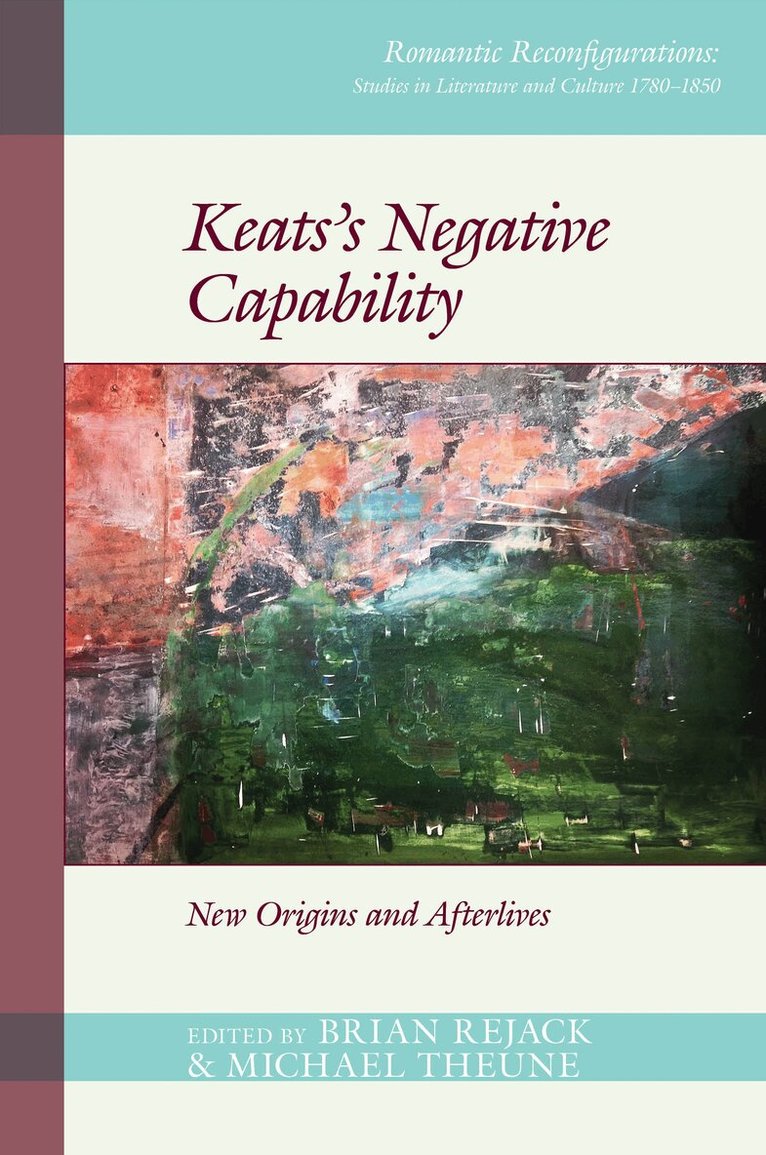
    Keats’s Negative Capability

    New Origins and Afterlives

    AvBrian Rejack,Michael Theune

    Häftad, Engelska, 2021

    Del 6 i serien Romantic Reconfigurations: Studies in Literature and Culture 1780-1850

    657 kr

    Beställningsvara. Skickas inom 5-8 vardagar. Fri frakt över 249 kr.

    Beskrivning

    In late December 1817, when attempting to name “what quality went to form a Man of Achievement especially in Literature,” John Keats coined the term “negative capability,” which he glossed as “being in uncertainties, Mysteries, doubts, without any irritable reaching after fact & reason.” Since then negative capability has continued to shape assessments of and responses to Keats’s work, while also surfacing in other contexts ranging from contemporary poetry to punk rock. The essays collected in this volume, taken as a whole, account for some of the history of negative capability, and propose new models and directions for its future in scholarly and popular discourse. The book does not propose a particular understanding of negative capability from among the many options (radical empathy, annihilation of self, philosophical skepticism, celebration of ambiguity) as the final word on the topic; rather, the book accounts for the multidimensionality of negative capability. Essays treat negative capability’s relation to topics including the Christmas pantomime, psychoanalysis, Zen Buddhism, nineteenth-century medicine, and Philip Pullman’s His Dark Materials trilogy. Describing the “poetical Character” Keats notes that “it enjoys light and shade; it lives in gusto, be it foul or fair, high or low, rich or poor, mean or elevated.” This book, too, revels in such multiplicity.

    Produktinformation

    • Utgivningsdatum:2021-09-01
    • Mått:156 x 234 x 20 mm
    • Vikt:482 g
    • Format:Häftad
    • Språk:Engelska
    • Serie:Romantic Reconfigurations: Studies in Literature and Culture 1780-1850
    • Antal sidor:320
    • Förlag:Liverpool University Press
    • ISBN:9781800856721

    Utforska kategorier

    • Kulturvetenskap inom Samhälle och politik
    • Poesi inom Skönlitteratur
    • Litteraturvetenskap inom Skönlitteratur

    Mer om författaren

    Brian Rejack is Associate Professor of English at Illinois State University. Michael Theune is Professor of English at Illinois Wesleyan University.

    Recensioner i media

    'The collection will be essential to students and scholars of Keats as Rejack's analysis of John Jeffrey's role in transcribing 'Negative Capability' refreshes our understating of the concept. Contributors to this collection have risen to Rejack's editorial challenge and, produced prominent and diverse readings, which extend in variety across a range of critical approaches, including feminism, phenomenology, and psychoanalysis. Keats's 'Negative Capability' remains a vital concept, which continues to provoke readers and writers alike to reflect on its myriad values and virtues in the present and will continue to do so in the future.'Amina Brik, The BARS Review

    Innehållsförteckning

    • Preface - Nicholas Roe Introduction. Disquisitions: Reading Negative Capability, 1817–2017 - Brian Rejack and Michael Theune Part I. ‘swelling into reality’: New Contexts for Negative Capability Keats’s Negative Capability: On Pantomime and ‘Irritable Reaching’ - Brian Bates John Keats’s Jeffrey’s ‘Negative Capability’; or, Accidentally Undermining Keats - Brian Rejack Keats’s ‘Negative Capability’ and Hazlitt’s ‘Natural Capacity’ - Michael Theune ‘that strong excepted soul’: Nineteenth-Century Women Read Keats - Carmen Faye Mathes Part II. ‘examplified throughout’: Forms of Negatively Capable Reading’Negatively Capable Reading - Cassandra Falke Knowledge’s ‘gordian shape’: Keats and the Disciplines - Kurtis Hessel ‘Irritable Reaching’ and the Conditions of Romantic Mediation - Jeanne Britton ‘uncertainties, Mysteries, doubts’: Pluralities and the Historical Present in Keats and Hazlitt - Emily Rohrbach Part III. ‘pursued through Volumes’, Volume I: Negative Capability in Twentieth- and Twenty-First-Century American Poetry Beyond the Great Divide: Negative Capability and Postwar American Poetics - Robert Archambeau Versions of Negative Capability in Modern American Poetry and Criticism - Eric Eisner ‘giddily off into the unknown’: Negative Capability and Naturalism in Elizabeth Bishop’s Poetics - Arsevi Seyran ‘Darkling I listen’: Jorie Graham and Negative Capability - Thomas Gardner Part IV. ‘pursued through Volumes’, Volume II: Adaptations, Appropriations, Mutations Negative Capability in the Twenty-First Century and Romantic Self Annihilation in Philip Pullman’s His Dark Materials - Suzanne L. Barnett Negative Capability in Psychoanalysis: Keats and Retroactive Judgment in Bion, Freud, Lacan, and Milner - David Sigler Zen and the Art of Negative Capability - Anne C. McCarthy Negative Capability in Dialogic Context - Walter L. Reed Afterword: Reading Keats’s Negative Capability - Jonathan MulrooneyIndex