• Fri frakt över 249 kr
  • •
  • Snabba leveranser
  • •
  • Billiga böcker
Kundservice

Du är på sajten för privatpersoner.

Företag, bibliotek eller offentlig verksamhet?

Du handlar på classic.bokus.com, där alla dina funktioner finns intakta.
Till classic.bokus.com
Bokus logotyp. Gå till startsidan.
  • Erbjudanden
  • Nyheter
  • Student
  • Topplistor
  • Barn & ungdom
  • Bokus Play
  • E-böcker
  • Pocketböcker
  • Spel & pussel

10% rabatt på allt med kod: NYSTART10 →

Sidfot

Mina sidor

    Hjälp

    • Kundservice
    • Vanliga frågor och svar
    • Frakt och leverans
    • Retur vid ångerrätt
    • Reklamera vara
    • Betalning
    • Köpvillkor
    • Allmänna villkor
    • Information om webbplatsens tillgänglighet

    Om Bokus

    • Om oss
    • Pressrum
    • För studenter
    • För företag
    • För bibliotek och offentlig verksamhet
    • För leverantörer
    • Hållbarhet

    Populärt

    • Aktuella erbjudanden
    • Presentkort
    • Studentlitteratur
    • Nya böcker
    • Topplistor
    • Signerade böcker
    • Engelska böcker

    Inspiration

    • Boktips
    • BookTok
    • Populära bokserier
    • Barnbokskaraktärer
    • Populära författare
    Logotyp för Bokus
    Följ oss på Facebook (extern länk)Följ oss på Instagram (extern länk)Följ oss på YouTube (extern länk)Följ oss på TikTok (extern länk)
    bokus @ CookiesAnpassa cookiesIntegritetspolicyKöpvillkor
    Till Citymail hemsida (extern länk)Till Budbee hemsida (extern länk)Till Postnord hemsida (extern länk)Till Schenker hemsida (extern länk)Till Early Bird hemsida (extern länk)Till Walleys hemsida (extern länk)
    1. Naturvetenskap och teknik
    2. Teknik och industri
    3. Agronomi och lantbruk

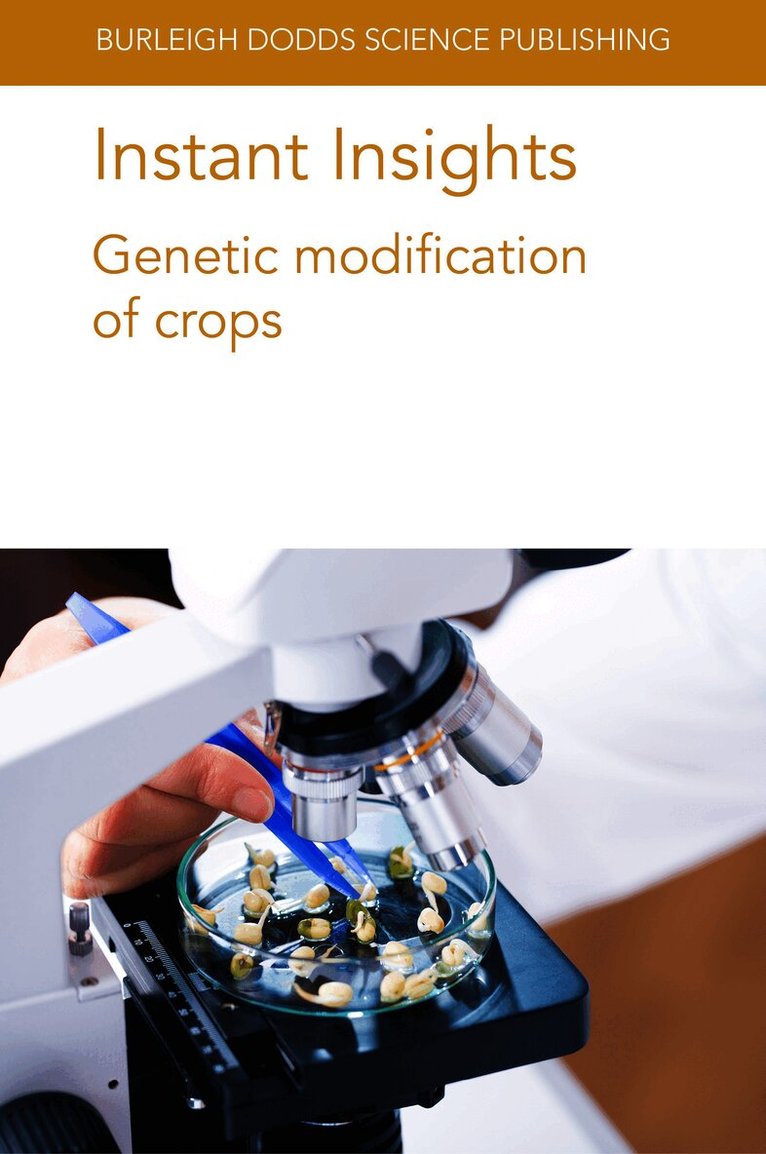
    Instant Insights: Genetic Modification of Crops

    AvJames Dale,W. K. Tushemereirwe

    Häftad, Engelska, 2021

    Del 34 i serien Burleigh Dodds Science: Instant Insights

    689 kr

    Beställningsvara. Skickas inom 5-8 vardagar. Fri frakt över 249 kr.

    Beskrivning

    This specially curated collection features six reviews of current and key research on genetic modification of crops.The first chapter reviews key challenges facing banana production, primarily the risk of species decimation by diseases such as Fusarium wilt, and considers how genetic modification may be a solution to this.The second chapter discusses the development and establishment of ‘Golden Rice’ - a biofortified variety designed as a health intervention to help alleviate the problem of vitamin A deficiency.The third chapter details recent advances in the genetic modification of important agronomic traits of soybean crops, such as herbicide tolerance and insect resistance. The fourth chapter addresses progress in and prospects for transgenic interventions in the improvement of grain legumes, concentrating on chickpea, pigeonpea, cowpea and more.The fifth chapter reviews recent research efforts in the production of genetically modified (GM) oil palm plants and looks towards establishing stable lines of commercially viable GM varieties.The final chapter describes recent progress relating to transgenic modification of cassava and how future research can strengthen food security and commercialization of the crop.

    Produktinformation

    • Utgivningsdatum:2021-06-15
    • Mått:152 x 229 x 8 mm
    • Vikt:220 g
    • Format:Häftad
    • Språk:Engelska
    • Serie:Burleigh Dodds Science: Instant Insights
    • Antal sidor:152
    • Förlag:Burleigh Dodds Science Publishing Limited
    • ISBN:9781801461610

    Utforska kategorier

    • Agronomi och lantbruk inom Naturvetenskap och teknik
    • Lantbruksteknik inom Naturvetenskap och teknik
    • Biokemisk teknik inom Naturvetenskap och teknik

    Innehållsförteckning

    • Chapter 1 - Genetic modification of bananas: the long road to farmers’ fields: James Dale, Queensland University of Technology, Australia; Wilberforce Tushemereirwe, National Agricultural Research Organisation, Uganda; and Robert Harding, Queensland University of Technology, Australia; 1 Introduction 2 Banana improvement by genetic modification and gene editing 3 Case study: biofortified East African Highland bananas 4 Future trends and conclusion 5 ReferencesChapter taken from: Kema, G. H. J. and Drenth, A. (eds.), Achieving sustainable cultivation of bananas – Volume 2: Germplasm and genetic improvement, Burleigh Dodds Science Publishing, Cambridge, UK, 2020, (ISBN 978 1 78676 344 0)Chapter 2 - Biofortified Golden Rice: an additional intervention for vitamin A deficiency: Adrian Dubock, Golden Rice Humanitarian Board, Switzerland; 1 Introduction2 The problem of vitamin A deficiency (VAD) 3 The origins of Golden Rice 4 Developing Golden Rice as a product 5 Current challenges to establishing Golden Rice as an additional VAD intervention 6 Conclusions 7 Acknowledgements 8 Where to look for further information ReferencesChapter taken from: Sasaki, T. (ed.), Achieving sustainable cultivation of rice – Volume 1: Breeding for higher yield and quality, Burleigh Dodds Science Publishing, Cambridge, UK, 2017, (ISBN 978 1 78676 024 1)Chapter 3 - Advances in the genetic modification of soybeans: Wensheng Hou, Chinese Academy of Agricultural Sciences, China; 1 Introduction 2 Genetic modification of agronomic traits: herbicide tolerance and insect resistance 3 Genetic modification of other agronomic traits 4 Genome editing technology 5 Case studies 6 Summary 7 Future trends in research 8 Where to look for further information 9 ReferencesChapter taken from: Nguyen, H. T. (ed.), Achieving sustainable cultivation of soybeans – Volume 1: Breeding and cultivation techniques, Burleigh Dodds Science Publishing, Cambridge, UK, 2018, (ISBN 978 1 78676 112 5)Chapter 4 - Genetic modification of grain legumes: Pooja Bhatnagar-Mathur and Kiran Kumar Sharma, International Crops Research Institute for the Semi-Arid Tropics (ICRISAT), India; 1 Introduction 2 Genetic engineering of grain legumes 3 Genetic engineering of chickpea 4 Genetic engineering of pigeonpea 5 Genetic engineering of cowpea 6 Genetic engineering of lentil 7 Genetic engineering of pea (Pisum sativum) 8 Genetic engineering of peanut 9 Genetic engineering of other grain legumes: tepary bean, Vigna species and faba bean 10 Challenges in the commercialization of genetically engineered grain legumes 11 Conclusion 12 Future trends 13 Where to look for further information 14 ReferencesChapter taken from: Sivasankar, S., Bergvinson, D., Gaur, P., Kumar, S., Beebe, S. and Tamò, M. (eds.), Achieving sustainable cultivation of grain legumes – Volume 1: Advances in breeding and cultivation techniques, Burleigh Dodds Science Publishing, Cambridge, UK, 2018, (ISBN 978 1 78676 136 1)Chapter 5 - Advances in the genetic modification of oil palm: Denis J. Murphy, Head of Genomics and Computational Biology Research Group, University of South Wales, United Kingdom; 1 Introduction 2 Early and current genetically modified (GM) crop varieties 3 GM oil palm in Malaysia 4 Improving the fatty acid composition of palm oil 5 Progress to date in oil palm transformation 6 New technologies for genome editing – an alternative to ‘classical GM’ 7 Conclusions and future prospects 8 Where to look for further information 9 ReferencesChapter taken from: Rival, A. (ed.), Achieving sustainable cultivation of oil palm – Volume 1: Introduction, breeding and cultivation techniques, Burleigh Dodds Science Publishing, Cambridge, UK, 2018, (ISBN 978 1 78676 104 0)Chapter 6 - Advances in genetic modification of cassava: P. Zhang, Q. Ma, M. Naconsie, X. Wu, W. Zhou, National Key Laboratory of Plant Molecular Genetics, CAS Center for Excellence in Molecular Plant Sciences, Chinese Academy of Sciences, China and J. Yang, Shanghai Chenshan Plant Science Research Center, Shanghai Chenshan Botanical Garden, China; 1 Introduction 2 Transition from model cultivars to farmer-preferred cultivars 3 Tools of gene expression regulation 4 Production of virus-resistant cassava 5 Cassava biofortifi cation for better nutrition 6 Starch modifi cation of cassava for industrial applications 7 Improving storage, root production and post-harvest storage 8 Future trends and conclusion 9 Where to look for further information 10 Acknowledgements 11 ReferencesChapter taken from: Hershey, C. (ed.) Achieving sustainable cultivation of cassava – Volume 2: Genetics, breeding, pests and diseases, Burleigh Dodds Science Publishing, Cambridge, UK, 2017, (ISBN 978 1 78676 004 3)