• Fri frakt över 249 kr
  • •
  • Snabba leveranser
  • •
  • Billiga böcker
Kundservice

Du är på sajten för privatpersoner.

Företag, bibliotek eller offentlig verksamhet?

Du handlar på classic.bokus.com, där alla dina funktioner finns intakta.
Till classic.bokus.com
Bokus logotyp. Gå till startsidan.
  • Erbjudanden
  • Nyheter
  • Student
  • Topplistor
  • Barn & ungdom
  • Bokus Play
  • E-böcker
  • Pocketböcker
  • Spel & pussel

10% rabatt på allt med kod: NYSTART10 →

Sidfot

Mina sidor

    Hjälp

    • Kundservice
    • Vanliga frågor och svar
    • Frakt och leverans
    • Retur vid ångerrätt
    • Reklamera vara
    • Betalning
    • Köpvillkor
    • Allmänna villkor
    • Information om webbplatsens tillgänglighet

    Om Bokus

    • Om oss
    • Pressrum
    • För studenter
    • För företag
    • För bibliotek och offentlig verksamhet
    • För leverantörer
    • Hållbarhet

    Populärt

    • Aktuella erbjudanden
    • Presentkort
    • Studentlitteratur
    • Nya böcker
    • Topplistor
    • Signerade böcker
    • Engelska böcker

    Inspiration

    • Boktips
    • BookTok
    • Populära bokserier
    • Barnbokskaraktärer
    • Populära författare
    Logotyp för Bokus
    Följ oss på Facebook (extern länk)Följ oss på Instagram (extern länk)Följ oss på YouTube (extern länk)Följ oss på TikTok (extern länk)
    bokus @ CookiesAnpassa cookiesIntegritetspolicyKöpvillkor
    Till Citymail hemsida (extern länk)Till Budbee hemsida (extern länk)Till Postnord hemsida (extern länk)Till Schenker hemsida (extern länk)Till Early Bird hemsida (extern länk)Till Walleys hemsida (extern länk)
    1. Naturvetenskap och teknik
    2. Teknik och industri
    3. Agronomi och lantbruk

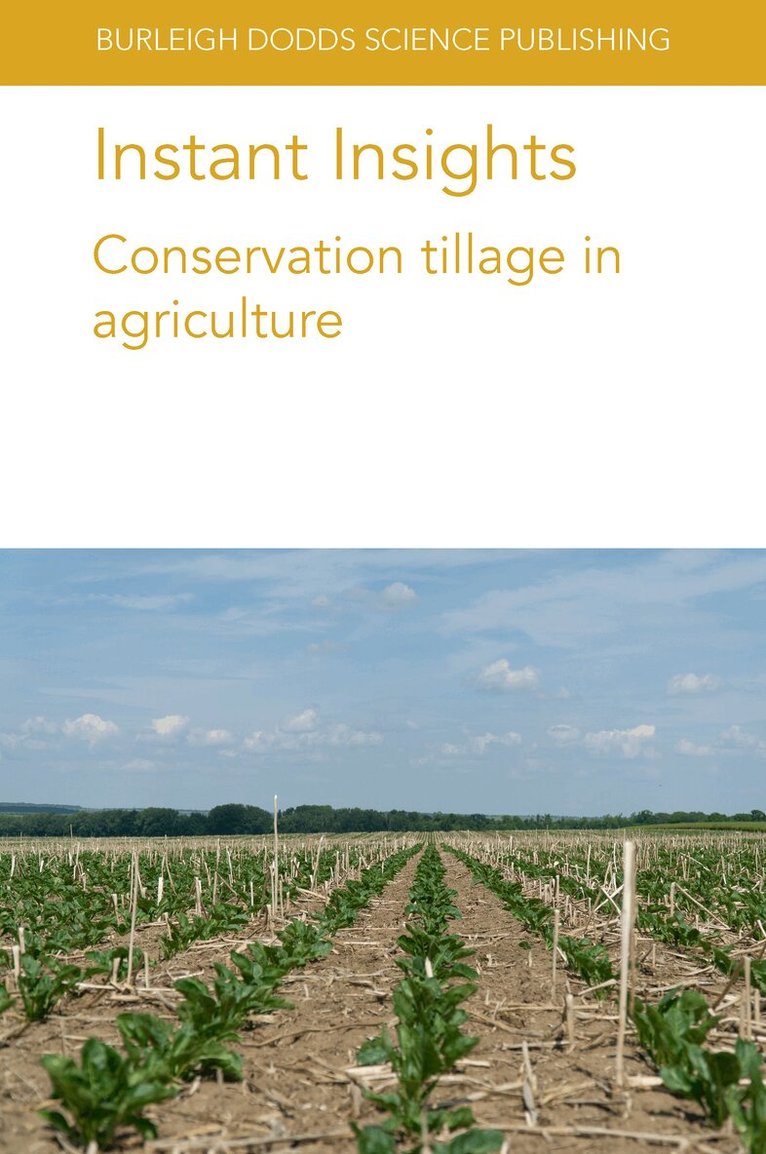
    Instant Insights: Conservation Tillage in Agriculture

    AvMaike Krauss,Paul Mäder

    Häftad, Engelska, 2021

    Del 46 i serien Burleigh Dodds Science: Instant Insights

    689 kr

    Beställningsvara. Skickas inom 5-8 vardagar. Fri frakt över 249 kr.

    Beskrivning

    This collection features five peer-reviewed literature reviews on conservation tillage in agriculture.The first chapter reviews types of tillage and soil disturbance and how different soil management techniques affect the cropping cycle. The chapter also discusses how soil disturbance can be minimised during key farming operations.The second chapter describes the principles of Conservation Agriculture (CA), looking primarily at soil management. It also examines the key concepts of no-tillage agriculture, as well as the environmental and economic benefits these techniques offer.The third chapter discusses the role of conservation tillage in organic farming, reviewing over 20 years of practical, on-farm research. It outlines the main benefits associated with conservation tillage, whilst also considering the challenges that arise with its implementation and how these can be addressed.The fourth chapter explores the emergence of conservation tillage (CT) as an innovation to address stagnant wheat yields in the Indo-Gangetic Plains of South Asia. The chapter explores the benefits of CT for soil health and crop yields, and highlights current obstacles facing region-wide adoption of CT.The final chapter reviews the advantages of zero-till maize cultivation, including reduced soil erosion and nutrient losses. It also summarises best management practices to optimise zero-till maize systems.

    Produktinformation

    • Utgivningsdatum:2021-12-14
    • Mått:152 x 229 x 6 mm
    • Vikt:170 g
    • Format:Häftad
    • Språk:Engelska
    • Serie:Burleigh Dodds Science: Instant Insights
    • Antal sidor:118
    • Förlag:Burleigh Dodds Science Publishing Limited
    • ISBN:9781801462808

    Utforska kategorier

    • Agronomi och lantbruk inom Naturvetenskap och teknik
    • Lantbruksteknik inom Naturvetenskap och teknik
    • Ekologisk odling inom Naturvetenskap och teknik

    Mer om författaren

    Dr Gottlieb Basch is a Full Professor in the Department of Plant Science at the University of Évora, Portugal. He is President of the European Conservation Agriculture Federation and has contributed to a number of EIP AGRI Focus Groups, EU Horizon and other research projects on more sustainable methods of crop cultivation.

    Innehållsförteckning

    • Chapter 1 - Conservation tillage in organic farming: Maike Krauss and Paul Mäder, Research Institute of Organic Agriculture (FiBL), Switzerland; Joséphine Peigné, ISARA-Lyon, France; and Julia Cooper, Newcastle University, UK; 1 Introduction 2 Main benefits of conservation tillage 3 Main challenges of conservation tillage 4 Future trends 5 Conclusion 6 Where to look for further information 7 ReferencesChapter taken from: Köpke, U. (ed.), Improving organic crop cultivation, Burleigh Dodds Science Publishing, Cambridge, UK, 2018, (ISBN 978 1 78676 184 2)Chapter 2 - The role of no or minimum mechanical soil disturbance in Conservation Agriculture systems: Theodor Friedrich, Food and Agriculture Organization of the United Nations (FAO), Italy; 1 Introduction 2 Effects of soil tillage and tillage implements on the soil 3 Minimizing soil disturbance in farming 4 Conclusion 5 Where to look for further information 6 ReferencesChapter taken from: Kassam, A. (ed.), Advances in Conservation Agriculture – Volume 1: Systems and Science, Burleigh Dodds Science Publishing, Cambridge, UK, 2020, (ISBN 978 1 78676 264 1)Chapter 3 - Soil management practices and benefits in Conservation Agriculture systems: Michele Pisante, University of Teramo, Italy; Angelica Galieni, Council for Agricultural Research and Economics and Research Centre for Vegetable and Ornamental Crops, Italy; Gottlieb Basch, University of Évora, Portugal; Theodor Friedrich, Food and Agriculture Organization of the United Nations (FAO), Italy; and Fabio Stagnari, University of Teramo, Italy; 1 Introduction 2 The principles of CA 3 Environmental benefits and ecosystem services 4 Economic benefits 5 Future trends 6 Conclusion 7 Where to look for further information 8 ReferencesChapter taken from: Kassam, A. (ed.), Advances in Conservation Agriculture – Volume 2: Practice and Benefits, Burleigh Dodds Science Publishing, Cambridge, UK, 2020, (ISBN 978 1 78676 268 9)Chapter 4 - Zero-tillage cultivation of maize: Wade E. Thomason, Bee Khim Chim and Mark S. Reiter, Virginia Tech University, USA; 1 Introduction 2 History of zero-tillage maize cultivation 3 Advantages of zero-tillage maize production: reduced soil erosion 4 Advantages of zero-tillage maize production: reduced nutrient losses 5 Advantages of zero-tillage maize production: water infiltration and use, economics and soil organic matter 6 Potential disadvantages of zero-tillage maize production 7 Success with zero-tillage maize production 8 The future of zero-tillage maize production 9 Where to look for further information 10 ReferencesChapter taken from: Watson, D. (ed.), Achieving sustainable cultivation of maize – Volume 2: Cultivation techniques, pest and disease control, Burleigh Dodds Science Publishing, Cambridge, UK, 2017, (ISBN 978 1 78676 012 8)Chapter 5 - Conservation tillage for sustainable wheat intensification: the example of South Asia: Vijesh Krishna, Georg-August University of Göttingen, Germany; Alwin Keil, International Maize and Wheat Improvement Center (CIMMYT), India; Sreejith Aravindakshan, Wageningen University, The Netherlands; and Mukesh Meena, Indian Institute of Soil and Water Conservation, India; 1 Introduction 2 Factors affecting the diffusion of CT wheat in South Asia 3 Recent evidence of the agronomic and economic impacts of CT wheat in South Asia 4 Constraints to the diffusion of CT practices in wheat in South Asia 5 Recent developments in CT wheat 6 Concluding remarks 7 Where to look for further information 8 Acknowledgements 9 ReferencesChapter taken from: Langridge, P. (ed.), Achieving sustainable cultivation of wheat – Volume 2: Cultivation techniques, Burleigh Dodds Science Publishing, Cambridge, UK, 2017, (ISBN 978 1 78676 020 3)