• Fri frakt över 249 kr
  • •
  • Snabba leveranser
  • •
  • Billiga böcker
Kundservice

Du är på sajten för privatpersoner.

Företag, bibliotek eller offentlig verksamhet?

Du handlar på classic.bokus.com, där alla dina funktioner finns intakta.
Till classic.bokus.com
Bokus logotyp. Gå till startsidan.
  • Erbjudanden
  • Nyheter
  • Student
  • Topplistor
  • Barn & ungdom
  • Bokus Play
  • E-böcker
  • Pocketböcker
  • Spel & pussel

10% rabatt på allt med kod: NYSTART10 →

Sidfot

Mina sidor

    Hjälp

    • Kundservice
    • Vanliga frågor och svar
    • Frakt och leverans
    • Retur vid ångerrätt
    • Reklamera vara
    • Betalning
    • Köpvillkor
    • Allmänna villkor
    • Information om webbplatsens tillgänglighet

    Om Bokus

    • Om oss
    • Pressrum
    • För studenter
    • För företag
    • För bibliotek och offentlig verksamhet
    • För leverantörer
    • Hållbarhet

    Populärt

    • Aktuella erbjudanden
    • Presentkort
    • Studentlitteratur
    • Nya böcker
    • Topplistor
    • Signerade böcker
    • Engelska böcker

    Inspiration

    • Boktips
    • BookTok
    • Populära bokserier
    • Barnbokskaraktärer
    • Populära författare
    Logotyp för Bokus
    Följ oss på Facebook (extern länk)Följ oss på Instagram (extern länk)Följ oss på YouTube (extern länk)Följ oss på TikTok (extern länk)
    bokus @ CookiesAnpassa cookiesIntegritetspolicyKöpvillkor
    Till Citymail hemsida (extern länk)Till Budbee hemsida (extern länk)Till Postnord hemsida (extern länk)Till Schenker hemsida (extern länk)Till Early Bird hemsida (extern länk)Till Walleys hemsida (extern länk)
    1. Samhälle och politik
    2. Samhälle och kultur
    3. Sociala grupper och identitet

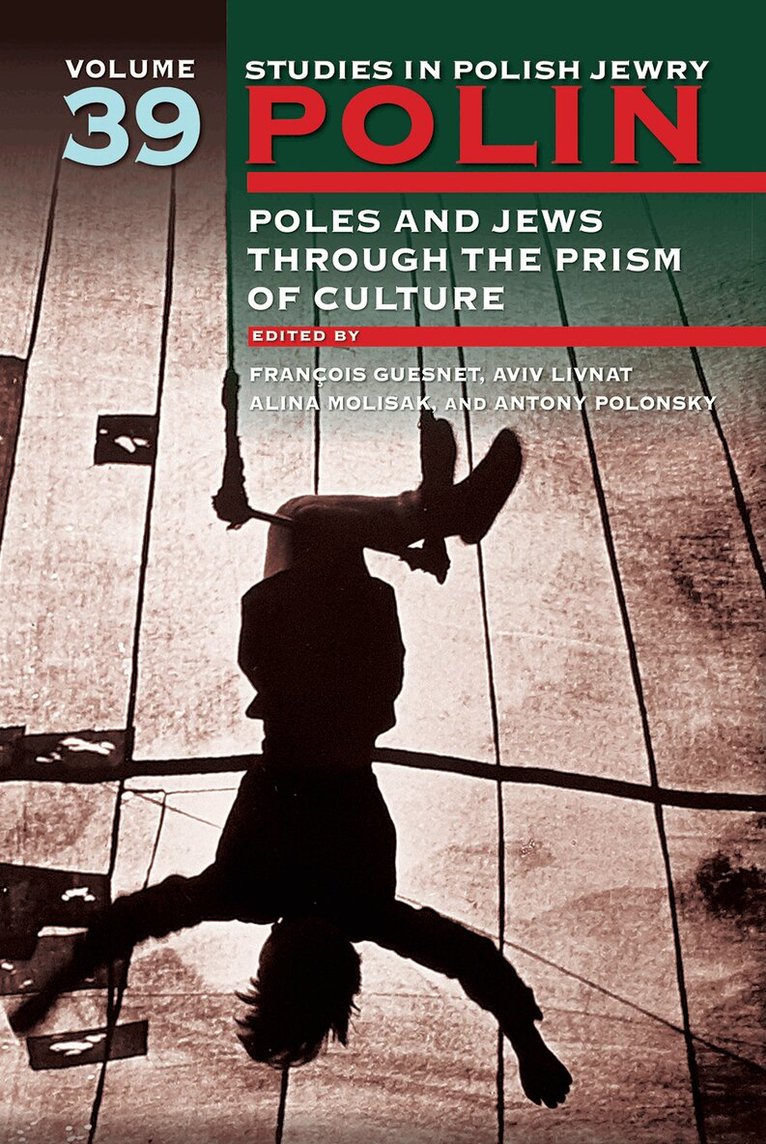
    Polin: Studies in Polish Jewry Volume 39

    Poles and Jews through the Prism of Culture

    AvAviv Livnat,Alina Molisak

    Inbunden, Engelska, 2027

    Del 39 i serien Polin: Studies in Polish Jewry

    765 kr

    Slutsåld

    Beskrivning

    Since the late eighteenth century artistic representation has had a growing impact on how Poles and Jews have perceived each other. Literary works, the visual arts, and, from the twentieth century onwards, film, have complemented earlier perceptions shaped by religious prejudice and everyday culture. Introduced by a section evaluating these earlier mutual perceptions, this volume provides interpretations of literary works from the eighteenth to the twentieth century in Polish and Yiddish by Jan Potocki, Julian Ursynowicz Niemcewicz, Klemens Junosza-Szaniawski, Bruno Schulz, Piotr Szewc, and others. A section on cinematographic representation before and after the Second World War illustrates the importance of this new genre of cultural production, and an extensive reflection on the fine arts examines the impact of artistic contexts (such as Kazimierz Dolny) as well as individual creators (Józef Herman, Zdzisław Bęksiński) and representations in popular culture. Literature, film, and the fine arts thus emerge as a prism through which it is possible to trace both negative stereotyping and nuanced representation.Interested in subscribing to Polin? Institutional subscriptions are now available via LUP's Journals department. To find out more or to recommend Polin to your institutional librarian, please visit: https://liverpooluniversitypress.co.uk/journal/polin

    Produktinformation

    • Utgivningsdatum:2027-02-28
    • Format:Inbunden
    • Språk:Engelska
    • Serie:Polin: Studies in Polish Jewry
    • Antal sidor:464
    • Förlag:Liverpool University Press
    • ISBN:9781802070408

    Utforska kategorier

    • Sociala grupper och identitet inom Samhälle och politik
    • Socialhistoria och kulturhistoria inom Historia och arkeologi
    • Judendom inom Filosofi och religion

    Mer om författaren

    Publications include ‘Art as Refuge: Sketches and Insights on the Jewish-Polish Art Scene from a Refugee's Perspective’, Studia Judaica, 27/2 (2024), 261–90; ‘“Sefirot”, Wanderings, and Superstructures: Futurism in the Polish Yiddish Arena’, Polin, 28 (2016), 283–305; ‘“Far undzere kinstler”: Tea Arciszewska and the Jewish Artists’, in Art in Jewish Society, Polish Society of Oriental Art (Warsaw, 2017). Chair, Korczak Academic Forum; director, Raz-Ram Foundation; curator, the Core Collection of Contemporary Israeli Art, NYUPublications include ‘Strategies of Reconstructing the Jewish World in Polish Literature after 1989’, in John J. Bukowczyk and Halina Filipowicz (eds.), Pole/Jew. History, Literature, Identity, Future (Athens, Ohio, 2025); ‘Narratives of the First World War: Multiple Jewish Perspectives’, in Polin, 37 (2024). Since 2022 she has been the president of the Polish Association for Jewish Studies, and she is a member of the editorial boards of Prace Filologiczne. Literaturoznawstwo and of Kwartalnik Historii Żydów.Co-editor, with Antony Polonsky, of Jewish Self-Government in Eastern Europe, Polin, 34 (2022), and, with Jerzy Tomaszewski, of Sources on Jewish Self-Government in the Polish Lands from Its Inception to the Present (2022). He is chair of the Institute for Polish-Jewish Studies and secretary of the European Association for Jewish Studies. He has held research fellowships and visiting teaching positions at University of Pennsylvania, University of Oxford, the Hebrew University of Jerusalem, Dartmouth College, Potsdam University, Vilnius University, and the Jagiellonian University Kraków.Author of The Jews in Poland and Russia, 3 vols. (Littman Library, 2010–12), also published in an abridged version: The Jews in Poland and Russia: A Short History (2014). In 2012 The Jews in Poland and Russia was awarded the Pro Historia Polonorum prize of the Polish Senate for the best book on the history of Poland in a non-Polish language written in the previous five years. Holds honorary doctorates from the University of Warsaw (2010) and the Jagiellonian University (2014). In 2011 he was awarded the Officer’s Cross of the Order of Merit of Polonia Restituta and the Officer’s Cross of the Order of Merit of Independent Lithuania.

    Innehållsförteckning

    • IntroductionFrançois Guesnet, Aviv Livnat, Alina Molisak, Antony Polonsky1. ETHNIC STEREOTYPING IN THE POLISH LANDSHoffmann’s Shadow? The Creation of German Jewish Family Names in WarsawJohannes CzakaiFear of Being Eaten: Mutual Perceptions of Everyday Jewish and Catholic Religious Culture in Interwar LublinMagdalena DziaczkowskaJews in the Eyes of Polesian Peasants: Lessons from Pre-war Ethnographical Field NotesAnna EngelkingPoland and Polish–Jewish Relations in Memoirs of Polish Jews in the USSR, 1939–1946Magdalena Ruta2. THROUGH THE PRISM OF LITERATURE: BEFORE 1900Potocki’s Resistance: The Manuscript Found in Saragossa as an Allegory of the Polish PartitionsMarc CaplanJulian Ursyn Niemcewicz’s Misinterpretation of Traditional JudaismDorota Burda-FischerJews in the Countryside: The Perspectives of Klemens Junosza and Jan JeleńskiAlina MolisakHow Do They Perceive Us? Confronting National Imaginaries in Polish Jewish ProseEugenia Prokop-JaniecThe Jewish ‘Helper’ in the Belarusian Literature of the Nasha Niva PeriodClaire Le Foll3. THROUGH THE PRISM OF LITERATURE: FROM 1900 TO THE AFTERMATH OF THE HOLOCAUST‘The lips that have often smiled so foolishly’: Jewish–Polish Relations in the Work of Itshe Meyer VaysenbergGil RibakBruno Schulz and Ukrainian Culture: Historical Contexts and Literary TracesStanley BillA ‘Jewish-Polish Idyll’? Kazimierz on the Vistula as Shtetl and Artistic ColonyMonika Adamczyk-GarbowskaHolocaust Poems in Polish and Polish Jewish Journals of the 1940sAleksandra KremerThe Polish and Jewish Identities of Leopold TyrmandFilip MazurczakAttending to the Imprint: Space, Community, and the Work of Memory in Piotr Szewc’s AnnihilationDiana Sacilowski4. THE CINEMATIC IMAGEThe Two Faces of Janus: Jewish Characters in Polish Films and Polish Characters in Jewish FilmsMarcos SilberBruno Schulz and Wojciech Jerzy Has: Two Bulbs of a Bereaved HourglassAviv LivnatIda, Aftermath, and In DarknessPaul Coates5. ARTISTIC PERCEPTIONS IN INDEPENDENT AND POST-WAR POLANDGolden Horn or Shofar of Liberation? Polish and Jewish Messianism in the Work of Jewish Artists from Łódź and WarsawMałgorzata Stolarska-FroniaAt the Crossroads of Worlds: Jewish Artists in 1930s WarsawRenata Piątkowska‘Realism in the broadest possible sense’: Czapka Frygijska and the Engaged Art of Józef HermanPiotr SłodkowskiWeird and Eerie Holocaust: Zdzisław Beksiński and the Memory of Jewish SanokClaudia WęgrzynPoland’s Jewish Figurines Twenty Years On: Cultural Barometer, Evolving Tradition, Domain of DisputeErica Lehrer