• Fri frakt över 249 kr
  • •
  • Snabba leveranser
  • •
  • Billiga böcker
Kundservice

Du är på sajten för privatpersoner.

Företag, bibliotek eller offentlig verksamhet?

Du handlar på classic.bokus.com, där alla dina funktioner finns intakta.
Till classic.bokus.com
Bokus logotyp. Gå till startsidan.
  • Erbjudanden
  • Nyheter
  • Student
  • Topplistor
  • Barn & ungdom
  • Bokus Play
  • E-böcker
  • Pocketböcker
  • Spel & pussel

10% rabatt på allt med kod: NYSTART10 →

Sidfot

Mina sidor

    Hjälp

    • Kundservice
    • Vanliga frågor och svar
    • Frakt och leverans
    • Retur vid ångerrätt
    • Reklamera vara
    • Betalning
    • Köpvillkor
    • Allmänna villkor
    • Information om webbplatsens tillgänglighet

    Om Bokus

    • Om oss
    • Pressrum
    • För studenter
    • För företag
    • För bibliotek och offentlig verksamhet
    • För leverantörer
    • Hållbarhet

    Populärt

    • Aktuella erbjudanden
    • Presentkort
    • Studentlitteratur
    • Nya böcker
    • Topplistor
    • Signerade böcker
    • Engelska böcker

    Inspiration

    • Boktips
    • BookTok
    • Populära bokserier
    • Barnbokskaraktärer
    • Populära författare
    Logotyp för Bokus
    Följ oss på Facebook (extern länk)Följ oss på Instagram (extern länk)Följ oss på YouTube (extern länk)Följ oss på TikTok (extern länk)
    bokus @ CookiesAnpassa cookiesIntegritetspolicyKöpvillkor
    Till Citymail hemsida (extern länk)Till Budbee hemsida (extern länk)Till Postnord hemsida (extern länk)Till Schenker hemsida (extern länk)Till Early Bird hemsida (extern länk)Till Walleys hemsida (extern länk)
    1. Samhälle och politik
    2. Sociologi och antropologi
    3. Antropologi

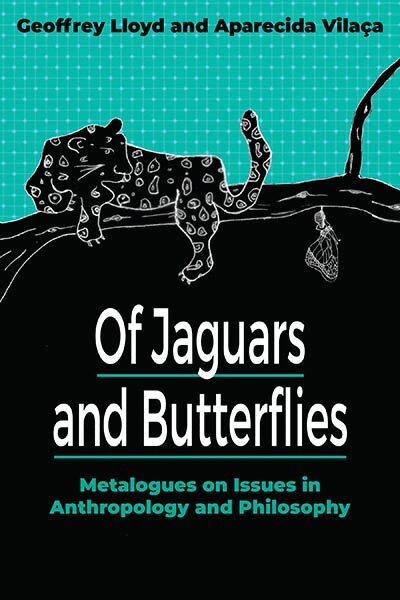
    Of Jaguars and Butterflies

    Metalogues on Issues in Anthropology and Philosophy

    AvGeoffrey Lloyd,Aparecida Vilaça

    Häftad, Engelska, 2025

    328 kr

    Skickas . Fri frakt över 249 kr.

    Fler format och utgåvor

    Inbunden

    1 648 kr

    Beskrivning

    Jointly authored by an anthropologist and a philosopher, this book investigates some of the most puzzling ideas and practices reported in modern ethnography and ancient philosophy concerning topics such as humans, animals, persons, spirits, agency, selfhood, consciousness, nature, life, death, disease and health.

    Produktinformation

    • Utgivningsdatum:2025-08-01
    • Mått:229 x 152 x 9 mm
    • Vikt:202 g
    • Format:Häftad
    • Språk:Engelska
    • Antal sidor:130
    • Förlag:Berghahn Books
    • ISBN:9781836950813

    Utforska kategorier

    • Antropologi inom Samhälle och politik
    • Sociologi inom Samhälle och politik
    • Filosofiska discipliner inom Filosofi och religion

    Mer om författaren

    Geoffrey Lloyd is Emeritus Professor of Ancient Philosophy and Science at the University of Cambridge. He was Master of Darwin College, Cambridge, from 1989 to 2000. Among his most notable publications are Magic, Reason and Experience (Cambridge University Press, 1979), and Cognitive Variantions (Oxford University Press, 2007).

    Recensioner i media

    “In this unusual and engaging book, a philosopher (Lloyd) and an anthropologist (Vilaça) spar and discourse around questions of reality, interpretation, ontology, culture, and metaphor… Readers interested in any or all of the topics will find much here that is enthusing and thought-provoking– and the free and lively form of the writing may make this short volume particularly well suited to whetting the appetite of students embarking upon these topics.” • Journal of the Royal Anthropological Institute (JRAI)“This short, unusual, and absorbing book places a social anthropologist of Amazonia (Aparecida Vilaça) and a historian-cum-philosopher of antiquity (Sir Geoffrey E. R. Lloyd) into a productive dialogue. In doing so, it sheds new light on the well-established but often implicit relationship between the disciplines… There is value here for all students and scholars of anthropology, philosophy, and mythology. Yet perhaps the greatest contribution of this book is its encouragement to seek out these kinds of productive collaborations in ‘the space between’ our own often inward-facing disciplines.” • American Ethnologist“[This book] offers an important reflection about the processes involved in the formulation of theoretical models in Social Sciences and the Humanities; a function of intellectual dialogue that would have been so useful to have in other key collaborations of Amerindian studies…The reader might find in this book more jaguars than butterflies, but it is above all a very useful tool for those interested in continuing thinking the possible contributions of the most recent developments in Anthropology and Philosophy.” • Anthropos“This is a work of outstanding interest and originality, both in form and in content.” • Nicholas Jardine, Cambridge University“This is a rare treat: a sequence of conversations between an anthropologist and a philosopher who tease out a series of fascinating questions, notably those posed to the mind of the philosopher by the materials of the anthropologist. It is a hugely illuminating exercise, because of who they are and what they are discussing.” • Marilyn Strathern, Cambridge University

    Innehållsförteckning

    • IntroductionChapter 1. Are People and Animals Separate Kinds of Beings?Chapter 2. Could Animal-Human Transformations Be Considered as Dreaming or Hallucinating?Chapter 3. Could We Think of Transformations as Metaphoric?Chapter 4. Similarities and Contrasts with Ancient GreeceChapter 5. Are There Complete and Incomplete Transformations?Chapter 6. How Do Things Become Equivalent?Chapter 7. Is Shamanism a Kind of Disease?Chapter 8. Are There Objects without Perspectives?Chapter 9. Why Are Some Animals Unable to Transform?Chapter 10. Do Transformations Need Proof? Are Shamans and Healers Ever Doubted?Chapter 11. Are Transformations Analogous to Miracles? Is It All about Believing?Chapter 12. Is Proof Linked to Literacy?Chapter 13. Could Those Transformations Be Compared to Those in Literary Fiction?Chapter 14. Should We Talk about Ontologies When Faced with a World in Flux?Chapter 15. Anthropologists and PhilosophersConclusionReferencesIndex