• Fri frakt över 249 kr
  • •
  • Snabba leveranser
  • •
  • Billiga böcker
Kundservice

Du är på sajten för privatpersoner.

Företag, bibliotek eller offentlig verksamhet?

Du handlar på classic.bokus.com, där alla dina funktioner finns intakta.
Till classic.bokus.com
Bokus logotyp. Gå till startsidan.
  • Erbjudanden
  • Nyheter
  • Student
  • Topplistor
  • Barn & ungdom
  • Bokus Play
  • E-böcker
  • Pocketböcker
  • Spel & pussel

Må bättre, för mindre! Upp till 50% rabatt på hälsoböcker

Sidfot

Mina sidor

    Hjälp

    • Kundservice
    • Vanliga frågor och svar
    • Frakt och leverans
    • Retur vid ångerrätt
    • Reklamera vara
    • Betalning
    • Köpvillkor
    • Allmänna villkor
    • Information om webbplatsens tillgänglighet

    Om Bokus

    • Om oss
    • Pressrum
    • För studenter
    • För företag
    • För bibliotek och offentlig verksamhet
    • För leverantörer
    • Hållbarhet

    Populärt

    • Aktuella erbjudanden
    • Presentkort
    • Studentlitteratur
    • Nya böcker
    • Topplistor
    • Signerade böcker
    • Engelska böcker

    Inspiration

    • Boktips
    • BookTok
    • Populära bokserier
    • Barnbokskaraktärer
    • Populära författare
    Logotyp för Bokus
    Följ oss på Facebook (extern länk)Följ oss på Instagram (extern länk)Följ oss på YouTube (extern länk)Följ oss på TikTok (extern länk)
    bokus @ CookiesAnpassa cookiesIntegritetspolicyKöpvillkor
    Till Citymail hemsida (extern länk)Till Budbee hemsida (extern länk)Till Postnord hemsida (extern länk)Till Schenker hemsida (extern länk)Till Early Bird hemsida (extern länk)Till Walleys hemsida (extern länk)
    1. Juridik
    2. Internationell rätt
    3. Folkrätt

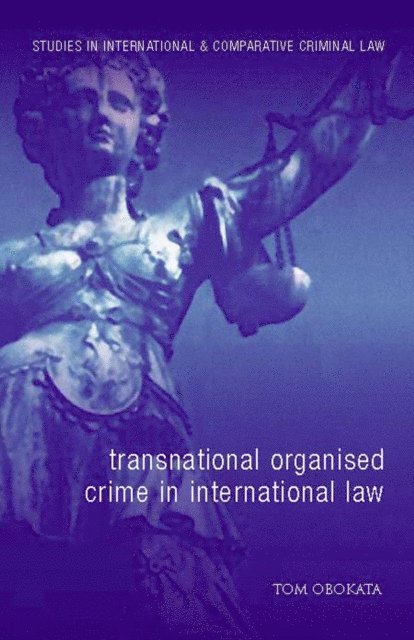
    Transnational Organised Crime in International Law

    AvTom Obokata

    Inbunden, Engelska, 2010

    Del i serien Studies in International and Comparative Criminal Law

    1 283 kr

    Beställningsvara. Skickas inom 10-15 vardagar. Fri frakt över 249 kr.

    Fler format och utgåvor

    E-bok

    1 388 kr

    Beskrivning

    There is extensive and detailed academic literature on the legal development of international crimes such as war crimes and crime against humanity. However, not much attention has been paid to other serious crimes, including narcotics-related offences, human trafficking and money laundering, which do not necessarily amount to international crimes in the traditional sense. The purpose of this monograph is to fill this gap and offer a critical analysis of developments in the field of transnational organised crime under international law. The book is divided into two parts. Part I is entitled "Norms, Principles, and Concepts." It traces the history of organised crime and explores key concepts and norms relating to the practice from a multi-disciplinary perspective. It then looks at legal obligations imposed upon States as well as non-State actors in relation to transnational organised crime. Part II illustrates how these norms, principles and obligations are translated and enforced in practice. This will be done through case studies at the level of national law (Thailand, Serbia and the UK), regional law (European Union) and international law (United Nations)."A book of many parts, its thematic coherence comes from its devotion to identifying the social threat posed by organised crime and the legal steps taken at the international and national levels against that threat. Rich with example and illustration and written in a light, direct, style, it will provide a lucid guide for practitioners, policy-makers and students to the largely untraversed territory of the international legal system set up to suppress transnational organised crime." Professor Neil Bolster, University of Canterbury, New Zealand. "...the international law governing organized crime is a close relative of the body of law applicable to the International Criminal Court and similar institutions. It provides a forum to address issues of more general concern, such as the scope of universal jurisdiction, immunities, statutory limitation and extradition. Tom Obokata's study, with its original and in some ways unique perspective, enriches our knowledge of the field". Professor William Schabas, Irish Centre for Human Rights. "The book is well written, its documentation is quite exhaustive, and its thesis is timely and compelling." Professor M.Cherif Bassiouni, DePaul University College of Law.

    Produktinformation

    • Utgivningsdatum:2010-08-17
    • Mått:156 x 244 x 20 mm
    • Vikt:606 g
    • Format:Inbunden
    • Språk:Engelska
    • Serie:Studies in International and Comparative Criminal Law
    • Antal sidor:258
    • Förlag:Bloomsbury Publishing PLC
    • ISBN:9781841136905

    Utforska kategorier

    • Folkrätt inom Juridik
    • Organiserad brottslighet inom Samhälle och politik

    Mer om författaren

    Tom Obokata is a Senior Lecturer in Law at the Queen's University, Belfast.

    Recensioner i media

    Transnational Organised Crime in International Law is an important contribution to the field. The book offers well-organised and lucid analysis of concepts and case studies that may interest both academicians and practitioners and is accessible for the casual reader who is interested in an introduction to the subject matter. Joseph Wheatley Global Crime Volume 12, Issue 3 Tom Obokata has written the most useful and comprehensive book that sheds light upon the complex relationship between organised crime and international law. As both crime and law become evermore 'transnational' it is essential that concerned police officials, lawyers and judges as well as academics have such well researched in-depth assistance which is what this excellent work provides. Written in a very readable and lucid style it should form part of every international lawyer's library H. E Judge Howard Morrison, ICTY ... a welcome addition in a research field which has seen significant developments in the last years, but a relatively low number of scholarly works. ... a thorough analysis of the relationship between organized crime and international criminal law Francesco Calderoni The European Journal of Criminal Policy and Research April 2011

    Innehållsförteckning

    • 1 Introduction 1.1 The Rise of Organised Crime 1.2 Contemporary Manifestation of Organised Crime 1.3 The Scope and Aim of This Book Part I: Concepts, Norms and Principles 2 Understanding Organised Crime from a Multi-Disciplinary Perspective 2.1 Introduction 2.2 Concepts of Organised Crime from a Multi-disciplinary Perspective 2.2.1 Organised Crime as a Set of Actors 2.2.2 Organised Crime as a Set of Activities 2.3 Legal Defi nitions of Organised Crime in National and International Law 2.3.1 Defi nitions of Organised Crime in International Law 2.3.1.1 General Discussion 2.3.1.2 The Transnational Nature of Organised Crime 2.3.1.3 'Transnational'and 'International' Crime 2.3.2 Defi nitions of Organised Crime in National Law 2.4 Conclusions 3 Obligations of States under International Law 3.1 Introduction 3.2 The Nature and Extent of Obligations under International Law 3.2.1 Prohibition of Organised Crime and Associated Acts 3.2.2 Criminal Jurisdiction over Organised Crime 3.2.3 Special Investigative Techniques and Intelligence-Led Law Enforcement 3.2.4 Mutual Assistance in Criminal Matters 3.2.4.1 Extradition 3.2.4.2 Other Mutual Legal Assistance 3.2.5 Prevention of Organised Crime 3.3 Key Legal Challenges Facing Effective Implementation of Obligations 3.3.1 Periods of Limitations for Organised Crime 3.3.2 Immunity of Government Offi cials and Diplomats 3.3.3 Protection of Human Rights of Suspects/Defendants 3.4 Conclusions 4 The Role of Non-state Actors in Suppression and Prevention of Organised Crime 4.1 Introduction 4.2 The Role of Non-state Actors in Prevention and Suppression of Organised Crime 4.2.1 The Concept of Global Governance 4.2.2 Global Governance over Transnational Organised Crime 4.2.2.1 Decision-Making and Participation 4.2.2.2 Accountability 4.2.2.2.1 Individual Criminal Responsibility 4.2.2.2.2 Criminal Organisations 4.2.2.2.3 Legal Persons 4.2.2.2.4 International Organisations 4.3 Towards an Inclusive Notion of the 'International Community' 4.4 Conclusions Part II: Enforcement of Norms and Principles 5 National Case Studies of Thailand, Serbia, Kosovo and the UK 5.1 Introduction 5.2 Thailand 5.2.1 Legal Framework to Address Organised Crime 5.2.1.1 Legislation on Substantive Offences 5.2.1.2 Legislation on Criminal Procedure and International Co-operation 5.2.1.2.1 Criminal Jurisdiction and Investigative Powers 5.2.1.2.2 The Rights of Suspects/Defendants, Victims and Witnesses 5.2.1.2.3 Mutual Legal Assistance in Criminal Matters 5.2.2 Assessment of Law Enforcement in Thailand 5.3 Serbia 5.3.1 Legal Framework to Address Organised Crime 5.3.1.1 Legislation on Substantive Offences 5.3.1.2 Legislation on Criminal Procedure and International Co-operation 5.3.1.2.1 Criminal Jurisdiction and Investigative Powers 5.3.1.2.2 The Rights of Suspects/Defendants, Victims and Witnesses 5.3.1.2.3 Mutual Legal Assistance in Criminal Matters 5.3.2 Assessment of Law Enforcement in Serbia 5.4 Kosovo 5.4.1 Legal Framework to Address Organised Crime 5.4.1.1 Legislation on Substantive Offences 5.4.1.2 Legislation on Criminal Procedure and International Co-operation 5.4.1.2.1 Criminal Jurisdiction and Investigative Powers 5.4.1.2.2 The Rights of Suspects/Defendants, Victims and Witnesses 5.4.1.2.3 Mutual Legal Assistance in Criminal Matters 5.4.2 Assessment of Law Enforcement in Kosovo 5.5 The UK 5.5.1 Legal Framework to Address Organised Crime 5.5.1.1 Legislation on Substantive Offences 5.5.1.2 Legislation on Criminal Procedure and International Co-operation 5.5.1.2.1 Criminal Jurisdiction and Investigative Powers 5.5.1.2.2 The Rights of Suspects/Defendants, Victims and Witnesses 5.5.1.2.3 Mutual Legal Assistance in Criminal Matters 5.5.2 Assessment of Law Enforcement in the UK 5.6 Comparative Analysis 5.7 Conclusions 6 The EU and Transnational Organised Crime 6.1 Introduction 6.2 Law, Policies and Measures under the TEU 6.2.1 Overview 1 6.2.2 Analysis of the TEU Measures 6.3 Law, Policies and Measures under the TEU as Revised by the Treaty of Amsterdam 6.3.1 Overview 6.3.2 Approximation of National Laws 6.3.3 Mutual Recognition of Judicial Decisions 6.3.4 The Principle of Availability-Intelligence Exchange 6.3.5 Analysis of Measures under the TEU as Revised by the Treaty of Amsterdam 6.3.5.1 Application of Approximation, Mutual Recognition and the Principle of Availability 6.3.5.2 Other Issues 6.4 The Future of the EU Action against Organised Crime in Light of the Lisbon Treaty 6.5 Conclusions 7 International Responses to Transnational Organised Crime 7.1 Introduction 7.2 Monitoring Implementation of the Organised Crime Convention 7.3 Provision of Technical Assistance 7.4 International Co-operation 7.4.1 Inter-state Co-operation 7.4.2 Inter-Agency Co-operation: UNIAP 7.5 Conclusions 8 Conclusion Selected Bibliography Books and Articles Reports and Working Papers