• Fri frakt över 249 kr
  • •
  • Snabba leveranser
  • •
  • Billiga böcker
Kundservice

Du är på sajten för privatpersoner.

Företag, bibliotek eller offentlig verksamhet?

Du handlar på classic.bokus.com, där alla dina funktioner finns intakta.
Till classic.bokus.com
Bokus logotyp. Gå till startsidan.
  • Erbjudanden
  • Student
  • Topplistor
  • Barn & ungdom
  • Bokus Play
  • E-böcker
  • Ljudböcker
  • Pocketböcker
  • Spel och pussel

Pocketfynda! Hundratals böcker för 49 kr/st →

Sidfot

Mina sidor

    Hjälp

    • Kundservice
    • Vanliga frågor och svar
    • Frakt och leverans
    • Retur vid ångerrätt
    • Reklamera vara
    • Betalning
    • Köpvillkor
    • Allmänna villkor
    • Information om webbplatsens tillgänglighet

    Om Bokus

    • Om oss
    • Pressrum
    • För studenter
    • För företag
    • För bibliotek och offentlig verksamhet
    • För leverantörer
    • Hållbarhet

    Populärt

    • Aktuella erbjudanden
    • Presentkort
    • Studentlitteratur
    • Nya böcker
    • Topplistor
    • Signerade böcker
    • Engelska böcker

    Inspiration

    • Boktips
    • BookTok
    • Barnbokskaraktärer
    • Populära författare
    Logotyp för Bokus
    Följ oss på Facebook (extern länk)Följ oss på Instagram (extern länk)Följ oss på YouTube (extern länk)Följ oss på TikTok (extern länk)
    bokus @ CookiesAnpassa cookiesIntegritetspolicyKöpvillkor
    Till Citymail hemsida (extern länk)Till Budbee hemsida (extern länk)Till Postnord hemsida (extern länk)Till Schenker hemsida (extern länk)Till Early Bird hemsida (extern länk)Till Walleys hemsida (extern länk)
    1. Naturvetenskap och teknik
    2. Matematik och naturvetenskap
    3. Biologi
    4. Biovetenskap

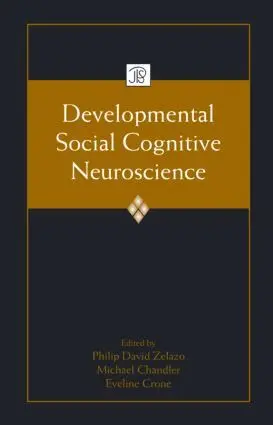
    Developmental Social Cognitive Neuroscience

    AvPhilip David Zelazo,Michael Chandler

    Inbunden, Engelska, 2009

    Del i serien Jean Piaget Symposia Series

    2 410 kr

    Beställningsvara. Skickas inom 10-15 vardagar. Fri frakt över 249 kr.

    Beskrivning

    This volume in the JPS Series is intended to help crystallize the emergence of a new field, "Developmental Social Cognitive Neuroscience," aimed at elucidating the neural correlates of the development of socio-emotional experience and behavior. No one any longer doubts that infants are born with a biologically based head start in accomplishing their important life tasks––genetic resources, if you will, that are exploited differently in different contexts. Nevertheless, it is also true that socially relevant neural functions develop slowly during childhood and that this development is owed to complex interactions among genes, social and cultural environments, and children’s own behavior. A key challenge lies in finding appropriate ways of describing these complex interactions and the way in which they unfold in real developmental time. This is the challenge that motivates research in developmental social cognitive neuroscience.The chapters in this book highlight the latest and best research in this emerging field, and they cover a range of topics, including the typical and atypical development of imitation, impulsivity, novelty seeking, risk taking, self and social awareness, emotion regulation, moral reasoning, and executive function. Also addressed are the potential limitations of a neuroscientific approach to the development of social cognition.Intended for researchers and advanced students in neuroscience and developmental, cognitive, and social psychology, this book is appropriate for graduate seminars and upper-level undergraduate courses on social cognitive neuroscience, developmental neuroscience, social development, and cognitive development.

    Produktinformation

    • Utgivningsdatum:2009-09-08
    • Mått:152 x 229 x 25 mm
    • Vikt:980 g
    • Format:Inbunden
    • Språk:Engelska
    • Serie:Jean Piaget Symposia Series
    • Antal sidor:372
    • Förlag:Taylor & Francis Ltd
    • ISBN:9781841697673

    Utforska kategorier

    • Biovetenskap inom Naturvetenskap och teknik
    • Barnpsykologi och utvecklingspsykologi inom Psykologi och pedagogik

    Mer om författaren

    Philip David Zelazo is the Nancy M. and John L. Lindahl Professor at the Institute of Child Development at the University of Minnesota. He received his PhD (with distinction) from Yale in 1993. The recipient of numerous awards including the Boyd McCandless Young Scientist Award from the American Psychological Association, Dr. Zelazo’s research focuses on the conscious control of thought, action, and emotion. He serves on the Board of Directors of the Jean Piaget Society, and is an editorial board member of Child Development, Emotion, Cognitive Development, Journal of Cognition and Development, Psyche, Frontiers in Human Neuroscience, and Monographs of the Society for Research in Child Development. Michael Chandler is a developmental psychologist at the University of British Columbia. He received his PhD in psychology, with a specialty in clinical developmental psychology from the University of California. Dr. Chandler is the only researcher in Canada ever named Distinguished Investigator of both the Canadian Institutes of Health Research and the Michael Smith Foundation for Health Research. His research explores the role that culture plays in the construction of identity development.Eveline Crone is Professor of Developmental Psychology at Leiden University and the Leiden Institute for Brain & Cognition. She has received several awards for her contributions to human sciences in the Netherlands and she is a member of the young academy of the Royal Netherlands Academy of Arts and Sciences.

    Recensioner i media

    "The application of neuroscientific approaches to the development of social and cognitive behavior is a … fast-developing field. This book provides expert guidance on what is known-- and what remains to be learned-- about how studies of brain function inform our understanding of developmental transitions in social development from infancy to adulthood. The chapters are thoughtful, masterful, and will be a valuable resource for both the educated novice and seasoned professional." - Seth D. Pollak, University of Wisconsin – Madison, USA"This comprehensive book … will provide a valuable resource for both professionals and graduate students who seek a deeper understanding of how the social mind develops." - Jean Decety, University of Chicago, USA"This is a wonderful book. It provides a timely set of contributions at a key time in the emergence of an exciting new field. This work represents a new wave of advances in cognitive neuroscience—one that emphasizes a synthesis and integration of several different lines of investigation—creating a new frontier in understanding the normal and abnormal development of the most fundamentally human (social) aspects of cognition." - Ronald Dahl, University of Pittsburgh, USA

    Innehållsförteckning

    • Part 1. Introduction. P.D. Zelazo, M. Chandler, E.A. Crone, The Birth and Early Development of a New Discipline: Developmental Social Cognitive Neuroscience. Part 2. The Typical and Atypical Development of Social Cognition in Childhood. V. Gallese, M. Rochat, Motor Cognition: The Role of the Motor System in the Phylogeny and Ontogeny of Social Cognition and its Relevance for the Understanding of Autism. C. Moore, J. Barresi, The Construction of Commonsense Psychology in Infancy. J.E. Benson, M. Sabbagh, Theory of Mind and Executive Functioning: A Developmental Neuropsychological Approach. W. Cunningham, P.D. Zelazo, The Development of Iterative Reprocessing: Implications for Affect and Its Regulation. S.B. Perlman, B.C. Vander Wyk, K.A. Pelphrey, Brain Mechanisms in the Typical and Atypical Development of Social Cognition. S. Baron-Cohen, Autism and the Emphasizing-Systemizing (E-S) Theory. Part 3. Social Cognition in Adolescence. J.H. Pfeifer, M. Dapretto, M.D. Lieberman, The Neural Foundations of Evaluative Self-Knowledge in Middle Childhood, Early Adolescence and Adulthood. M. Ernst, M. Hardin, Neurodevelopment Underlying Adolescent Behavior: A Neurobiological Model. A.A. Baird, The Terrible Twelves. L. van Leijenhorst, E. Crone, Paradoxes in Adolescent Risk-taking. R.L. Selman, L.F. Feigenberg, Between Neurons and Neighborhoods: Innovative Methods to Assess the Development and Depth of Adolescent Social Awareness. Part 4. The Developmental Social Cognitive Neuroscience of Moral Reasoning. P.J. Eslinger, M. Robinson-Long, Crucial Developmental Role of Prefrontal Cortex in Social Cognition and Moral Maturation: Evidence from Early Prefrontal Lesions and fMRI. R.J. Blair, Contributions of Neuroscience to the Understanding of Moral Reasoning and its Development. J. Carpendale, B.W. Sokol, U. Müller, Is a Neuroscience of Morality Possible?. E. Turiel, The Relevance of Moral Epistemology and Psychology for Neuroscience.