• Fri frakt över 249 kr
  • •
  • Snabba leveranser
  • •
  • Billiga böcker
Kundservice

Du är på sajten för privatpersoner.

Företag, bibliotek eller offentlig verksamhet?

Du handlar på classic.bokus.com, där alla dina funktioner finns intakta.
Till classic.bokus.com
Bokus logotyp. Gå till startsidan.
  • Erbjudanden
  • Student
  • Topplistor
  • Barn & ungdom
  • Bokus Play
  • E-böcker
  • Ljudböcker
  • Pocketböcker
  • Spel & pussel

Upp till 25% på utvalda nyheter →

Sidfot

Mina sidor

    Hjälp

    • Kundservice
    • Vanliga frågor och svar
    • Frakt och leverans
    • Retur vid ångerrätt
    • Reklamera vara
    • Betalning
    • Köpvillkor
    • Allmänna villkor
    • Information om webbplatsens tillgänglighet

    Om Bokus

    • Om oss
    • Pressrum
    • För studenter
    • För företag
    • För bibliotek och offentlig verksamhet
    • För leverantörer
    • Hållbarhet

    Populärt

    • Aktuella erbjudanden
    • Presentkort
    • Studentlitteratur
    • Nya böcker
    • Topplistor
    • Signerade böcker
    • Engelska böcker

    Inspiration

    • Boktips
    • BookTok
    • Populära bokserier
    • Barnbokskaraktärer
    • Populära författare
    Logotyp för Bokus
    Följ oss på Facebook (extern länk)Följ oss på Instagram (extern länk)Följ oss på YouTube (extern länk)Följ oss på TikTok (extern länk)
    bokus @ CookiesAnpassa cookiesIntegritetspolicyKöpvillkor
    Till Citymail hemsida (extern länk)Till Budbee hemsida (extern länk)Till Postnord hemsida (extern länk)Till Schenker hemsida (extern länk)Till Early Bird hemsida (extern länk)Till Walleys hemsida (extern länk)
    1. Samhälle och politik
    2. Samhälle och kultur
    3. Kultur och medier
    4. Referensverk och tvärvetenskap

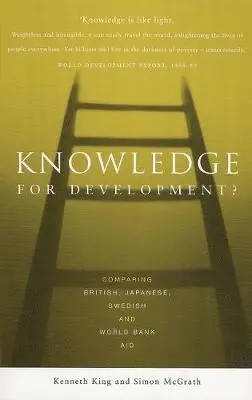
    Knowledge for Development?

    Comparing British, Japanese, Swedish and World Bank Aid

    AvKenneth King,Simon McGrath

    Häftad, Engelska, 2004

    504 kr

    Beställningsvara. Skickas inom 10-15 vardagar. Fri frakt över 249 kr.

    Fler format och utgåvor

    E-bok

    543 kr

    E-bok

    543 kr

    Beskrivning

    In 1996, the World Bank President, James Wolfensohn, declared that his organization would henceforth be 'the knowledge bank'. This marked the beginning of a new discourse of knowledge-based aid, which has spread rapidly across the development field. This book is the first detailed attempt to analyse this new discourse.Through an examination of four agencies -- the World Bank, the British Department for International Development, the Japan International Cooperation Agency and the Swedish International Development Cooperation Agency -- the book explores what this new approach to aid means in both theory and practice. It concludes that too much emphasis has been on developing capacity within agencies rather than addressing the expressed needs of Southern 'partners'. It also questions whether knowledge-based aid leads to greater agency certainty about what constitutes good development.

    Produktinformation

    • Utgivningsdatum:2004-02-01
    • Mått:217 x 135 x 22 mm
    • Vikt:282 g
    • Format:Häftad
    • Språk:Engelska
    • Antal sidor:256
    • Förlag:Bloomsbury Publishing PLC
    • ISBN:9781842773253

    Utforska kategorier

    • Referensverk och tvärvetenskap inom Samhälle och politik
    • Socialt arbete och välfärd inom Samhälle och politik

    Mer om författaren

    Kenneth King is Professor of International and Comparative Education and Director of the Centre of African Studies, University of Edinburgh. He is the author or editor of several books , including 'Aid and Education' and 'Changing International Aid to Education' (edited with Lene Buchert).Simon McGrath has been a research fellow at the Centre of African Studies, and became Research Director at the Human Sciences Research Council in Pretoria, South Africa in October 2002.Both authors have published extensively in African Studies and International Comparative Education and have been researching development cooperation for a number of years.

    Recensioner i media

    'In this excellent book the authors present a detailed analysis and a balanced assessment of the prospects for knowledge-based aid to achieve the goal of improving aid-effectiveness. Based on conceptual framework setting and a close examination of actual experience they reach the conclusion that success depends on reconceptualizing aid itself, in the direction of capacity building in poor countries.' Ravi Kanbur, Cornell University 'Knowledge management is popular. Aid agencies talk easily of sharing stories, communities of practice and double-loop learning. But are they ready to sacrifice a preoccupation with results and a concern to disseminate 'best-practice' - in favour of real partnership and mutual learning across divergent networks? McGrath and King are sceptical. Their case studies and their thesis challenge all of us involved in the production, sharing, and use of knowledge.' Simon Maxwell, Overseas Development Institute, and President of the Development Studies Association of the UK and Ireland

    Innehållsförteckning

    • 1. Researching Knowledge-Based Aid2. The New Aid Agenda3. Knowledge for Development4. The World Bank or the Knowledge Bank?5. From Information Management to Knowledge Sharing: DFID's Unfinished Revolution6. Knowledge, Learning and Capacity in the Swedish Approach to Development Cooperation7. Experience, Experts and Knowledge in Japanese Aid Policy and Practice8. Conclusions and Implications for Knowledge, Aid and Development