• Fri frakt över 249 kr
  • •
  • Snabba leveranser
  • •
  • Billiga böcker
Kundservice

Du är på sajten för privatpersoner.

Företag, bibliotek eller offentlig verksamhet?

Du handlar på classic.bokus.com, där alla dina funktioner finns intakta.
Till classic.bokus.com
Bokus logotyp. Gå till startsidan.
  • Erbjudanden
  • Nyheter
  • Student
  • Topplistor
  • Barn & ungdom
  • Bokus Play
  • E-böcker
  • Pocketböcker
  • Spel & pussel

10% studentrabatt med kod TERM26

Sidfot

Mina sidor

    Hjälp

    • Kundservice
    • Vanliga frågor och svar
    • Frakt och leverans
    • Retur vid ångerrätt
    • Reklamera vara
    • Betalning
    • Köpvillkor
    • Allmänna villkor
    • Information om webbplatsens tillgänglighet

    Om Bokus

    • Om oss
    • Pressrum
    • För studenter
    • För företag
    • För bibliotek och offentlig verksamhet
    • För leverantörer
    • Hållbarhet

    Populärt

    • Aktuella erbjudanden
    • Presentkort
    • Studentlitteratur
    • Nya böcker
    • Topplistor
    • Signerade böcker
    • Engelska böcker

    Inspiration

    • Boktips
    • BookTok
    • Populära bokserier
    • Barnbokskaraktärer
    • Populära författare

    Mina sidor

      Hjälp

      • Kundservice
      • Vanliga frågor och svar
      • Frakt och leverans
      • Retur vid ångerrätt
      • Reklamera vara
      • Betalning
      • Köpvillkor
      • Allmänna villkor
      • Information om webbplatsens tillgänglighet

      Om Bokus

      • Om oss
      • Pressrum
      • För studenter
      • För företag
      • För bibliotek och offentlig verksamhet
      • För leverantörer
      • Hållbarhet

      Populärt

      • Aktuella erbjudanden
      • Presentkort
      • Studentlitteratur
      • Nya böcker
      • Topplistor
      • Signerade böcker
      • Engelska böcker

      Inspiration

      • Boktips
      • BookTok
      • Populära bokserier
      • Barnbokskaraktärer
      • Populära författare
      Logotyp för Bokus
      Följ oss på Facebook (extern länk)Följ oss på Instagram (extern länk)Följ oss på YouTube (extern länk)Följ oss på TikTok (extern länk)
      bokus @ CookiesAnpassa cookiesIntegritetspolicyKöpvillkor
      Till Citymail hemsida (extern länk)Till Budbee hemsida (extern länk)Till Postnord hemsida (extern länk)Till Schenker hemsida (extern länk)Till Early Bird hemsida (extern länk)Till Walleys hemsida (extern länk)
      1. Naturvetenskap och teknik
      2. Geovetenskap
      3. Miljövetenskap och miljöpolitik

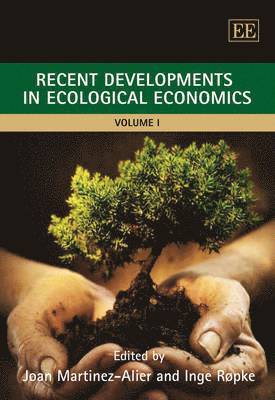
      Recent Developments in Ecological Economics

      AvJoan Martínez-Alier,Inge Røpke

      Inbunden, Engelska, 2008

      Del i serien Elgar Mini Series

      10 721 kr

      Beställningsvara. Skickas inom 5-8 vardagar. Fri frakt över 249 kr.

      Beskrivning

      Ecological economics is an increasingly important subject that addresses the current conflict between positive economic growth and negative environmental consequences. In this state-of-the-art two-volume set, the editors, both leading scholars in their field, have selected the most important recently published papers on the subject. This authoritative collection will be a vital resource for researchers and practitioners in ecological economics, human ecology, industrial ecology and environmental sciences.

      Produktinformation

      • Utgivningsdatum:2008-05-30
      • Mått:169 x 244 x undefined mm
      • Format:Inbunden
      • Språk:Engelska
      • Serie:Elgar Mini Series
      • Förlag:Edward Elgar Publishing Ltd
      • ISBN:9781843767831

      Utforska kategorier

      • Miljövetenskap och miljöpolitik inom Naturvetenskap och teknik
      • Biovetenskap inom Naturvetenskap och teknik

      Mer om författaren

      Edited by Joan Martínez-Alier, Professor of Economics and Economic History, Universitat Autònoma de Barcelona, Spain, Recipient of the Balzan Prize in 2020 and the Holberg Prize in 2023 and Inge Røpke, Aalborg University, Denmark

      Recensioner i media

      ‘An excellent source of reference for researchers and practitioners in ecological economics, human ecology, industrial ecology and environmental sciences, this publication will help its readers keep abreast of major recent developments in the field.’

      Innehållsförteckning

      • Contents:Volume IAcknowledgementsIntroductionJoan Martinez-Alier and Inge RøpkePART IROOTS 1. Inge Røpke (2004), ‘The Early History of Modern Ecological Economics’2. Inge Røpke (2005), ‘Trends in the Development of Ecological Economics from the Late 1980s to the Early 2000s’3. Carl Folke (2006), ‘Resilience: The Emergence of a Perspective for Social-Ecological Systems Analyses’4. Cutler J. Cleveland and Mathias Ruth (1997), ‘When, Where and by How Much do Biophysical Limits Constrain the Economic Process? A Survey of Nicholas Georgescu-Roegen’s Contribution to Ecological Economics’5. Stefan Baumgärtner, Harald Dyckhoff, Malte Faber, John Proops and Johannes Schiller (2001), ‘The Concept of Joint Production and Ecological Economics’6. Robert U. Ayres (2004), ‘On the Life Cycle Metaphor: Where Ecology and Economics Diverge’7. John O’Neill (2004), ‘Ecological Economics and the Politics of Knowledge: The Debate Between Hayek and Neurath’PART IIRESILIENCE AND EVOLUTION IN SOCIO-ECOLOGICAL SYSTEMS 8. Simon A. Levin, Scott Barrett, Sara Aniyar, William Baumol and Christopher Bliss (1998), ‘Resilience in Natural and Socioeconomic Systems’9. Charles Perrings (1998), ‘Resilience in the Dynamics of Economy-Environment Systems’10. Carl Folke, Fikret Berkes and Johan Colding (1998), ‘Ecological Practices and Social Mechanisms for Building Resilience and Sustainability’11. Per Olsson, Carl Folke and Fikret Berkes (2004), ‘Adaptive Comanagement for Building Resilience in Social-Ecological Systems’12. Jeroen C.J.M. van den Bergh and John M. Gowdy (2000), ‘Evolutionary Theories in Environmental and Resource Economics: Approaches and Applications’PART III THE METABOLISM OF SOCIETY 13. Paul R. Ehrlich and Anne H. Ehrlich (2004), ‘The Tide of Population’14. Robert U. Ayres and Benjamin Warr (2005), ‘Accounting for Growth: The Role of Physical Work’15. Helga Weisz, Fridolin Krasumann, Christof Amann, Nina Eisenmenger, Karl-Heinz Erb, Klaus Hubacek and Marina Fischer-Kowalski (2006), ‘The Physical Economy of the European Union: Cross-Country Comparison and Determinants of Material Consumption’16. Helmut Haberl, Christoph Plutzar, Karl-Heinz Erb, Veronika Gaube, Martin Pollheimer and Niels B. Schulz (2005), ‘Human Appropriation of Net Primary Production as Determinant of Avifauna Diversity in Austria’17. Mathis Wackernagel, Larry Onisto, Patricia Bello, Alejandro Callejas Linares, Ina Susana López Falfán, Jesus Méndez García, Ana Isabel Suárez Guerrero and Ma. Guadalupe Suárez Guerrero (1999), ‘National Natural Capital Accounting with the Ecological Footprint Concept’18.Mathis Wackernagel, Justin Kitzes, Dan Moran, Steven Goldfinger and Mary Thomas (2006), ‘The Ecological Footprint of Cities and Regions: Comparing Resource Availability with Resource Demand’19. Jesus Ramos-Martin, Mario Giampietro and Kozo Mayumi (2007), ‘On China’s Exosomatic Energy Metabolism: An Application of Multi-Scale Integrated Analysis of Societal Metabolism (MSIASM)’PART IV TRADE AND GLOBALIZATION 20. Stefan Giljum and Nina Eisenmenger (2004), ‘North-South Trade and the Distribution of Environmental Goods and Burdens: A Biophysical Perspective’21. Giovani Machado, Roberto Schaeffer and Ernst Worrell (2001), ‘Energy and Carbon Embodied in the International Trade of Brazil: An Input-Output Approach’22. Helga Weisz (2007), ‘Combining Social Metabolism and Input-Output Analyses to Account for Ecologically Unequal Trade’23. Alf Hornborg (2006), ‘Footprints in the Cotton Fields: The Industrial Revolution as Time-Space Appropriation and Environmental Load Displacement’24. Herman E. Daly (1999), ‘Globalization versus Internationalization – Some Implications’25. William E. Rees (2006), ‘Globalization, Trade and Migration: Undermining Sustainability’26. Juliet B. Schor (2005), ‘Prices and Quantities: Unsustainable Consumption and the Global Economy’PART V INCOME GROWTH AND ENVIRONMENTAL IMPACTS 27. Richard B. Norgaard (1990), ‘Economic Indicators of Resource Scarcity: A Critical Essay’28. Herman E. Daly (1997), ‘Georgescu-Roegen versus Solow/Stiglitz’29. Robert M. Solow (1997), ‘Reply: Georgescu-Roegen versus Solow/Stiglitz’30. Joseph E. Stiglitz (1997), ‘Reply: Georgescu-Roegen versus Solow/Stiglitz’31. Herman E. Daly (1997), ‘Reply to Solow/Stiglitz’32. Dale S. Rothman (1998), ‘Environmental Kuznets Curves – Real Progress or Passing the Buck? A Case for Consumption-based Approaches’33. David I. Stern (2004), ‘The Rise and Fall of the Environmental Kuznets Curve’PART VIENVIRONMENTAL SUSTAINABILITY AND SOCIAL WELFARE AThe Critique of Weak Sustainability34. Peter Victor, J. Edward Hanna and A. Kubursi (1998), ‘How Strong is Weak Sustainability?’35. Simon Dietz and Eric Neumayer (2006), ‘A Critical Appraisal of Genuine Savings as an Indicator of Sustainability’36. Daniel W. Bromley (1998), ‘Searching for Sustainability: The Poverty of Spontaneous Order’BAlternative Social Welfare Measures37. Reyer Gerlagh, Rob Dellink, Marjan Hofkes and Harmen Verbruggen (2002), ‘A Measure of Sustainable National Income for the Netherlands’38. Philip A. Lawn (2003), ‘A Theoretical Foundation to Support the Index of Sustainable Economic Welfare (ISEW), Genuine Progress Indicator (GPI) and Other Related Indexes’39. Marilyn Waring (2003), ‘Counting for Something! Recognising Women’s Contribution to the Global Economy Through Alternative Accounting Systems’Name IndexVolume IIAcknowledgementsAn introduction to both volumes by the editors appears in Volume I.PART IISSUES IN VALUATION AComplexity, Conflicts and Languages of Valuation1. Silvio O. Funtowicz and Jerome R. Ravetz (1994), ‘The Worth of a Songbird: Ecological Economics as a Post-Normal Science’2. Joan Martinez-Alier, Giuseppe Munda and John O’Neill (1998), ‘Weak Comparability of Values as a Foundation for Ecological Economics’3. Joan Martinez-Alier (2001), ‘Ecological Conflicts and Valuation: Mangroves versus Shrimps in the Late 1990s’4. Federico Aguilera-Klink, Eduardo Pérez-Moriana and Juan Sánchez-García (2000), ‘The Social Construction of Scarcity. The Case of Water in Tenerife (Canary Islands)’BCritique of Cost-Benefit Analysis5. Arild Vatn and Daniel W. Bromley (1994), ‘Choices Without Prices Without Apologies’6. Christian Azar and Thomas Sterner (1996), ‘Discounting and Distributional Considerations in the Context of Global Warming’7. Clive L. Spash (2007), ‘The Economics of Climate Change Impacts à la Stern: Novel and Nuanced or Rhetorically Restricted?’8. Jack L. Knetsch (2005), ‘Gains, Losses, and the US-EPA Economic Analyses Guidelines: A Hazardous Product?’CMulticriteria Evaluation and Participatory Methods9. Clive L. Spash and Claudia Carter (2001), ‘Environmental Valuation in Europe: Findings from the Concerted Action’10. Giuseppe Munda (2004), ‘Social Multi-criteria Evaluation: Methodological Foundations and Operational Consequences’11. Wendy Proctor, Chris McQuade and Anne Dekker (2006), ‘Managing Environmental and Health Risks from a Lead and Zinc Smelter: An Application of Deliberative Multi-Criteria Evaluation’PART IIECONOMIC VALUATION OF ECOSYSTEM SERVICES 12. Rudolf S. de Groot, Matthew A. Wilson and Roelof M.J. Boumans (2002), ‘A Typology for the Classification, Description and Valuation of Ecosystem Functions, Goods and Services’13. R. Kerry Turner, Jouni Paavola, Philip Cooper, Stephen Farber, Valma Jessamy and Stavros Georgiou (2003), ‘Valuing Nature: Lessons Learned and Future Research Directions’14. Wanda Born, Felix Rauschmayer and Ingo Bräuer (2005), ‘Economic Evaluation of Biological Invasions – A Survey’15. Kanchan Chopra and Saroj Kumar Adhikari (2004), ‘Environment Development Linkages: Modelling a Wetland System for Ecological and Economic Value’16. Philip M. Fearnside (1997), ‘Environmental Services as a Strategy for Sustainable Development in Rural Amazonia’17. Stefan Gössling (1999), ‘Ecotourism: A Means to Safeguard Biodiversity and Ecosystem Functions?’PART IIIHUMAN BEHAVIOUR, INSTITUTIONS AND GOVERNANCE 18. Herbert Gintis (2000), ‘Beyond Homo Economicus: Evidence from Experimental Economics’19. John Gowdy and Jon Erikson (2005), ‘Ecological Economics at a Crossroads’20. Susan S. Hanna (1997), ‘The New Frontier of American Fisheries Governance’21. Robert Costanza, Francisco Andrade, Paula Antunes, Marjan van den Belt, Dee Boersma, Donald F. Boesch, Fernando Catarino, Susan Hanna, Karin Limburg, Bobbi Low, Michael Molitor, João Gil Pereira, Steve Rayner, Rui Santos, James Wilson and Michael Young (1998), ‘Principles for Sustainable Governance of the Oceans’22. Marco A. Janssen and Elinor Ostrom (2007), ‘Adoption of a New Regulation for the Governance of Common-Pool Resources by a Heterogeneous Population’23. Bina Agarwal (2001), ‘Participatory Exclusions, Community Forestry and Gender: An Analysis for South Asia and a Conceptual Framework’24. Jouni Paavola and W. Neil Adger (2005), ‘Institutional Ecological Economics’25. Mikael Skou Andersen (2000), ‘Designing and Introducing Green Taxes: Institutional Dimensions’26. Arild Vatn (2000), ‘Efficiency and Fairness: The Norwegian Experience with Agri-environmental Taxation’27. Valérie Boisvert and Franck-Dominique Vivien (2005), ‘The Convention on Biological Diversity: A Conventionalist Approach’PART IVTECHNOLOGICAL CHANGE, SUSTAINABLE PRODUCTION AND CONSUMPTION ATechnological Change and Industrial Transformation28. René Kemp (2002), ‘Environmental Protection through Technological Regime Shifts’29. René Kemp and Jan Rotmans (2004), ‘Managing the Transition to Sustainable Mobility’30. Reinhard Madlener and Sigrid Stagl (2005), ‘Sustainability-guided Promotion of Renewable Electricity Generation’31. Klaus Rennings, Andreas Ziegler, Kathrin Ankele and Esther Hoffman (2006), ‘The Influence of Different Characteristics of the EU Environmental Management and Auditing Scheme on Technical Environmental Innovations and Economic Performance’ BSustainable Consumption32. Tim Jackson, Wander Jager and Sigrid Stagl (2004), ‘Beyond Insatiability – Needs Theory Consumption and Sustainability’33. Inge Røpke (1999), ‘The Dynamics of Willingness to Consume’34. Faye Duchin (2005), ‘Sustainable Consumption of Food: A Framework for Analyzing Scenarios about Changes in Diets’Name Index
      Hoppa över listan

      Du kanske också är intresserad av

      Lucia A. Reisch, Inge Røpke - Ecological Economics of Consumption, Inbunden

      Ecological Economics of Consumption

      Lucia A. Reisch, Inge Røpke

      Inbunden, 2004

      1 967 kr

      Europa Publications - International Who's Who in Classical Music 2023, Inbunden

      International Who's Who in Classical Music 2023

      Europa Publications

      Inbunden, 2023

      10 720 kr

      Joan Martínez-Alier - Land, Water, Air and Freedom, Inbunden

      Land, Water, Air and Freedom

      Joan Martínez-Alier

      Inbunden, 2023

      2 758 kr

      Joan Martínez-Alier - Environmentalism of the Poor, Häftad

      Environmentalism of the Poor

      Joan Martínez-Alier

      Häftad, 2003

      783 kr

      Joan Martínez-Alier - Environmentalism of the Poor, Inbunden

      Environmentalism of the Poor

      Joan Martínez-Alier

      Inbunden, 2002

      2 153 kr

      Paul Smeyers - International Handbook of Philosophy of Education, E-bok

      International Handbook of Philosophy of Education

      Paul Smeyers

      E-bok
      2018

      10 726 kr

      Hali Healy, Joan Martínez-Alier, Leah Temper, Mariana Walter, Julien-François Gerber - Ecological Economics from the Ground Up, Häftad

      Ecological Economics from the Ground Up

      Hali Healy, Joan Martínez-Alier, Leah Temper, Mariana Walter, Julien-François Gerber

      Häftad, 2012

      823 kr

      Joan Martinez-Alier - Land, Water, Air and Freedom, E-bok

      Land, Water, Air and Freedom

      Joan Martinez-Alier

      E-bok
      2023

      24 kr

      Information Resources Management Association - Social Media Marketing: Breakthroughs in Research and Practice, E-bok

      Social Media Marketing: Breakthroughs in Research and Practice

      Information Resources Management Association

      E-bok
      2018

      10 724 kr

      Gerrit Winter - Lebensversicherung, E-bok

      Lebensversicherung

      Gerrit Winter

      E-bok
      2013

      10 726 kr