• Fri frakt över 249 kr
  • •
  • Snabba leveranser
  • •
  • Billiga böcker
Kundservice

Du är på sajten för privatpersoner.

Företag, bibliotek eller offentlig verksamhet?

Du handlar på classic.bokus.com, där alla dina funktioner finns intakta.
Till classic.bokus.com
Bokus logotyp. Gå till startsidan.
  • Erbjudanden
  • Student
  • Topplistor
  • Barn & ungdom
  • Bokus Play
  • E-böcker
  • Ljudböcker
  • Pocketböcker
  • Spel & pussel

10% rabatt på allt med kod NYSTART10 →

Sidfot

Mina sidor

    Hjälp

    • Kundservice
    • Vanliga frågor och svar
    • Frakt och leverans
    • Retur vid ångerrätt
    • Reklamera vara
    • Betalning
    • Köpvillkor
    • Allmänna villkor
    • Information om webbplatsens tillgänglighet

    Om Bokus

    • Om oss
    • Pressrum
    • För studenter
    • För företag
    • För bibliotek och offentlig verksamhet
    • För leverantörer
    • Hållbarhet

    Populärt

    • Aktuella erbjudanden
    • Presentkort
    • Studentlitteratur
    • Nya böcker
    • Topplistor
    • Signerade böcker
    • Engelska böcker

    Inspiration

    • Boktips
    • BookTok
    • Populära bokserier
    • Barnbokskaraktärer
    • Populära författare
    Logotyp för Bokus
    Följ oss på Facebook (extern länk)Följ oss på Instagram (extern länk)Följ oss på YouTube (extern länk)Följ oss på TikTok (extern länk)
    bokus @ CookiesAnpassa cookiesIntegritetspolicyKöpvillkor
    Till Citymail hemsida (extern länk)Till Budbee hemsida (extern länk)Till Postnord hemsida (extern länk)Till Schenker hemsida (extern länk)Till Early Bird hemsida (extern länk)Till Walleys hemsida (extern länk)
    1. Naturvetenskap och teknik
    2. Geovetenskap
    3. Miljövetenskap och miljöpolitik

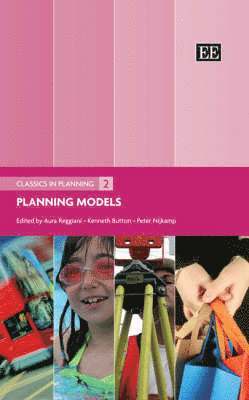
    Planning Models

    AvAura Reggiani,Kenneth Button

    Inbunden, Engelska, 2006

    Del 2 i serien Classics in Planning series

    4 699 kr

    Beställningsvara. Skickas inom 5-8 vardagar. Fri frakt över 249 kr.

    Beskrivning

    While planning involves seeking ways of influencing future behavior, it is important to have at the outset an abstraction of the world upon which to base an assessment of outcomes. The papers in this collection represent some of the major works in the field of planning models, with land use planning as a core theme. The collection is divided into several parts:Part 1 focuses on location models and embraces a series of classic survey papers as well as a number of more specific contributions covering such topics as the distribution of residential activities. This is followed in part 2 by papers concerned with spatial interaction and, in particular the gravity model. Part 3 of the collection contains papers on micro-macro models that look at ways of moving from individual to collective behavior, whilst part 4 is concerned with dynamic models. Part 5 of the volume reflects an increasing interest in the role of various networks in the formulation of plans, and finally part 6 completes the volume with a selection of policy-planning models.

    Produktinformation

    • Utgivningsdatum:2006-10-27
    • Mått:169 x 244 x undefined mm
    • Format:Inbunden
    • Språk:Engelska
    • Serie:Classics in Planning series
    • Förlag:Edward Elgar Publishing Ltd
    • ISBN:9781845420222

    Utforska kategorier

    • Miljövetenskap och miljöpolitik inom Naturvetenskap och teknik
    • Regional planering inom Naturvetenskap och teknik

    Mer om författaren

    Edited by Aura Reggiani, Professor of Economic Policy, University of Bologna, Italy, Kenneth Button, University Professor, Schar School of Policy and Government, George Mason University, US and Peter Nijkamp, Professor Emeritus, Vrije Universiteit Amsterdam, the Netherlands, the Centre for European Studies, Universitatea Alexandru Ioan Cuza din Iasi, Romania and the School of Public Policy and Management, Tsinghua University, China

    Recensioner i media

    'This book deftly mixes acknowledged classics with new and important work to provide a balanced portrayal of the ways in which modelling has both informed and redefined the practices of planning. It is the indispensable guide to this indispensable area.'

    Innehållsförteckning

    • Contents:AcknowledgementsSeries Preface Kenneth Button and Peter NijkampIntroduction Planning Models: Scoping the Scene Aura Reggiani, Kenneth Button and Peter NijkampPART ILOCATION MODELS 1. John D. Herbert and Benjamin H. Stevens (1960), ‘A Model of the Distribution of Residential Activity in Urban Areas’2. Douglass B. Lee, Jr (1973), ‘Requiem for Large-scale Models’3. John Roy, Börje Johansson and Giorgio Leonardi (1985), ‘Some Spatial Equilibria in Facility Investment under Uncertain Demand’4. Britton Harris (1985), ‘Urban Simulation Models in Regional Science’5. Michael Wegener (1994), ‘Operational Urban Models: State of the Art’6. M.E. O’Kelly (2004), ‘Isard’s Contribution to Spatial Interaction Modelling’PART IISPATIAL INTERACTION MODELS 7. Peter Nijkamp (1975), ‘Reflections on Gravity and Entropy Models’8. Eric S. Sheppard (1978), ‘Theoretical Underpinnings of the Gravity Hypothesis’9. Ashish Sen and Siim Sööt (1981), ‘Selected Procedures for Calibrating the Generalized Gravity Model’10. A. Stewart Fotheringham and Tony Dignan (1984), ‘Futher Contributions to a General Theory of Movement’11. John R. Roy and Jean-Claude Thill (2004), ‘Spatial Interaction Modelling’PART IIIMICRO-MACRO MODELS 12. Daniel McFadden and Fred Reid (1975), ‘Aggregate Travel Demand Forecasting from Disaggregated Behavioral Models’13. Andre De Palma and Claude Lefevre (1983), ‘Individual Decision-Making in Dynamic Collective Systems’14. Günter Haag and Wolfgang Weidlich (1984), ‘A Stochastic Theory of Interregional Migration’15. Manfred M. Fischer (1985), ‘Changing Modes of Reasoning in Spatial Choice Analysis’16. Peter Nijkamp and Aura Reggiani (1988), ‘Entropy, Spatial Interaction Models and Discrete Choice Analysis: Static and Dynamic Analogies’17. Bryan Raney, Nurhan Cetin, Andreas Völlmy, Milenko Vrtic, Kay Axhausen and Kai Nagel (2003), ‘An Agent-Based Microsimulation Model of Swiss Travel: First Results’PART IVDYNAMIC MODELS 18. P.M. Allen and M. Sanglier (1981), ‘A Dynamic Model of a Central Place System – II’19. Demitrios S. Dendrinos and Michael Sonis (1986), ‘Variational Principles and Conservation Conditions in Volterra’s Ecology and in Relative Urban Relative Dynamics’20. Michael Batty and Paul A. Longley (1987), ‘Urban Shapes as Fractals’21. Peter Nijkamp and Aura Reggiani (1995), ‘Non-linear Evolution of Dynamic Spatial Systems: The Relevance of Chaos and Ecologically-based Models’22. Jean-Claude Thill and Aaron K. Wheeler (1995), ‘On Chaos, Continuous-Time and Discrete-Time Models of Spatial Systems Dynamics’23. Kieran P. Donaghy (2002), ‘The “Green Book” Twenty Years On: A New Look at the Research Program of Isard and Liossatos “Spatial Dynamics and Optimal Space-Time Development”’PART VNETWORK MODELS 24. Roberto Camagni, Lidia Diappi and Giorgio Leonardi (1986), ‘Urban Growth and Decline in a Hierarchical System: A Supply-orientated Dynamic Approach’25. Paul Krugman (1994), ‘Complex Landscapes in Economic Geography’26. John R. Roy (1999), ‘Areas, Nodes and Networks: Some Analytical Considerations’27. Albert-László Barabási and Réka Albert (1999), ‘Emergence of Scaling in Random Networks’28. Manfred M. Fischer, Martin Reismann and Katerina Hlavackova-Schindler (2003), ‘Neural Network Modeling of Constrained Spatial Interaction Flows: Design, Estimation and Performance Issues’PART VIPOLICY-PLANNING MODELS 29. P. Nijkamp and P. Rietveld (1976), ‘Multiobjective Programming Models: New Ways in Regional Decision-Making’30. Folke Snickars and Jörgen W. Weibull (1977), ‘A Minimum Information Principle: Theory and Practice’31. Tschangho John Kim, David E. Boyce and Geoffrey J.D. Hewings (1983), ‘Combined Input-Output and Commodity Flow Models for Interregional Development Planning: Insights from a Korean Application’32. Sergio J. Rey (2000), ‘Integrated Regional Econometric+Input-Output Modeling: Issues and Opportunities’Name Index