• Fri frakt över 249 kr
  • •
  • Snabba leveranser
  • •
  • Billiga böcker
Kundservice

Du är på sajten för privatpersoner.

Företag, bibliotek eller offentlig verksamhet?

Du handlar på classic.bokus.com, där alla dina funktioner finns intakta.
Till classic.bokus.com
Bokus logotyp. Gå till startsidan.
  • Erbjudanden
  • Nyheter
  • Student
  • Topplistor
  • Barn & ungdom
  • Bokus Play
  • E-böcker
  • Pocketböcker
  • Spel & pussel

10% rabatt på allt med kod: NYSTART10 →

Sidfot

Mina sidor

    Hjälp

    • Kundservice
    • Vanliga frågor och svar
    • Frakt och leverans
    • Retur vid ångerrätt
    • Reklamera vara
    • Betalning
    • Köpvillkor
    • Allmänna villkor
    • Information om webbplatsens tillgänglighet

    Om Bokus

    • Om oss
    • Pressrum
    • För studenter
    • För företag
    • För bibliotek och offentlig verksamhet
    • För leverantörer
    • Hållbarhet

    Populärt

    • Aktuella erbjudanden
    • Presentkort
    • Studentlitteratur
    • Nya böcker
    • Topplistor
    • Signerade böcker
    • Engelska böcker

    Inspiration

    • Boktips
    • BookTok
    • Populära bokserier
    • Barnbokskaraktärer
    • Populära författare
    Logotyp för Bokus
    Följ oss på Facebook (extern länk)Följ oss på Instagram (extern länk)Följ oss på YouTube (extern länk)Följ oss på TikTok (extern länk)
    bokus @ CookiesAnpassa cookiesIntegritetspolicyKöpvillkor
    Till Citymail hemsida (extern länk)Till Budbee hemsida (extern länk)Till Postnord hemsida (extern länk)Till Schenker hemsida (extern länk)Till Early Bird hemsida (extern länk)Till Walleys hemsida (extern länk)
    1. Historia och arkeologi
    2. Historia
    3. Europas historia

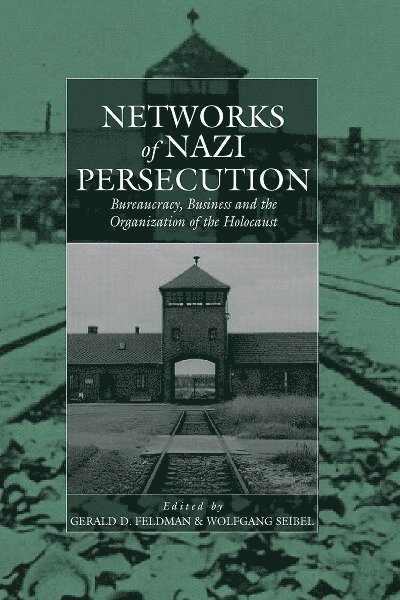
    Networks of Nazi Persecution

    Business, Bureaucracy and the Organization of the Holocaust

    AvGerald D. Feldman,Wolfgang Seibel

    Häftad, Engelska, 2006

    Del i serien War and Genocide

    599 kr

    Beställningsvara. Skickas inom 5-8 vardagar. Fri frakt över 249 kr.

    Beskrivning

    The persecution and mass-murder of the Jews during World War II would not have been possible without the modern organization of division of labor. Moreover, the perpetrators were dependent on human and organizational resources they could not always control by hierarchy and coercion. Instead, the persecution of the Jews was based, to a large extent, on a web of inter-organizational relations encompassing a broad variety of non-hierarchical cooperation as well as rivalry and competition. Based on newly accessible government and corporate archives, this volume combines fresh evidence with an interpretation of the governance of persecution, presented by prominent historians and social scientists. Gerald D. Feldman is Professor of History and Director of the Institute of European Studies at the University of California, Berkeley. His special fields of interest are 20th-century German history, and he has a special interest in business history, most recently authoring a biography of Hugo Stinnes, participating in the history of the Deutsche Bank, and writing a history of the Allianz Insurance Company in the Nazi period.He has recently started work on a history of the Austrian banks under National Socialism. Wolfgang Seibel is Professor of Political Science at the University of Konstanz, Germany. Previous appointments include guest professorships at the Institute for Advanced Study, Vienna (1992), and the University of California at Berkeley (1994). He was also a temporary member of the School of Social Science (1989/90) and of the School of Historical Studies (2003) of the Institute of Advanced Study, Princeton. Currently (2004/2005) he is a fellow of the Wissenschaftskolleg zu Berlin. His research is mainly devoted to issues of politics, public bureaucracy and non-governmental organizations.

    Produktinformation

    • Utgivningsdatum:2006-01-31
    • Mått:152 x 229 x 20 mm
    • Vikt:524 g
    • Format:Häftad
    • Språk:Engelska
    • Serie:War and Genocide
    • Antal sidor:392
    • Förlag:Berghahn Books
    • ISBN:9781845451639

    Utforska kategorier

    • Europas historia inom Historia och arkeologi
    • Andra världskriget inom Historia och arkeologi
    • Politiskt förtryck inom Samhälle och politik

    Mer om författaren

    Gerald D. Feldman is Professor of History and Director of the Institute of European Studies at the University of California, Berkeley. His special fields of interest are 20th-century German history, and he has a special interest in business history, most recently authoring a biography of Hugo Stinnes, participating in the history of the Deutsche Bank, and writing a history of the Allianz Insurance Company in the Nazi period. He has recently started work on a history of the Austrian banks under National Socialism. Wolfgang Seibel is Professor of Political Science at the University of Konstanz, Germany. Previous appointments include guest professorships at the Institute for Advanced Study, Vienna (1992), and the University of California at Berkeley (1994). He was also a temporary member of the School of Social Science (1989/90) and of the School of Historical Studies (2003) of the Institute of Advanced Study, Princeton. Currently (2004/2005) he is a fellow of the Wissenschaftskolleg zu Berlin. His research is mainly devoted to issues of politics, public bureaucracy and non-governmental organizations.

    Recensioner i media

    "The Berghahn series Studies on War and Genocide, in which this collection appears, has immeasurably enriched the English language scholarship available to scholars and students of genocide and, in particular, the Holocaust. This particular collection is no exception, and is another excellent, if contentious, addition to and summary of contemporary Holocaust scholarship.This is then a valuable collection that confirms some of the accepted ideas of Holocaust historiography, while also revising others. It will give access for the first time to many students and scholars to some perspectives not previously available in the English language. The diversity of those perspectives is testament to the vigour of contemporary Holocaust scholarship."—Totalitarian Movements and Political Religions.

    Innehållsförteckning

    • List of FiguresList of AbbreviationsIntroduction: The Holocaust as Division-of-Labor-Based Crime—Evidence and Analytical ChallengesGerald D. Feldman and Wolfgang SeibelPART I: RIVALRY AND COMPETITIONChapter 1. Introduction to Rivalry and CompetitionChristian GerlachChapter 2. The SS Security Service and the Gestapo in the National Socialist Persecution of the Jews 1933–1939Wolfgang DierkerChapter 3. “Aryanization” and the Role of the German Banks, 1933–1938Dieter ZieglerChapter 4. The Looting of Jewish Property and Franco-German Rivalry, 1940–1944Philippe VerheydeChapter 5. Seizure of Jewish Property and Inter-Agency Rivalry in the Reich and in the Occupied Soviet TerritoriesMartin C. DeanChapter 6. The Polycratic Nature of Art Looting: The Dynamic Balance of the Third ReichJonathan PetropoulosChapter 7. The Holocaust and CorruptionFrank BajohrPart II: "SMOOTH COOPERATION"Chapter 8. Introduction to “Smooth Cooperation”Gerhard Hirschfeld and Wolfgang SeibelChapter 9. The Looting of Jewish Property and the German Financial AdministrationAlfons KenkmannChapter 10. Organized Looting: The Nazi Seizure of Jewish Property in the Netherlands, 1940–1945Gerard AaldersChapter 11. Perpetrator Networks and the Holocaust. The Spoliation of Jewish Property in France, 1940–1944Marc Olivier BaruchChapter 12. "Ethnic Resettlement" and Inter-Agency Cooperation in the Occupied Eastern TerritoriesIsabel HeinemannChapter 13. Der "reibungslose" Holocaust? The German Military and Civilian Implementation of the "Final Solution" in Ukraine, 1941–1944Wendy LowerPART III: DECENTRAL INITIATIVE AND VERTICAL INTEGRATIONChapter 14. A Bureaucratic Holocaust: Toward a New ConsensusMicheal Thad AllenChapter 15. Local Initiatives, Central Coordination: German Municipal Administration and the HolocaustWolf GrunerChapter 16. The Reichskristallnacht and the Insurance Industry: The Politics of Damage ControlGerald D. FeldmanPART IV: "STRUCTURE", "AGENCY", AND THE LOGIC OF RADICALIZATIONChapter 17. More than Just a Metaphor: the Network Concept and Its Potential in Holocaust ResearchJörg RaabChapter 18. Restraining or Radicalizing? Division of Labor and Persecution EffectivenessWolfgang SeibelNotes on ContributorsIndex