• Fri frakt över 249 kr
  • •
  • Snabba leveranser
  • •
  • Billiga böcker
Kundservice

Du är på sajten för privatpersoner.

Företag, bibliotek eller offentlig verksamhet?

Du handlar på classic.bokus.com, där alla dina funktioner finns intakta.
Till classic.bokus.com
Bokus logotyp. Gå till startsidan.
  • Erbjudanden
  • Student
  • Topplistor
  • Barn & ungdom
  • Bokus Play
  • E-böcker
  • Ljudböcker
  • Pocketböcker
  • Spel och pussel

5% studentrabatt – använd koden KURSBOK27 →

Sidfot

Mina sidor

    Hjälp

    • Kundservice
    • Vanliga frågor och svar
    • Frakt och leverans
    • Retur vid ångerrätt
    • Reklamera vara
    • Betalning
    • Köpvillkor
    • Allmänna villkor
    • Information om webbplatsens tillgänglighet

    Om Bokus

    • Om oss
    • Pressrum
    • För studenter
    • För företag
    • För bibliotek och offentlig verksamhet
    • För leverantörer
    • Hållbarhet

    Populärt

    • Aktuella erbjudanden
    • Presentkort
    • Studentlitteratur
    • Nya böcker
    • Topplistor
    • Signerade böcker
    • Engelska böcker

    Inspiration

    • Boktips
    • BookTok
    • Barnbokskaraktärer
    • Populära författare
    Logotyp för Bokus
    Följ oss på Facebook (extern länk)Följ oss på Instagram (extern länk)Följ oss på YouTube (extern länk)Följ oss på TikTok (extern länk)
    bokus @ CookiesAnpassa cookiesIntegritetspolicyKöpvillkor
    Till Citymail hemsida (extern länk)Till Budbee hemsida (extern länk)Till Postnord hemsida (extern länk)Till Schenker hemsida (extern länk)Till Early Bird hemsida (extern länk)Till Walleys hemsida (extern länk)
    1. Historia och arkeologi
    2. Historia
    3. Europas historia

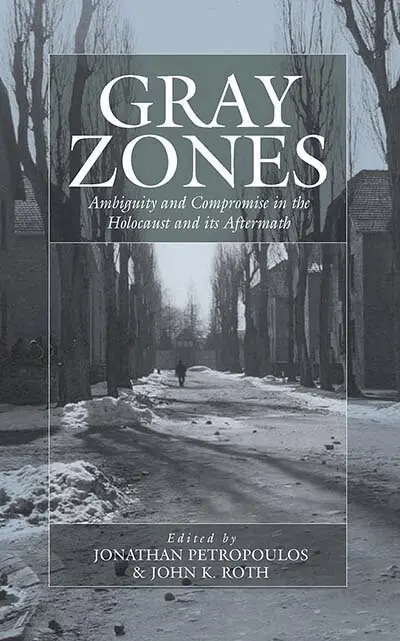
    Gray Zones

    Ambiguity and Compromise in the Holocaust and its Aftermath

    AvJonathan Petropoulos,John Roth

    Häftad, Engelska, 2006

    Del i serien War and Genocide

    648 kr

    Beställningsvara. Skickas inom 3-6 vardagar. Fri frakt över 249 kr.

    Beskrivning

    Few essays about the Holocaust are better known or more important than Primo Levi’s reflections on what he called “the gray zone,” a reality in which moral ambiguity and compromise were pronounced. In this volume accomplished Holocaust scholars, among them Raul Hilberg, Gerhard L. Weinberg, Christopher Browning, Peter Hayes, and Lynn Rapaport, explore the terrain that Levi identified. Together they bring a necessary interdisciplinary focus to bear on timely and often controversial topics in cutting-edge Holocaust studies that range from historical analysis to popular culture. While each essay utilizes a particular methodology and argues for its own thesis, the volume as a whole advances the claim that the more we learn about the Holocaust, the more complex that event turns out to be. Only if ambiguities and compromises in the Holocaust and its aftermath are identified, explored, and at times allowed to remain--lest resolution deceive us--will our awareness of the Holocaust and its implications be as full as possible.

    Produktinformation

    • Utgivningsdatum:2006-10-01
    • Mått:152 x 229 x 24 mm
    • Vikt:585 g
    • Format:Häftad
    • Språk:Engelska
    • Serie:War and Genocide
    • Antal sidor:440
    • Förlag:Berghahn Books
    • ISBN:9781845453022

    Utforska kategorier

    • Europas historia inom Historia och arkeologi
    • Andra världskriget inom Historia och arkeologi
    • Filosofiska discipliner inom Filosofi och religion

    Mer om författaren

    Jonathan Petropoulos is the John V. Croul Professor of European History and Director of the Gould Center for Humanistic Studies, at Claremont McKenna College.

    Recensioner i media

    "...a useful addition to Holocaust historiography and literature. It is accessible for students and teachers as well as the general reader. It provides a taste of what the world of Holocaust scholarship is actively engaged in--the constant exploration and understanding of the history of the murder of the Jews of Europe and the ongoing effect of these events on the world today. Hopefully, this book will stimulate others to read further and deeper."   · H-German

    Innehållsförteckning

    • List of FiguresList of AbbreviationsPrologue: The Gray Zones of the HolocaustJonathan Petropoulos and John K. RothPart I: Ambiguity and Compromise in Writing and Depicting Holocaust HistoryIntroductionChapter 1. The Ambiguities of Evil and Justice: Degussa, Robert Pross, and the Jewish Slave Laborers at GleiwitzPeter HayesChapter 2. “Alleviation” and “Compliance”: The Survival Strategies of the Jewish Leadership in the Wierzbnik Ghetto and the Starachowice Factory Slave Labor CampsChristopher R. BrowningChapter 3. Between Sanity and Insanity: Spheres of Everyday Life in the Auschwitz-Birkenau SonderkommandoGideon GreifChapter 4. Sonderkommando: Testimony from EvidenceMichael BerenbaumChapter 5. A Commentary on “Gray Zones” in Raul Hilberg’s WorkGerhard L. WeinbergChapter 6. Incompleteness in Holocaust HistoriographyRaul HilbergPart II: Identity, Gender, and Sexuality During and After the Third ReichIntroductionChapter 7. Choiceless Choices: Surviving on False Papers on the “Aryan” SideRobert MelsonChapter 8. “Who Am I?” The Struggle for Religious Identity of Jewish Children Hidden by Christians During the ShoahEva FleischnerChapter 9. Hitler’s Jewish SoldiersBryan Mark RiggChapter 10. A Gray Zone Among the Field Gray Men: Confusion in the Discrimination Against Homosexuals in the WehrmachtGeoffrey J. GilesChapter 11. Pleasure and Evil: Christianity and the Sexualization of Holocaust MemoryDagmar HerzogChapter 12. The Gender of Good and Evil: Women and Holocaust MemorySara R. HorowitzPart III: Gray Spaces: Geographical and Imaginative LandscapesIntroductionChapter 13. Hitler’s “Garden of Eden” in Ukraine: Nazi Colonialism, Volksdeutsche, and the Holocaust, 1941–1944Wendy LowerChapter 14. Life and Death in the “Gray Zone” of Jewish Ghettos in Nazi-Occupied Europe: The Unknown, the Ambiguous, and the DisappearedMartin DeanChapter 15. “Almost-Camps” in Paris: The Difficult Description of Three Annexes of Drancy—Austerlitz, Lévitan, and Bassano, July 1943 to August 1944Jean-Marc DreyfusChapter 16. Alternate Holocausts and the Mistrust of MemoryGavriel D. RosenfeldChapter 17. Laughter and Heartache: The Functions of Humor in Holocaust TragedyLynn RapaportChapter 18. The Holocaust in Popular Culture: Master-Narrative and Counter-Narratives in the Gray ZoneRonald SmelserChapter 19. The Grey Zone: The Cinema of Choiceless ChoicesLawrence BaronPart IV: Justice, Religion, and Ethics During and After the HolocaustIntroductionChapter 20. Gray into Black: The Case of Mordecai Chaim RumkowskiRichard L. RubensteinChapter 21. Catalyzing Fascism: Academic Science in National Socialist Germany and AfterwardJeffrey LewisChapter 22. Postwar Justice and the Treatment of Nazi AssetsJonathan PetropoulosChapter 23. The Gray Zones of Holocaust Restitution: American Justice and Holocaust MoralityMichael J. BazylerChapter 24. The Creation of Ethical “Gray Zones” in the German Protestant Church: Reflections on the Historical Quest for Ethical ClarityVictoria J. BarnettChapter 25. Gray-Zoned Ethics: Morality’s Double Binds During and After the HolocaustJohn K. RothEpilogue: An Intense Wish to UnderstandJonathan Petropoulos and John K. RothSelect BibliographyAbout the Editors and ContributorsIndex