• Fri frakt över 249 kr
  • •
  • Snabba leveranser
  • •
  • Billiga böcker
Kundservice

Du är på sajten för privatpersoner.

Företag, bibliotek eller offentlig verksamhet?

Du handlar på classic.bokus.com, där alla dina funktioner finns intakta.
Till classic.bokus.com
Bokus logotyp. Gå till startsidan.
  • Erbjudanden
  • Nyheter
  • Student
  • Topplistor
  • Barn & ungdom
  • Bokus Play
  • E-böcker
  • Pocketböcker
  • Spel & pussel

10% rabatt på allt med kod: NYSTART10 →

Sidfot

Mina sidor

    Hjälp

    • Kundservice
    • Vanliga frågor och svar
    • Frakt och leverans
    • Retur vid ångerrätt
    • Reklamera vara
    • Betalning
    • Köpvillkor
    • Allmänna villkor
    • Information om webbplatsens tillgänglighet

    Om Bokus

    • Om oss
    • Pressrum
    • För studenter
    • För företag
    • För bibliotek och offentlig verksamhet
    • För leverantörer
    • Hållbarhet

    Populärt

    • Aktuella erbjudanden
    • Presentkort
    • Studentlitteratur
    • Nya böcker
    • Topplistor
    • Signerade böcker
    • Engelska böcker

    Inspiration

    • Boktips
    • BookTok
    • Populära bokserier
    • Barnbokskaraktärer
    • Populära författare
    Logotyp för Bokus
    Följ oss på Facebook (extern länk)Följ oss på Instagram (extern länk)Följ oss på YouTube (extern länk)Följ oss på TikTok (extern länk)
    bokus @ CookiesAnpassa cookiesIntegritetspolicyKöpvillkor
    Till Citymail hemsida (extern länk)Till Budbee hemsida (extern länk)Till Postnord hemsida (extern länk)Till Schenker hemsida (extern länk)Till Early Bird hemsida (extern länk)Till Walleys hemsida (extern länk)
    1. Psykologi och pedagogik
    2. Psykologi

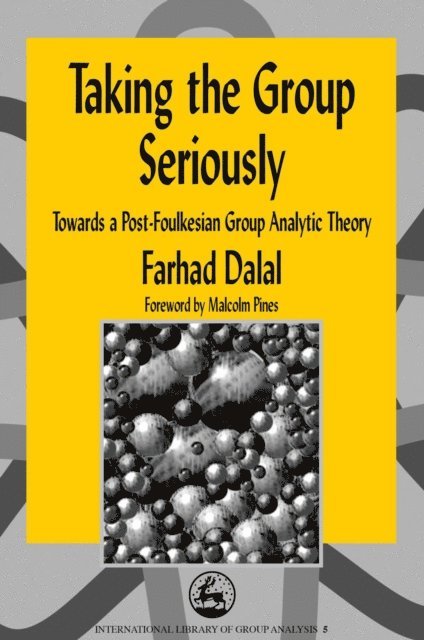
    Taking the Group Seriously

    Towards a Post-Foulkesian Group Analytic Theory

    AvFarhad Dalal

    E-bok
    Engelska, 1998

    Del i serien International Library of Group Analysis

    602 kr

    Läs direkt i Bokus Reader – eller ladda ned till din enhet

    Fler format och utgåvor

    Häftad

    620 kr

    Beskrivning

    In this critique and extension of the work of S.H.Foulkes, Farhad Dalal presents a thorough contemporary appraisal of the theory of group analysis and its relevance to psychoanalysis as a whole. The author argues that Foulkes failed to develop a specific set of group concepts, relying instead on the traditional individualistic framework of Freud. The book explores why Foulkes failed to escape from the orthodox mother-infant paradigm and offers a new post-Foulkesian interpretation of group analytic theory.Taking the Group Seriously is divided into six parts which trace the history of ideas behind group work, and draws on a wide range of subjects to support its thesis: not only psychoanalysis and group analysis, but also sociology, biology, chaos theory, genetics, economics, game theory and discourse theory. Using the author's practical group experience and including the latest ideas on the subject, this volume will be of interest to all those working in the field of psychoanalysis.

    Produktinformation

    • Utgivningsdatum:1998-08-01
    • Språk:Engelska
    • Filformat:EPUB
    • Kopieringsskydd:LCP
    • ISBN:9781846422249
    • Förlag:Jessica Kingsley Publishers
    • Serie:International Library of Group Analysis

    Utforska kategorier

    • Psykologi inom Psykologi och pedagogik
    • Biologisk psykologi och neuropsykologi inom Psykologi och pedagogik
    • Medicin: allmänt inom Medicin

    Mer om författaren

    Farhad Dalal is training group analyst and supervisor for the Institute of Group Analysis, London. He is in private practice as a psychotherapist and group analyst, and is a member of the North East London Psychotherapy and Counselling Association and the Group Analytic Network

    Recensioner i media

    This book sets out to think about the development of the scientific understanding of the analytic group. The book is broken into six chapters, Freud Foulkes, The interlude between Foulkes and Elias, the sociologist, Biology, and it concludes with a chapter on the Elements of a Post-Foulkian Group Analytic Theory...It is both energetic, meticulous, restless, scrutinising, sometimes under a microscope, hungry for knowledge and re-evaluative.

    Innehållsförteckning

    • Part I: Freud. 1. Introduction: 2. Freud: Culturalist or Nativist? 3. Freud: Idealist or Materialist? 4. The Freudian Infant. 5.The Development of Psychological Structures 6. Phylogeny. 7. In and Between Groups. 8. The Freudian View of Groups. 9. Summary. Part II: Foulkes. 10. Introduction. 11.The Basis of Foulkes' Radical Ideas. 12. Foulkes' Developmental Model. 13. Modifying the Freudian Developmental Frame. 14. Modifying the Freudian Developmental Frame. 15. Between the Internal and the External. 16. Recasting the Life and Death Instincts. 17. Three Group-Specific Ideas. 18. The Matrix. 17. A Summary of the Ideas of Radical Foulkes. 18. Application of the Theories. 19. Hostility and Aggression. 20. Summary. Part III: Interlude between Foulkes and Elias. 21. Interlude Figuring out the Ground. 22. An Overview of Structuralism and Post-Structuralism. Part IV: Elias. 23. Introduction. 24. Figuration. 25. Power Relations I. 26. Symbol Theory. 27. A Bird's Eye View. 28. Power Relations II. 29. The Preservation of Power Differentials. Part V: Biology. 30.Introduction. 31. Hot Air and Desire. 32. Order and Chaos. 33. The Co-operative Gene. 34. The Evolution of Culture. 35. The Return of Group Selection. 36. Free Will and Determinism (again) 37. Summary. Part VI: Elements of a Post-Foulkesian Group Analytic Theory. 38. Introduction. 39. Belonging. 40. Overview of Matte-Blanco's Theory. 41. The Structure of Thought. 42. A Digression. 43. Increasing the Complexities of Belonging. 44. A Partial Summary. 45. Identity Crisis. 46. The Emotional Need to Belong. 47. From Here to Infinity: Further Strucures of Thinking. 48. Name-Calling and Hair-Splitting. 49. A Reprise. 50. A Reformation of the Notion of Identity. 51. Mind the Gap. 52. Conflict. 53. Power Relations in action. 54. The Social Unconscious. 55. Cultural Transmission and Cohesion. 56. The Therapy Group. 57. Constraint and Order. Index.