• Fri frakt över 249 kr
  • •
  • Snabba leveranser
  • •
  • Billiga böcker
Kundservice

Du är på sajten för privatpersoner.

Företag, bibliotek eller offentlig verksamhet?

Du handlar på classic.bokus.com, där alla dina funktioner finns intakta.
Till classic.bokus.com
Bokus logotyp. Gå till startsidan.
  • Erbjudanden
  • Nyheter
  • Student
  • Topplistor
  • Barn & ungdom
  • Bokus Play
  • E-böcker
  • Pocketböcker
  • Spel & pussel

10% rabatt på allt med kod: NYSTART10 →

Sidfot

Mina sidor

    Hjälp

    • Kundservice
    • Vanliga frågor och svar
    • Frakt och leverans
    • Retur vid ångerrätt
    • Reklamera vara
    • Betalning
    • Köpvillkor
    • Allmänna villkor
    • Information om webbplatsens tillgänglighet

    Om Bokus

    • Om oss
    • Pressrum
    • För studenter
    • För företag
    • För bibliotek och offentlig verksamhet
    • För leverantörer
    • Hållbarhet

    Populärt

    • Aktuella erbjudanden
    • Presentkort
    • Studentlitteratur
    • Nya böcker
    • Topplistor
    • Signerade böcker
    • Engelska böcker

    Inspiration

    • Boktips
    • BookTok
    • Populära bokserier
    • Barnbokskaraktärer
    • Populära författare
    Logotyp för Bokus
    Följ oss på Facebook (extern länk)Följ oss på Instagram (extern länk)Följ oss på YouTube (extern länk)Följ oss på TikTok (extern länk)
    bokus @ CookiesAnpassa cookiesIntegritetspolicyKöpvillkor
    Till Citymail hemsida (extern länk)Till Budbee hemsida (extern länk)Till Postnord hemsida (extern länk)Till Schenker hemsida (extern länk)Till Early Bird hemsida (extern länk)Till Walleys hemsida (extern länk)
    1. Psykologi och pedagogik
    2. Pedagogik
    3. Specialundervisning

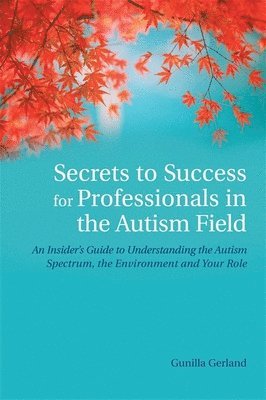
    Secrets to Success for Professionals in the Autism Field

    An Insider's Guide to Understanding the Autism Spectrum, the Environment and Your Role

    AvGunilla Gerland

    Häftad, Engelska, 2012

    472 kr

    Skickas . Fri frakt över 249 kr.

    Fler format och utgåvor

    E-bok

    506 kr

    Beskrivning

    Gunilla Gerland's extensive experience of the autism spectrum means she is expertly placed to offer a fresh perspective on working with autism as well as a wealth of effective tools and interventions to use in practice. In a highly readable style, with many inspiring examples, this book offers original explanations of the impairments associated with autism, showing how to discover the root cause of behaviours that are challenging, not just how to manage them superficially. It looks objectively and non-judgementally at the common pitfalls and difficulties that autism professionals may encounter, explaining how to deal with these and transition to more effective working relationships. An important section on ethics and reflection equips the reader with the knowledge and skills needed to grow professionally in the field. Packed with original insights and practical, hands-on tools and strategies, this is essential reading for teachers, teaching assistants, support workers, counsellors, social workers and anyone else working with individuals of any age on the autism spectrum.

    Produktinformation

    • Utgivningsdatum:2012-12-15
    • Mått:152 x 228 x 22 mm
    • Vikt:555 g
    • Format:Häftad
    • Språk:Engelska
    • Antal sidor:384
    • Förlag:Jessica Kingsley Publishers
    • ISBN:9781849053709

    Utforska kategorier

    • Specialundervisning inom Psykologi och pedagogik

    Mer om författaren

    Gunilla Gerland was diagnosed with Asperger syndrome several years ago. She has more than 15 years' experience in the autism field, working as a counsellor, supervisor and educator. She is well-known internationally for her autobiography A Real Person: Life on the Outside, and is very active in informing people about autism, through writing and lecturing all over Europe. She lives in Stockholm, where she also works closely with the Swedish National Autism Society. She is the author of Finding Out About Asperger Syndrome, High-Functioning Autism and PDD, also published by JKP.

    Recensioner i media

    The sections on empathy, ethics, moral competence and reflection are particularly informative. Entertaining and inspiring anecdotes to entertain, amuse, educate and inform are scattered throughout this book. I give it a ringing endorsement.

    Innehållsförteckning

    • 1. Helping the Helper Help. A preface of sorts: about me, why and for whom. Section I: The Professional Role...which deals with interactions and reflects on professionalism. 2. The Framework and Ideologies - a chapter on how it can be a constructive action to smash a window. 3. Same Same but Different - a chapter for everyone but especially for those who have previously worked in psychosocial treatment settings. 4. Just doing your job or being a true professional? A chapter with some thoughts about what professionalism could mean. 4.1. Awareness, Development and Change. 4.2. Making right and doing wrong. 4.3 Empathy, ethics and moral competence. 4.4. Some ideas. 5. Remove the cake even if you don't think it's ready: Common pitfalls for staff - A chapter on things you would rather avoid. 5.1. Pitfall 1 and 2: Falling into another role (than the professional) - "Parent" or "Buddy". 5.2. Pitfall 3: That's the way he wants it! 5.3. Pitfall 4: Prohibit or allow - this is not the question! 5.4. Pitfall 5: Steering the will of others. 5.5. Pitfall 6: Excessive empathy. 5.6. Pitfall 7: Lack of empathy. 5.7. Pitfall 8: Universal truths. 5.8. Pitfall 9: "We know this". 5.9. Pitfall 10: More normal than normal. 5.10. Pitfall 11: The gender trap? 5.11. Pitfall 12: Good aids that no one uses. 5.12. Pitfall 13: "What if everybody...?" 5.13. Pitfall 14: Other children will never accept... 5.14. Pitfall 15: Normality produces quality of life. Section II: Understanding the Impairments...which deals with the symptoms we often see and what may cause them. 6. "You never know if orange juice will taste like orange juice." A chapter on sensory processing issues. 6.1. The visual perception. 6.2. The tactile perception. 6.3. The auditory perception. 6.4. The olfactory sense. 6.5. The sense of taste. 6.6. Balance. 6.7. Proprioception - "Muscle and joint sense". 6.8. Interoceptive senses. 6.9. Synaesthesia. 6.10. Sensory integration problems. 6.11. Desensitization (Habituation). 6.12. Different is not always a problem. 6.13. How do we know, what do we do? 7. The man with two left feet - a chapter on motor skills. 7.1. Motor automization. 7.2 Other motor difficulties. 7.3. Practical implications. 8. One person may be of many ages. - a chapter on the development perspective. 8.1. Mentalization in practice. 9. Say what you mean and mean what you say - a chapter on communication. 9.1. Language comprehension poorer than verbal expression. 9.2. Echolalia. 9.3. Truths, lies and subtext. 9.4. To announce your actions. 9.5. Literal language comprehension. 9.6. Lack of "auto correction". 9.7 "Attitude". 9.8. Restorative Communication. 9.9. Repetitive communication. 10. Living without a spare gas can - a chapter on energy and stress. 10.1. The drop excavates the stone (and the straw that broke the camel's back). 10.2. Stress and stress management. 10.3. Sleep. 10.4. Time Perception. 11. I don't give a damn about the chores! A chapter on cognition. 11.1. Executive functions. 11.2. Working memory. 11.3. Categorization. 12. The short and boring chapter - a chapter on definitions, incidence and other things you may want to know, but which are of little help little in practice. 12.1. Definition. 12.2. Incidence. 12.3. Causes. 12.4. Criteria. 12.5. Work-up. Section III: The Change Process...which is an important element of the craftsmanship. 13. Can we make a deaf person hear better by setting limits? A chapter on punishment of "violations", and consequences of action. 13.1. Ch-ch-ch-ch-changes. 13.2. Truth and Consequence. 13.3. Making the professional "environmental friendly". 13.4. Avoid a financial crisis on the trust account. 13.5. The development of mature strategies - how does it come about? 14. CRAP - a chapter with thoughts on the use of Confirmations or Rewards, the idea of being Affirmative, and why Punishments do not work. 14.1. Attribution. 14.2. Penalty marking is banned! 14.3. A/C - Affirm and Confirm. 15. Diving lessons in the ocean - a chapter on how to make assessments and analyses. 15.1. Assessment. 15.2. Analysis and hypothesis. 15.3. Intervention plan. 15.4. Evaluation. 15.5. Documentation. 15.6. Troubleshooting or "HELP - it does not work!" 15.7. Finally, about assessments. 16. An underwater guide - a chapter on common contributing factors in challenging behaviours. 16.1. Self-esteem. 16.2. Ability to envision/imagine. 16.3. Developmental perspective and Theory of Mind (mentalization). 16.4. Communication. 16.5. There and then, here and now: When someone fights or injures himself. 17. The danger of focusing on the behaviour itself - a chapter about what could happen if you do not learn to dive. Section IV: Practical Intervention. 18. The toolbox - an introduction to the tools. 19. Not having to learn to be "as others" - a chapter on adjustments. 20. Inform more - and well! A chapter on how we can work with information as a tool. 20.1. The individual - "I do not have any bloody autism!" 21. Written, drawn and other visual aids - an important chapter on matters that too many get too little of! 21.1. Choices and ability to envision. 21.2. Informed choices. 21.3. Stress, overview and time. 21.4. TEACCH. 21.5. Social stories and comic strip conversations. 21.6. Nag-free information. 21.7. The time model. 21.8. Five point scale. 21.9. The Clothes-according-to-temperature-thermometer. 22. Talk, gab and babble, and a little about how to play - a chapter on how to use conversation as a tool. 22.1. Conversations for "landing". 22.2. Solution-focused conversations. 22.3. Furnishing. 22.4. Conversations in group. 22.5. Younger children: play skills. 22.6. Rule play. 23. Can you be yourself when you do not know who you are? A chapter on working with self-knowledge and self-esteem. 23.1. Thought - Feeling - Action. 23.2. Getting your reality confirmed. 23.3. Positive feedback. 23.4. Balance of power. 23.5. Better communication skills break powerlessness. 24. Methods and approaches - a short chapter about some specific techniques that may be useful. 24.1. Social stories and drawn conversations. 24.2. Solution-focused methods. 24.3. Cat-kit. 24.4. CBT. 24.5 Motivational interviewing. 25. Tips, tricks and gadgets - a final chapter for filling your toolbox. 25.1. Learning to shop. 25.2. Structure in the fridge. 25.3. Belt bag. 25.4. Smart phones and apps. 25.5. Brushing teeth and hygiene. 25.6. Other stuff. 26. Finally...the last chapter. 27. But wait a minute, was not the previous chapter the last chapter? References. Index.