• Fri frakt över 249 kr
  • •
  • Snabba leveranser
  • •
  • Billiga böcker
Kundservice

Du är på sajten för privatpersoner.

Företag, bibliotek eller offentlig verksamhet?

Du handlar på classic.bokus.com, där alla dina funktioner finns intakta.
Till classic.bokus.com
Bokus logotyp. Gå till startsidan.
  • Erbjudanden
  • Nyheter
  • Student
  • Topplistor
  • Barn & ungdom
  • Bokus Play
  • E-böcker
  • Pocketböcker
  • Spel & pussel

10% rabatt på allt med kod: NYSTART10 →

Sidfot

Mina sidor

    Hjälp

    • Kundservice
    • Vanliga frågor och svar
    • Frakt och leverans
    • Retur vid ångerrätt
    • Reklamera vara
    • Betalning
    • Köpvillkor
    • Allmänna villkor
    • Information om webbplatsens tillgänglighet

    Om Bokus

    • Om oss
    • Pressrum
    • För studenter
    • För företag
    • För bibliotek och offentlig verksamhet
    • För leverantörer
    • Hållbarhet

    Populärt

    • Aktuella erbjudanden
    • Presentkort
    • Studentlitteratur
    • Nya böcker
    • Topplistor
    • Signerade böcker
    • Engelska böcker

    Inspiration

    • Boktips
    • BookTok
    • Populära bokserier
    • Barnbokskaraktärer
    • Populära författare
    Logotyp för Bokus
    Följ oss på Facebook (extern länk)Följ oss på Instagram (extern länk)Följ oss på YouTube (extern länk)Följ oss på TikTok (extern länk)
    bokus @ CookiesAnpassa cookiesIntegritetspolicyKöpvillkor
    Till Citymail hemsida (extern länk)Till Budbee hemsida (extern länk)Till Postnord hemsida (extern länk)Till Schenker hemsida (extern länk)Till Early Bird hemsida (extern länk)Till Walleys hemsida (extern länk)
    1. Samhälle och politik
    2. Samhälle och kultur
    3. Kultur och medier
    4. Kulturvetenskap

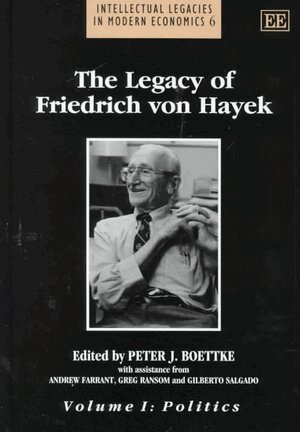
    Legacy of Friedrich von Hayek

    AvPeter J. Boettke,Andrew Farrant

    Inbunden, Engelska, 2000

    Del 6 i serien Intellectual Legacies in Modern Economics series

    12 870 kr

    Beställningsvara. Skickas inom 5-8 vardagar. Fri frakt över 249 kr.

    Beskrivning

    This major three-volume collection - offered in the centenary year of Hayek’s birth - celebrates a lifetime of scholarship and original contributions that cross the disciplines of politics, philosophy and economics.Hayek rose to fame as a young technical economist engaged in debate with Keynes and became infamous in middle age for his harsh critique of socialist planning. For much of the 1950s and 1960s Hayek was ignored as a relic of 19th century economic liberalism as the tide of intellectual and political fashion moved against both his warnings about Keynesian demand management and his critique of socialist planning. Late in life, Hayek was celebrated as a prescient scholar who foresaw the decline in both the Keynesian and socialist systems of economic control. Hayek made major analytical contributions which have yet to be appreciated by either friend or foe. Through this selection of classic articles The Legacy of Friedrich von Hayek attempts to place Hayek’s contributions to political economy in a proper perspective.

    Produktinformation

    • Utgivningsdatum:2000-02-24
    • Mått:169 x 244 x undefined mm
    • Format:Inbunden
    • Språk:Engelska
    • Serie:Intellectual Legacies in Modern Economics series
    • Förlag:Edward Elgar Publishing Ltd
    • ISBN:9781858982991

    Utforska kategorier

    • Kulturvetenskap inom Samhälle och politik
    • Nationalekonomi inom Ekonomi och Ledarskap
    • Ekonomisk politik inom Ekonomi och Ledarskap

    Mer om författaren

    Edited by Peter J. Boettke, University Professor of Economics and Philosophy, George Mason University, US Assisted by Andrew Farrant, George Mason University, US, Greg Ransom, MiraCosta College, US and Gilberto O. Salgado, New York University, US

    Recensioner i media

    ’. . . to have [all the papers in these volumes] available for selected study or reference in a single set of volumes is an editorial achievement for which all with an interest in Hayek will be grateful.’

    Innehållsförteckning

    • Contents:Volume I: PoliticsAcknowledgements • Introduction1. John Gray (1982), ‘F.A. Hayek and the Rebirth of Classical Liberalism’2. Viktor Vanberg (1994), ‘Hayek's Legacy and the Future of Liberal Thought: Rational Liberalism versus Evolutionary Agnosticism’3. Ronald Hamowy (1987), excerpt from The Scottish Enlightenment and the Theory of Spontaneous Order4. Viktor Vanberg (1986), ‘Spontaneous Market Order and Social Rules: A Critical Examination of F.A. Hayek’s Theory of Cultural Evolution’5. Douglas Glen Whitman (1998), ‘Hayek contra Pangloss on Evolutionary Systems’6. Steve Fleetwood (1996), ‘Order Without Equilibrium: A Critical Realist Interpretation of Hayek's Notion of Spontaneous Order’7. Richard Bellamy (1994), ‘’Dethroning Politics’: Liberalism, Constitutionalism and Democracy in the Thought of F.A. Hayek’8. Richard Vernon (1976), ‘The “Great Society” and the “Open Society”: Liberalism in Hayek and Popper’ 9. Theodore Rosenof (1974), ‘Freedom, Planning, and Totalitarianism: The Reception of F. A. Hayek's Road to Serfdom’10. Morris M. Wilhelm (1972), ‘The Political Thought of Friedrich A. Hayek’11. Ronald Hamowy (1971), ‘Freedom and the Rule of Law in F.A. Hayek’12. Lord Robbins (1961), ‘Hayek on Liberty’13. Jacob Viner (1961), ‘Hayek on Freedom and Coercion’14. E.F.M. Durbin (1945), ‘Professor Hayek on Economic Planning and Political Liberty’15. Murray Forsyth (1988), ‘Hayek's Bizarre Liberalism: A Critique’16. Linda C. Raeder (1997), ‘The Liberalism/Conservatism of Edmund Burke and F.A. Hayek: A Critical Comparision’17. Alain de Benoist (1998), ‘Hayek: A Critique’18. Mario J. Rizzo (1985), ‘Rules Versus Cost-Benefit Analysis in the Common Law’19. A.I. Ogus (1989), ‘Law and Spontaneous Order: Hayek’s Contribution to Legal Theory’20. Bruce L. Benson (1989), ‘The Spontaneous Evolution of Commercial Law’21. Anna Elisabetta Galeotti (1987), ‘Individualism, Social Rules, Tradition: The Case of Friedrich A. Hayek’22. Eugene Heath (1989), ‘How to Understand Liberalism as Gardening: Galeotti on Hayek’23. Gerard Radnitzky (1987), ‘An Economic Theory of the Rise of Civilization and Its Policy Implications: Hayek’s Account Generalized’24. Linda C. Raeder (1998), ‘Liberalism and the Common Good: A Hayekian Perspective on Communitarianism’25. Karen I. Vaughn (1984), ‘The Constitution of Liberty from an Evolutionary Perspective’26. Peter J. Boettke (1995), ‘Hayek’s The Road to Serfdom Revisited: Government Failure in the Argument Against Socialism’27. Barry R. Weingast (1995), ‘The Economic Role of Political Institutions: Market-Preserving Federalism and Economic Development’Name IndexVolume II: Philosophy1. Donald W. Livingston (1991), ‘Hayek as Humean’2. Robin Cowan and Mario J. Rizzo (1996), ‘The Genetic-Causal Tradition and Modern Economic Theory’3. G.B. Madison (1989), ‘Hayek and the Interpretive Turn’4. Theodore A. Burczak (1994), ‘The Postmodern Moments of F.A. Hayek’s Economics’ 5. Bruce Caldwell (1994), ‘Hayek’s Scientific Subjectivism’6. Theodore A. Burczak (1994), ‘Reply to Bruce Caldwell: Can Subjectivism be Non-Hermeneutic?’7. David L. Prychitko (1989/90), ‘Methodological Individualism and the Austrian School: A Note on its Critics’8. G.B. Madison (1990), ‘How Individualistic is Methodological Individualism?’9. Joseph Agassi (1975), ‘Institutional Individualism’10. Steven Lukes (1968), ‘Methodological Individualism Reconsidered’11. Joseph Agassi (1960), ‘Methodological Individualism’12. Walter B. Weimer (1982), ‘Hayek's Approach to the Problems of Complex Phenomena: An Introduction to the Theoretical Psychology of The Sensory Order’13. Rosemary Agonito (1975), ‘Hayek Revisited: Mind as the Process of Classification’14. Gary T. Dempsey (1996), ‘Hayek’s Terra Incognita of the Mind’15. Edna Ullmann-Margalit (1978), ‘Invisible-Hand Explanations’16. A.M. Macleod (1983), ‘Justice and the Market’17. A.W. Cragg (1983), ‘Hayek, Justice and the Market’18. Eric Mack (1983), ‘Hayek on Justice and the Market: A Reply to MacLeod’19. A.M. Macleod (1983), ‘Hayek on Justice and the Market: A Rejoinder to Cragg and Mack’20. Eugene Heath (1992), ‘Rules, Function, and The Invisible Hand: An Interpretation of Hayek's Social Theory’21. Edna Ullmann-Margalit (1997), ‘The Invisible Hand and the Cunning of Reason’22. Lee Cronk (1988), ‘Spontaneous Order Analysis and Anthropology’23. Nigel Pleasants (1997), ‘The Epistemological Argument Against Socialism: A Wittgensteinian Critique of Hayek and Giddens’24. Daniel B. Klein (1992), ‘Go Ahead and Let Him Try: A Plea for Egonomic Laissez-faire’25. Marina Bianchi (1993), ‘How to Learn Sociality: True and False Solutions to Mandeville’s Problem’Name IndexVolume III: Economics1. Fritz Machlup (1974), ‘Friedrich von Hayek's Contribution to Economics’2. M. Polanyi (1941), ‘The Growth of Thought in Society’3. Sanford J. Grossman and Joseph E. Stiglitz (1980), ‘On the Impossibility of Informationally Efficient Markets’4. Richard R. Nelson (1981), ‘Assessing Private Enterprise: An Exegesis of Tangled Doctrine’5. Manfred E. Streit (1984), ‘Information Processing in Futures Markets - An Essay on Adequate Abstraction’6. Stephan Böhm (1989), ‘Hayek on Knowledge, Equilibrium, and Prices: Context and Impact’7. Carlo Zappia (1996), ‘The Notion of Private Information in a Modern Perspective: A Reappraisal of Hayek's Contribution’8. Bruce J. Caldwell (1988), ‘Hayek’s Transformation’9. Sanford Ikeda (1990), ‘Market-Process Theory and “Dynamic” Theories of the Market’10. Israel M. Kirzner (1967), ‘Methodological Individualism, Market Equilibrium, and Market Process’11. Israel M. Kirzner (1997), ‘Entrepreneurial Discovery and the Competitive Market Process: An Austrian Approach’12. Mario J. Rizzo (1990), ‘Hayek’s Four Tendencies Toward Equilibrium’13. William N. Butos (1985), ‘Hayek and General Equilibrium Analysis’14. Gottfried Haberler (1986), ‘Reflections on Hayek’s Business Cycle Theory’15. Roger W. Garrison (1985), ‘Intertemporal Coordination and the Invisible Hand: An Austrian Perspective on the Keynesian Vision’16. Don Bellante and Roger W. Garrison (1988), ‘Phillips Curves and Hayekian Triangles: Two Perspectives on Monetary Dynamics’17. Roger Garrison (1984), ‘Time and Money: The Universals of Macroeconomic Theorizing’18. Steven Horwitz (1996), ‘Capital Theory, Inflation, and Deflation: The Austrians and Monetary Disequilibrium Theory Compared’19. George A. Selgin and Lawrence H. White (1994), ‘How Would the Invisible Hand Handle Money?’20. Bruce Caldwell (1997), ‘Hayek and Socialism’Name Index