• Fri frakt över 249 kr
  • •
  • Snabba leveranser
  • •
  • Billiga böcker
Kundservice

Du är på sajten för privatpersoner.

Företag, bibliotek eller offentlig verksamhet?

Du handlar på classic.bokus.com, där alla dina funktioner finns intakta.
Till classic.bokus.com
Bokus logotyp. Gå till startsidan.
  • Erbjudanden
  • Nyheter
  • Student
  • Topplistor
  • Barn & ungdom
  • Bokus Play
  • E-böcker
  • Pocketböcker
  • Spel & pussel

10% studentrabatt med kod TERM26

Sidfot

Mina sidor

    Hjälp

    • Kundservice
    • Vanliga frågor och svar
    • Frakt och leverans
    • Retur vid ångerrätt
    • Reklamera vara
    • Betalning
    • Köpvillkor
    • Allmänna villkor
    • Information om webbplatsens tillgänglighet

    Om Bokus

    • Om oss
    • Pressrum
    • För studenter
    • För företag
    • För bibliotek och offentlig verksamhet
    • För leverantörer
    • Hållbarhet

    Populärt

    • Aktuella erbjudanden
    • Presentkort
    • Studentlitteratur
    • Nya böcker
    • Topplistor
    • Signerade böcker
    • Engelska böcker

    Inspiration

    • Boktips
    • BookTok
    • Populära bokserier
    • Barnbokskaraktärer
    • Populära författare
    Logotyp för Bokus
    Följ oss på Facebook (extern länk)Följ oss på Instagram (extern länk)Följ oss på YouTube (extern länk)Följ oss på TikTok (extern länk)
    bokus @ CookiesAnpassa cookiesIntegritetspolicyKöpvillkor
    Till Citymail hemsida (extern länk)Till Budbee hemsida (extern länk)Till Postnord hemsida (extern länk)Till Schenker hemsida (extern länk)Till Early Bird hemsida (extern länk)Till Walleys hemsida (extern länk)
    1. Historia och arkeologi
    2. Historia
    3. Europas historia

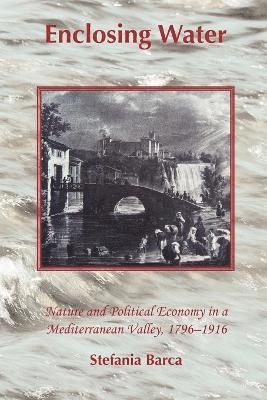
    Enclosing Water

    Nature and Political Economy in a Mediterranean Valley, 1796-1916

    AvStefania Barca

    Häftad, Engelska, 2010

    470 kr

    Beställningsvara. Skickas inom 5-8 vardagar. Fri frakt över 249 kr.

    Fler format och utgåvor

    Inbunden

    909 kr

    Beskrivning

    Enclosing Water is an environmental history of the Industrial Revolution, as inscribed on the Liri valley in Italy's Central Apennines. Amid forces of revolution and empire, and Enlightenment discourses of 'improvement' and political economy, the Liri's natural wealth - water-power - generated sweeping changes in its landscape and working and living environments. This book tells the story of how defining water as property - both materially and discursively - led to the emergence of an industrial riverscape, and of a concomitant new ecological consciousness; to heightened environmental risks and awareness of those risks. A dramatic century in the Liri's socio-environmental history, with its cast of new industrial bourgeoisie, engineers and civil servants, illuminates how material developments and ideological currents completely reshaped the relationship between society and nature at the periphery of 19th century Europe. By integrating Political Economy into the narrative of European environmental history, this pioneering book offers a critical new view of discourses of water disorder and environmental politics in the Mediterranean region.

    Produktinformation

    • Utgivningsdatum:2010-06-16
    • Mått:152 x 229 x 11 mm
    • Vikt:296 g
    • Format:Häftad
    • Språk:Engelska
    • Antal sidor:196
    • Förlag:White Horse Press
    • ISBN:9781874267577
    • Utmärkelser:Winner of Turku Book Award for Environmental History 2011

    Utforska kategorier

    • Europas historia inom Historia och arkeologi
    • Miljövetenskap och miljöpolitik inom Naturvetenskap och teknik
    • Industrialismen och industrihistoria inom Historia och arkeologi

    Mer om författaren

    Stefania Barca (born in Naples in 1968) is a researcher at the Centre for Social Studies at the University of Coimbra, Portugal. After obtaining her PhD in Economic History from the University of Bari (1997) she was a research associate with the Institute of Studies on Mediterranean Societies in Naples (part of the Italian National Research Council) and taught courses in economic, social and environmental history. She has published numerous articles in Italian and English and co-authored the book Storia dell'ambiente. Una introduzione ('An Introduction to Environmental History', 2004, with M. Armiero). In 2003 she was involved in founding the first Italian environmental history journal, I Frutti di Demetra. Bollettino di Storia e Ambiente, on whose editorial board she still serves. From 2005 to 2008 she was in the US, first as visiting scholar to the Program in Agrarian Studies at Yale University and then as Ciriacy Wantrup postdoctoral fellow at the University of California, Berkeley. She returned to Europe in 2009. Her current research projects include a comparative environmental history of petrochemicals, and a biography of Italian leading ecologist Laura Conti.

    Recensioner i media

    'The close and dense connections pinpointed between culture, environment, and economy make this work an enriching, even indispensable read - Essential.' R. Spickermann, University of Texas. CHOICE Academic Reviews 'The Industrial Revolution is one of the great themes for environmental history. Here Barca rises to the challenge, providing a clear case study of an industrial transformation of a riverine environment in its political, intellectual, social, and economic context.' J.R. McNeill, Georgetown University. Environmental History '[Barca's] penetrating, multi-layered unpacking of this tragic story makes significant contributions to environmental, social and intellectual history. Enclosing Water is essential reading for understanding the dialectical consequences of changing socio-ecological relationships. It offers an original, thought-provoking way of seeing how society creates landscapes out of visionary ideal of itself.' Harold Platt, Environment and History.

    Innehållsförteckning

    • TABLE OF CONTENTS Part I: WATER AND REVOLUTIONS. Italian landscape with waterfall A road to waterpower 1. The landscape of Political Economy Nature and nation in the Kingdom of Naples Improving the Valley Landscape and violence 2. Empire and the 'disorder of water' Liberating nature Rivers and revolution Seeing like a statistician 3. The ecology of waterpower The making of an industrial riverscape 'I'll have your flesh for three cents per pound': Gender and mechanisation Improvement vs. habitation The machine in the river: a pastoral narrative PART II: THE ECONOMY OF WATER One hundred years of enclosures Rivers and property in the Italian South 4.Enclosing the river Picture a river open to all... The appropriators Water wars, water discipline The tragedy of enclosure 5. Floods and politics in the Apennines Seeing like an engineer The un-improving State Industry and disaster EPILOGUE Common Water