• Fri frakt över 249 kr
  • •
  • Snabba leveranser
  • •
  • Billiga böcker
Kundservice

Du är på sajten för privatpersoner.

Företag, bibliotek eller offentlig verksamhet?

Du handlar på classic.bokus.com, där alla dina funktioner finns intakta.
Till classic.bokus.com
Bokus logotyp. Gå till startsidan.
  • Erbjudanden
  • Nyheter
  • Student
  • Topplistor
  • Barn & ungdom
  • Bokus Play
  • E-böcker
  • Pocketböcker
  • Spel & pussel

10% rabatt på allt med kod: NYSTART10 →

Sidfot

Mina sidor

    Hjälp

    • Kundservice
    • Vanliga frågor och svar
    • Frakt och leverans
    • Retur vid ångerrätt
    • Reklamera vara
    • Betalning
    • Köpvillkor
    • Allmänna villkor
    • Information om webbplatsens tillgänglighet

    Om Bokus

    • Om oss
    • Pressrum
    • För studenter
    • För företag
    • För bibliotek och offentlig verksamhet
    • För leverantörer
    • Hållbarhet

    Populärt

    • Aktuella erbjudanden
    • Presentkort
    • Studentlitteratur
    • Nya böcker
    • Topplistor
    • Signerade böcker
    • Engelska böcker

    Inspiration

    • Boktips
    • BookTok
    • Populära bokserier
    • Barnbokskaraktärer
    • Populära författare
    Logotyp för Bokus
    Följ oss på Facebook (extern länk)Följ oss på Instagram (extern länk)Följ oss på YouTube (extern länk)Följ oss på TikTok (extern länk)
    bokus @ CookiesAnpassa cookiesIntegritetspolicyKöpvillkor
    Till Citymail hemsida (extern länk)Till Budbee hemsida (extern länk)Till Postnord hemsida (extern länk)Till Schenker hemsida (extern länk)Till Early Bird hemsida (extern länk)Till Walleys hemsida (extern länk)
    1. Medicin
    2. Andra medicinska specialiteter
    3. Smärta och smärtbehandling

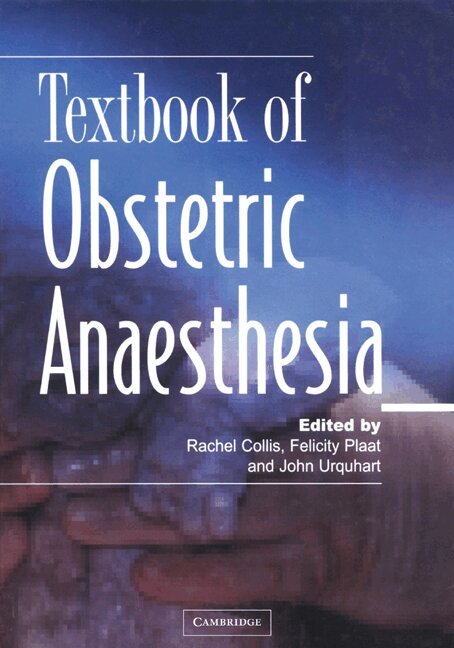
    Textbook of Obstetric Anaesthesia

    AvRachel E. Collis,Felicity Plaat

    Inbunden, Engelska, 2002

    1 394 kr

    Beställningsvara. Skickas inom 10-15 vardagar. Fri frakt över 249 kr.

    Beskrivning

    The modern obstetric anaesthetist must not only provide safe and effective pain-relief in labour and anaesthesia for Caesarean section, but also understand the wider role of the anaesthetist in the management of the pregnant woman. Originally published in 2002, Textbook of Obstetric Anaesthesia is a comprehensive, fully illustrated account of all aspects of modern obstetric anaesthesia. It provides useful, practical, evidence-based information on all aspects of labour ward management. Written by a multidisciplinary team of expert contributors, it features comprehensive chapters covering everything from departmental audit to cutting-edge practice for neonatal resuscitation and administration of mobile epidurals. It will be useful for both the trainee and practising obstetric anaesthetist.

    Produktinformation

    • Utgivningsdatum:2002-01-10
    • Mått:195 x 251 x 23 mm
    • Vikt:1 012 g
    • Format:Inbunden
    • Språk:Engelska
    • Antal sidor:344
    • Förlag:Greenwich Medical Media
    • ISBN:9781900151771

    Utforska kategorier

    • Smärta och smärtbehandling inom Medicin
    • Gynekologi och obstetrik inom Medicin
    • Förlossningsvård inom Medicin

    Recensioner i media

    Some books say 'read me' and I think this is one of them. The excellent opening chapter on the history of obstetric anaesthesia foretells a book that is interesting stimulating and informative. Each chapter has an introductory index, which makes it easy to find what you are looking for, whether you are a specialist registrar in the run up to the final FRCA, or a DGH obstetric anaesthestist wanting to know how to handle a problem. It is a book that would also be useful for a doctor undertaking background research before commencing a project, for many chapters are extensively referenced. Early in the book, there is a concise chapter on the use of audit and research, which tells one how to set up an audit of obstetric anaesthesia activity, and has a useful precis of the Confidential Enquiry into Maternal Deaths. As recently as 1930, the UK Maternal Mortality rate was 500 per 100 000, with many deaths being attributed to puerperal sepsis. The rate is now 12.2 per 100 000 maternities. The chapter cautions us against complacency at home and abroad, and points out that the rate is still 344 per 100 000 in Zimbabwe. Anaesthetists who give talks on pain relief in labour to expectant mothers will find Wee's chapter useful in handling not uncommon questions on alternative methods of pain relief. Few of these techniques do much harm, although they appear not to do that much measurable good in relieving the pain of labour. Fernando and Price's chapter on regional anaesthesia is a model of good construction and common sense, with the anatomy, pharmacology, indications, technique, and complications and their management laid out in order. They do believe in test doses (p.78,hooray!). Their references are extensive and modern. Those who wish to establish 'walking epidurals' in their units could start by reading Plaat's chapter on ambulatory anaesthesia. She commences with the question why do women in Western Europe end up on their beds when in labour? The combined spinal epidural technique of analgesia allows the woman to walk if she wants to. But there is a price. It is different from conventional epidural analgesia, and it is clear from the text that it is a difficult and demanding technique to administer and to supervise. The chapter on the use of general anaesthesia has a chilling statistic that following the introduction of succinylcholine as the relaxant of choice in 1959, there was a doubling of the death rate attributable to anaesthesia in the 1964-1966 Confidential Enquiry. However, general anaesthesia is an essential practice for obstetric anaesthetists. The text explores modern issues, such as how do trainees gain supervised experience in general anaesthesia when it is less frequently practiced. The text cautions against the regular use of laryngeal masks in obstetric anaesthesia, because they do not prevent regurgitation. The text also has sensible cautionary paragraphs about the risks of pulmonary aspiration of gastric contents. The text advocates the strong points of the use of succinylcholine for intubation. It is the only muscle relaxant which works rapidly, and whose effect is also normally transient. My two quibbles are firstly with the mention of the capnograph, which could be more prominent (p. 116). The use of the capnograph has made general anaesthesia safe for obstetrics (see p.45). Second the algorithm for failed intubation is comprehensive, but quite complex (p.123). In practice, the management is usually fairly simple. Have two good goes, possible three, and if unsuccessful, wake the patient up: failure to intubate is not failure, but failure to stop intubating is. The chapter on regional anaesthesia for Caesarean section advocates the advantages of the technique both for mother and baby. It has a useful paragraphs for example on how to prevent aortocaval occlusion. The combined spinal epidural technique is described in intrusive detail. However, in the section on epidural anaesthesia, I must admit to feeling unease when top-ups of 20ml of epidural solution are mentioned (p.141). Surely epidural doses should be given as increments, in case the catheter has migrated (p.86)? I liked the chapter on intrapartum fetal monitoring which has a readable section on

    Innehållsförteckning

    • 1. History of obstetric analgesia and anaesthesia; 2. Maternal physiology; 3. Audit in obstetric anaesthesia; 4. Non-regional analgesia I (non pharmacological); 5. Non-regional analgesia II (pharmacological); 6. Regional analgesia for labour; 7. Ambulatory analgesia in labour; 8. Anaesthesia for caesarean section: general anaesthesia; 9. Regional anaesthesia for caesarean section; 10. Anaesthesia for the distressed fetus and major obstetric haemorrhage; 11. Intrapartum fetal monitoring; 12. The obstetric patient with cardiac disease; 13. The obstetric patient with respiratory, neurological and endocrine disease; 14. Pre-eclampsia; 15. Intensive and high dependency care of the obstetric patient; 16. Cardiopulmonary resuscitation in pregnancy; 17. Amniotic fluid embolism; 18. Anaesthesia during pregnancy; 19. Midwifery education and the anaesthetist.