• Fri frakt över 249 kr
  • •
  • Snabba leveranser
  • •
  • Billiga böcker
Kundservice

Du är på sajten för privatpersoner.

Företag, bibliotek eller offentlig verksamhet?

Du handlar på classic.bokus.com, där alla dina funktioner finns intakta.
Till classic.bokus.com
Bokus logotyp. Gå till startsidan.
  • Erbjudanden
  • Nyheter
  • Student
  • Topplistor
  • Barn & ungdom
  • Bokus Play
  • E-böcker
  • Pocketböcker
  • Spel & pussel

Må bättre, för mindre! Upp till 50% rabatt på hälsoböcker

Sidfot

Mina sidor

    Hjälp

    • Kundservice
    • Vanliga frågor och svar
    • Frakt och leverans
    • Retur vid ångerrätt
    • Reklamera vara
    • Betalning
    • Köpvillkor
    • Allmänna villkor
    • Information om webbplatsens tillgänglighet

    Om Bokus

    • Om oss
    • Pressrum
    • För studenter
    • För företag
    • För bibliotek och offentlig verksamhet
    • För leverantörer
    • Hållbarhet

    Populärt

    • Aktuella erbjudanden
    • Presentkort
    • Studentlitteratur
    • Nya böcker
    • Topplistor
    • Signerade böcker
    • Engelska böcker

    Inspiration

    • Boktips
    • BookTok
    • Populära bokserier
    • Barnbokskaraktärer
    • Populära författare
    Logotyp för Bokus
    Följ oss på Facebook (extern länk)Följ oss på Instagram (extern länk)Följ oss på YouTube (extern länk)Följ oss på TikTok (extern länk)
    bokus @ CookiesAnpassa cookiesIntegritetspolicyKöpvillkor
    Till Citymail hemsida (extern länk)Till Budbee hemsida (extern länk)Till Postnord hemsida (extern länk)Till Schenker hemsida (extern länk)Till Early Bird hemsida (extern länk)Till Walleys hemsida (extern länk)
    1. Historia och arkeologi
    2. Historia
    3. Historia: särskilda händelser och ämnen
    4. Socialhistoria och kulturhistoria

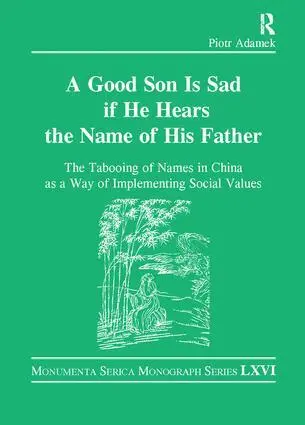
    Good Son is Sad If He Hears the Name of His Father

    The Tabooing of Names in China as a Way of Implementing Social Values

    AvPiotr Adamek

    Inbunden, Engelska, 2015

    Del i serien Monumenta Serica Monograph Series

    1 638 kr

    Tillfälligt slut

    Fler format och utgåvor

    Häftad

    783 kr

    E-bok

    831 kr

    E-bok

    829 kr

    Beskrivning

    When in 1775 the scholar Wang Xihou 王錫侯 compiled a dictionary called Ziguan 字貫, he wrote, for illustrative purposes, the personal names of Confucius and the three emperors Kangxi, Yongzheng and Qianlong in the introduction. In oversight, he recorded their complete names. This accidental writing of a few names was condemned by Emperor Qianlong as an unprecedented crime, rebellion and high treason. Wang Xihou was executed, his property confiscated and his books were burnt. His family was arrested and his sons and grandsons were killed or sent as slaves to Heilongjiang. It is surprising what an enormous impact the tabooing of names (bihui 避諱) had on Chinese culture. The names of sovereigns, ancestors, officials, teachers, and even friends were all considered taboo, in other words it was prohibited to pronounce them or to record them in writing. In numerous cases characters identical or similar in writing or pronunciation were often avoided as well. The tabooing of names was observed in the family and on the street, in the office and in the emperor’s palace. The practice of bihui had serious consequences for the daily lives of the Chinese and for Chinese historiography. People even avoided certain places and things, and refused to accept offices. They were punished and sometimes even killed in connection with the tabooing of names. The bihui custom existed as an important element of Chinese culture and was perceived as significant by Chinese and foreigners alike. It was crucial for implementing social values and demonstrating the political hierarchy. The present work A Good Son Is Sad if He Hears the Name of His Father is a systematic study of Chinese name-tabooing customs, which until now have been relatively little explored in Western-language Sinological studies. It attempts to provide a long-term perspective on the changing dynamics of tabooing and elucidates various aspects related to the fascinating topic of tabooing of names.

    Produktinformation

    • Utgivningsdatum:2015-08-28
    • Mått:174 x 246 x undefined mm
    • Vikt:1 012 g
    • Format:Inbunden
    • Språk:Engelska
    • Serie:Monumenta Serica Monograph Series
    • Antal sidor:416
    • Förlag:Taylor & Francis Ltd
    • ISBN:9781909662698

    Utforska kategorier

    • Socialhistoria och kulturhistoria inom Historia och arkeologi
    • Sociologi inom Samhälle och politik
    • Kulturhistoria inom Historia och arkeologi

    Mer om författaren

    Piotr Adamek

    Innehållsförteckning

    • Chapter One: IntroductionChapter Two: Taboo and NameChapter Three: Basic Characteristics of Name TabooingChapter Four: Beginnings of the Custom of Name Taboo in ChinaChapter Five: Name Tabooing from the Han to Southern and Northern DynastiesChapter Six: Culmination of the Custom of Name TabooChapter Seven: Last Centuries of Name TabooingChapter Eight: Consequences of Name Taboo for Chinese PeopleChapter Nine: Historiographical Consequences and the Basics of the Discipline of Name TabooingChapter Ten: Special Topics of Name TabooingBibliographyChronological Index of Taboo Names of Emperors and Other Famous PersonsAlphabetical Index of Taboo CharactersTable: Confucian Officials Executed for Taboo Mistakes