• Fri frakt över 249 kr
  • •
  • Snabba leveranser
  • •
  • Billiga böcker
Kundservice

Du är på sajten för privatpersoner.

Företag, bibliotek eller offentlig verksamhet?

Du handlar på classic.bokus.com, där alla dina funktioner finns intakta.
Till classic.bokus.com
Bokus logotyp. Gå till startsidan.
  • Erbjudanden
  • Nyheter
  • Student
  • Topplistor
  • Barn & ungdom
  • Bokus Play
  • E-böcker
  • Pocketböcker
  • Spel & pussel

10% rabatt på allt med kod: NYSTART10 →

Sidfot

Mina sidor

    Hjälp

    • Kundservice
    • Vanliga frågor och svar
    • Frakt och leverans
    • Retur vid ångerrätt
    • Reklamera vara
    • Betalning
    • Köpvillkor
    • Allmänna villkor
    • Information om webbplatsens tillgänglighet

    Om Bokus

    • Om oss
    • Pressrum
    • För studenter
    • För företag
    • För bibliotek och offentlig verksamhet
    • För leverantörer
    • Hållbarhet

    Populärt

    • Aktuella erbjudanden
    • Presentkort
    • Studentlitteratur
    • Nya böcker
    • Topplistor
    • Signerade böcker
    • Engelska böcker

    Inspiration

    • Boktips
    • BookTok
    • Populära bokserier
    • Barnbokskaraktärer
    • Populära författare
    Logotyp för Bokus
    Följ oss på Facebook (extern länk)Följ oss på Instagram (extern länk)Följ oss på YouTube (extern länk)Följ oss på TikTok (extern länk)
    bokus @ CookiesAnpassa cookiesIntegritetspolicyKöpvillkor
    Till Citymail hemsida (extern länk)Till Budbee hemsida (extern länk)Till Postnord hemsida (extern länk)Till Schenker hemsida (extern länk)Till Early Bird hemsida (extern länk)Till Walleys hemsida (extern länk)
    1. Samhälle och politik
    2. Politik och statsskick
    3. Politiska ideologier och rörelser
    4. Nationalism

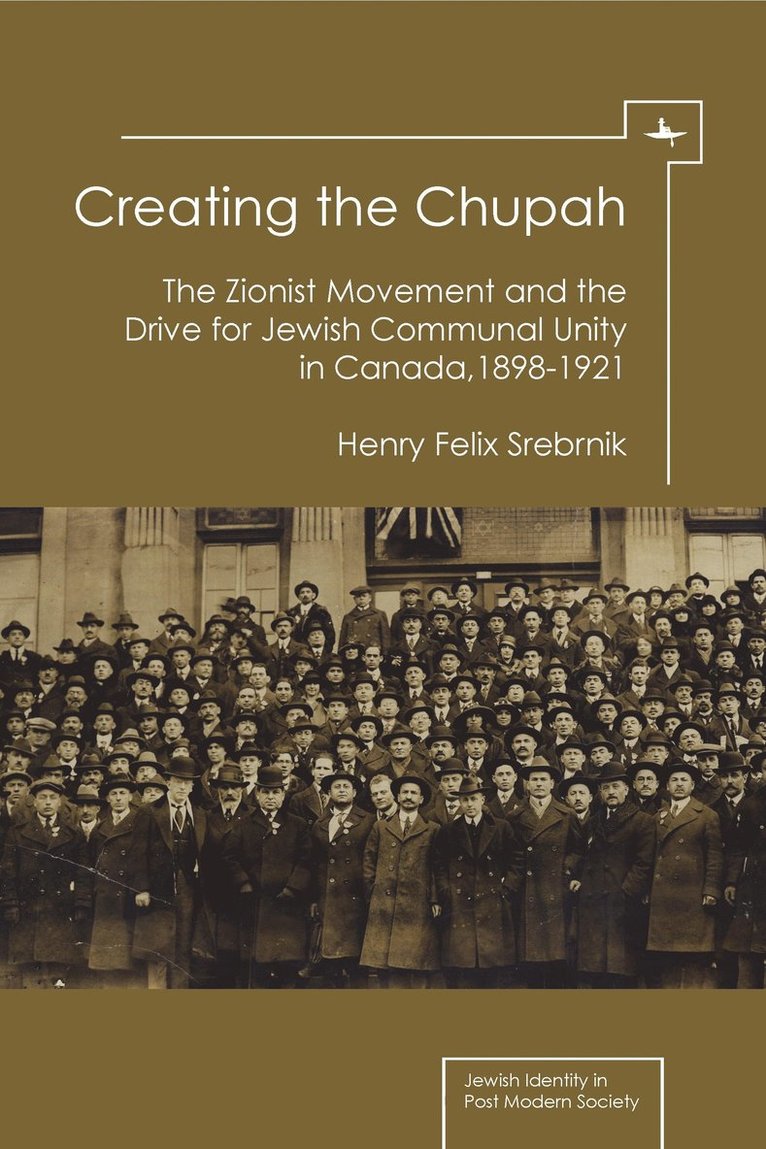
    Creating the Chupah

    The Zionist Movement and the Drive for Jewish Communal Unity in Canada, 1898-1921

    AvHenry Felix Srebrnik

    Inbunden, Engelska, 2011

    Del i serien Jewish Identities in Post-Modern Society

    1 097 kr

    Skickas . Fri frakt över 249 kr.

    Fler format och utgåvor

    E-bok

    2 522 kr

    Beskrivning

    Creating the Chupah assesses the role of Canadian Zionist organizations in the drive for communal unity within Canadian Jewry in the first two decades of the twentieth century. Two strands of Zionism, represented respectively by the Federation of Zionist Societies of Canada and Poale Zion, were often in conflicts that reflected greater disputes. The book also describes Zionist activities within the larger spectrum of Canadian Jewish life. Montreal was at the time the “capital” of Canadian Jewry, but the Jewish communities of Toronto and Winnipeg also played a significant role in these events. Srebrnik here makes a substantial contribution to our understanding of Zionism and twentieth-century Jewish life in Canada.

    Produktinformation

    • Utgivningsdatum:2011-09-15
    • Mått:155 x 234 x 19 mm
    • Vikt:556 g
    • Format:Inbunden
    • Språk:Engelska
    • Serie:Jewish Identities in Post-Modern Society
    • Antal sidor:264
    • Förlag:Academic Studies Press
    • ISBN:9781936235711

    Utforska kategorier

    • Nationalism inom Samhälle och politik
    • Sociala grupper och identitet inom Samhälle och politik

    Mer om författaren

    Henry Srebrnik (PhD University of Birmingham, England) teaches comparative politics and ethnic relations at the University of Prince Edward Island, Charlottetown, PEI, Canada. He is the author of London Jews and British Communism, 1935-1945 (London: Vallentine Mitchell, 1995); Jerusalem on the Amur: Birobidzhan and the Canadian Jewish Communist Movement, 1924-1951 (Montreal and Kingston: McGill-Queen’s University Press, 2008); and Dreams of Nationhood: American Jewish Communists and the Soviet Birobidzhan Project, 1924-1951 (Boston: Academic Studies Press, 2010).

    Recensioner i media

    This pioneering study makes a major contribution to the history of Canadian Jewry by arguing that Zionism has historically been a unifying factor within the community. During the formative period 1898-1921, Zionism was not a source of divisiveness, as it was in the neighbouring United States, but a shared arena in which the Canadian Jewish community expressed its ideological and political divisions. Employing primary sources, largely in Yiddish, Srebrnik discusses the role of Zionism in community-building and in the process sheds light on an area of scholarly study that has too long been neglected.