• Fri frakt över 249 kr
  • •
  • Snabba leveranser
  • •
  • Billiga böcker
Kundservice

Du är på sajten för privatpersoner.

Företag, bibliotek eller offentlig verksamhet?

Du handlar på classic.bokus.com, där alla dina funktioner finns intakta.
Till classic.bokus.com
Bokus logotyp. Gå till startsidan.
  • Erbjudanden
  • Nyheter
  • Student
  • Topplistor
  • Barn & ungdom
  • Bokus Play
  • E-böcker
  • Pocketböcker
  • Spel & pussel

10% studentrabatt med kod TERM26

Sidfot

Mina sidor

    Hjälp

    • Kundservice
    • Vanliga frågor och svar
    • Frakt och leverans
    • Retur vid ångerrätt
    • Reklamera vara
    • Betalning
    • Köpvillkor
    • Allmänna villkor
    • Information om webbplatsens tillgänglighet

    Om Bokus

    • Om oss
    • Pressrum
    • För studenter
    • För företag
    • För bibliotek och offentlig verksamhet
    • För leverantörer
    • Hållbarhet

    Populärt

    • Aktuella erbjudanden
    • Presentkort
    • Studentlitteratur
    • Nya böcker
    • Topplistor
    • Signerade böcker
    • Engelska böcker

    Inspiration

    • Boktips
    • BookTok
    • Populära bokserier
    • Barnbokskaraktärer
    • Populära författare
    Logotyp för Bokus
    Följ oss på Facebook (extern länk)Följ oss på Instagram (extern länk)Följ oss på YouTube (extern länk)Följ oss på TikTok (extern länk)
    bokus @ CookiesAnpassa cookiesIntegritetspolicyKöpvillkor
    Till Citymail hemsida (extern länk)Till Budbee hemsida (extern länk)Till Postnord hemsida (extern länk)Till Schenker hemsida (extern länk)Till Early Bird hemsida (extern länk)Till Walleys hemsida (extern länk)
    1. Biografier
    2. Sanna berättelser

    Jewish Underground of Samarkand

    How Faith Defied Soviet Rule

    AvHillel Zaltzman

    Häftad, Engelska, 2023

    Del i serien Mandel Vilar Press

    269 kr

    Beställningsvara. Skickas inom 5-8 vardagar. Fri frakt över 249 kr.

    Fler format och utgåvor

    E-bok

    202 kr

    Beskrivning

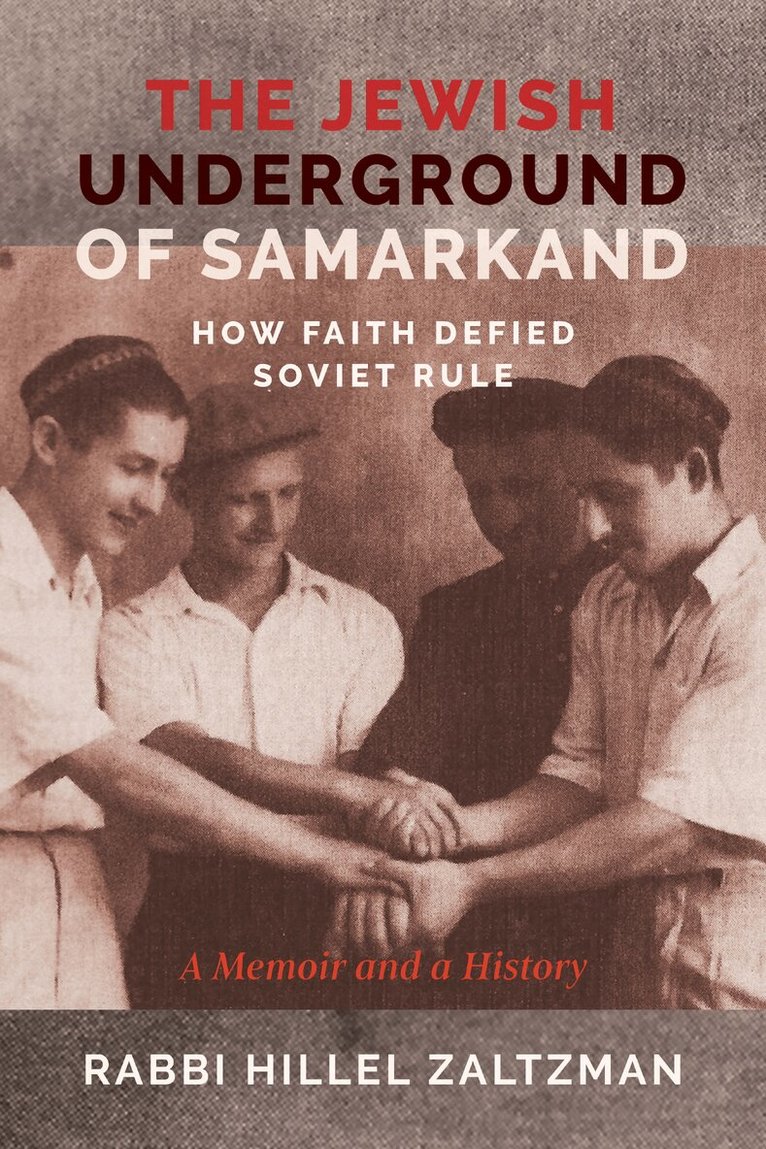
    A portal into the perseverance of Jewish culture in the face of attempts to destroy it.To answer his son's question: what was it like growing up in Samarkand? Rabbi Hillel Zaltzman wrote and researched this memoir and history about Chassidic Jews who found refuge in Samarkand during the World War II and continued to live there under Soviet rule. This is a personal story for Zaltzman, who was born in Kharkov, Ukraine. When the Nazis invaded Kharkov, Zaltzman’s parents fled with their three young children to Samarkand (Uzbekistan). There they reconnected to other refugee Chassidic families, as well as some famous Chassidic rebbes also in flight. In Uzbekistan they created a thriving Jewish community until its institutions were abruptly shut down by Stalin immediately after the war. Still this Jewish community in Samarkand, Uzbekistan is remembered as shpitz Chabad—the epitome of Chassidic ideals and devotion.Zaltzman’s father kept him out of the Soviet schools, where atheism was promoted and Sabbath observance was impossible, teaching him furtively at home, until a neighbor discovered his existence at the age of 9. Zaltzman had no choice but to attend a public school then, but he still observed the demands of his faith and stayed home from school when necessary. Hillel studied with esteemed Chabad Chassidic rebbes who taught at great personal risk. If discovered, they could be sentenced to harsh labor in Siberia.Zaltzman credits his father’s unswerving commitment to his chinuch—his Jewish education—was beyond any compromise, and it was an exemplary expression of their Chabad brand of Chassidic Judaism: “The Chabad community was infused with a rich inner world of Chassidic vitality,” Zaltzman writes.Meanwhile, the Soviet regime remained obsessed with eliminating a Jewish religious identity; a special division of the NKVD (Soviet secret police) was assigned the task of destroying Jewish schools and yeshivas, and surveilling individuals through synagogue informers. Zaltzman records his experiences and adventures and those of other memorable people he has known and the sacrifices they made to share their love of Torah and Jewish learning in the secret underground yeshivas. He describes their attempts to celebrate Jewish holidays, make matzah, and obtain prayer books, as well as their other colorful escapades. He also tells of their exasperating experiences trying to obtain exit visas to leave the Soviet Union. The largely untold story of Chabad activism and heroism comes through with great immediacy in this first-person account of spiritual resistance to a Communist regime at war with the Jewish devotion to God and Torah. From the age 16, along with several other idealistic young men, Hillel Zaltzman was involved in Chamah, an underground Jewish organization that helped sustain and preserve Jewish life in the Soviet Union through education. Chamah established a network of underground Jewish schools that clandestinely taught more than 1,500 children over the years and provided material and spiritual support to Jews trying to obtain exit visas in the 1960s and 70s. Hillel himself was allowed to immigrate to Israel only in 1971, after years of trying. Now living in New York, he is the director of IChamah, an international organization which is devoted to serving Jews from the Former Soviet Union in Israel, Russia, and the US. Rabbi Zaltzman was honored for his humanitarian and Jewish outreach in the U.S. Senate in May 2016, as part of Jewish American Heritage Month.

    Produktinformation

    • Utgivningsdatum:2023-12-14
    • Mått:152 x 228 x 25 mm
    • Vikt:688 g
    • Format:Häftad
    • Språk:Engelska
    • Serie:Mandel Vilar Press
    • Antal sidor:424
    • Förlag:Mandel Vilar Press
    • ISBN:9781942134923

    Utforska kategorier

    • Sanna berättelser inom Biografier
    • Religion: allmänt inom Filosofi och religion
    • Judendom inom Filosofi och religion

    Mer om författaren

    Rabbi Hillel Zaltzman was born in the city of Kharkov, Ukraine, in the year 1939. During the Second World War, as the Germans closed in on Kharkov, the Zaltzman family escaped to the city of Samarkand—present day Uzbekistan. Living under Soviet rule, Hillel had to received his childhood Jewish education in secret. His Jewish education came from the Chassidim present throughout his youth; his uncle the shochet, Reb Boruch Duchman and Reb Berke Chein who spent six years in the Zaltzman home while on the run from the authorities, and Reb Mendel Futerdas. Under their influence, his Chassidic perspectives formed properly.When he was sixteen, the Chassid Reb Moshe Nissilevitch recruited Hillel to become involved with the communal work of an underground organization by the name of Chamah, founded to promote the teaching of Torah and Chassidic philosophy. In the darkest days of Communist Russia, just being a Jew put one’s life in jeopardy. This small group of courageous young activists refused to let the flame of Judaism be extinguished. At peril to their lives Chamah started as a clandestine group with the aim of strengthening Jewish identity and helping their brethren both physically and spiritually.In 1964, Hillel married Mussia Shoshana Esther, her father was Reb Efraim Fishel Demichovsky, a graduate of Tomchei Tmimim, and the nephew of the Rogotchover Gaon.From his earliest days, Hillel Zaltzman remained deeply involved in activities and development of the Chamah. Over the years, Chamah grew to become an international Jewish organization working with Russian and Ukrainian Jewry conducting a broad range of humanitarian, social, and educational programs in Israel, Russia, and the United States. In 1971 Rabbi Zaltzman emigrated from the USSR to Israel and helped established the Chamah branch office in Israel. Two years later, in 1973, Hillel was asked to open the first Chamah branch in New York City. Shortly thereafter his family moved to join him in New York. He continued his work on behalf of Soviet Jewry, expanding Chamah’s operations to include medical aid, furthering Jewish education among Russian Jews in America and abroad. Today, Chamah International headquarters are located Manhattan and in Brooklyn and Rabbi Hillel Zaltzman is president of this international organization.

    Recensioner i media

    "Zaltzman's stirring memoir, which was originally published in 2015 as Samarkand and has been condensed for this new edition, recounts his attempts to preserve Jewish culture in Soviet Uzbekistan. . . . He writes of these achievements in steady, unshowy prose, succeeding in his stated goal to enlighten readers who are unaware of a thriving Jewish community in the former Soviet Union. It's a fascinating blend of personal and cultural history."—Publishers Weekly"While the Kremlin ruthlessly suppressed organized religion, Chassidic Jews in Samarkand managed to sustain their traditions with determined ingenuity. Brimming with vivid detail, this book will interest anyone curious to know how they survived in the face of Stalinist repression."—Joshua Rubenstein, Davis Center for Russian and Eurasian Studies at Harvard University and the author of nine books on Soviet history including The Last Days of Stalin"A debut history that details the plight of a family of Jews who fled from Ukraine to Uzbekistan while pursuing their faith . . . . the author does a remarkable job of vividly depicting the city of Samarkand, which became famous for its tenacious preservation of Jewish customs despite zealous political persecution. It serves as an effective historical study of Jewish life under Communist tyranny, and Zaltzman's mastery of details of the period is undeniable.—Kirkus Reviews"The inspiring story of Chabad's underground followers in far-off Samarkand as recounted by a Lubavitch activist who defied the Communists and survived to tell the tale. A valuable source on Jews under Communism and an unforgettable chronicle of courage and perseverance."—Jonathan D. Sarna, University Professor and Joseph H. & Belle R. Braun Professor of American Jewish History, Brandeis University"I'm drawn in by the storytelling, its unembellished directness and clarity and by the brief sketches of each character that nevertheless embody an entire personality in the eyes of an intelligent and sensitive observer. Rabbi Hillel's earnest poignancy and his humanity and modesty are irresistible. The bravery of resistance to oppression dominates throughout. You have in your hands a cultural treasure!"—Cynthia Ozick, American novelist, and essayist whose fiction and nonfiction books include The Shawl, Levitation: Five Fictions, The Cannibal Galaxy and Metaphor and Memory."Very little is known about the history of the Jews of Samarkand during the Soviet period. That is partly due to the clandestine nature of their struggle to maintain their Jewish identity under the most difficult circumstances. It is also due to the nature of the Soviet authoritarian regime that was intent on keeping the Soviet Jewry struggle hidden from public view. Rabbi Zaltzman's book makes an especially important contribution to Jewish history because it sheds light on aspects of the Jewish struggle for religious liberty in the Soviet Union that had not been previously studied and revealed. This book will inform, enlighten, and inspire the reader about events that took place in Samarkand that in many ways changed the course of Soviet Jewish history."—Michael N. Dobkowski, John Milton Potter Chair in the Humanities, Hobart and William Smith Colleges"Rabbi Zaltzman has the storyteller's genius: part historian, part I. B. Singer. In this astonishing narrative of a largely unknown piece of Jewish history, he tells of his family's journey and that of fellow Chabad Lubavitchers to the Uzbek city of Samarkand as they flee the Nazi invasion of Ukraine. He then recounts their struggles in Samarkand to keep themselves—and their religious practices—alive under the brutal rule of the Soviet Union after the war. Against those formidable enemies, Chabad Chassidism triumphs. No amount of political persecution can win when facing the dedication of the Chabad community. It is a dramatic story of perseverance, devotion to Jewish learning and the Jewish determination to survive."—Sol Gittleman, Alice and Nathan Gantcher University, Professor Emeritus, Tufts University

    Innehållsförteckning

    • Partial Table of Contents (Balance will be filled by February 1st):1.     A Chassidic Education in Communist Russia2.     My Father’s Youth in Lubavitch3.     The War Years in Samarkand4.     The Uncles I Didn't Know5.     The Postwar Years under Stalin6.     Our Distinguished Guest: R. Berke Chein7.     Secret Worship Services8.     The Legendary Chassid: R. Simcha Gorodetzky9.     Our Bukharian Champion: R. Refael Chudaidatov10.   Making Matzah11.   The Founding of Chamah12.   The Underground Yeshiva13.   What Was the KGB Looking for in My Workshop?14.   Shabbos Bereishis in the Cotton Field15.   Mentor and Friend: R Mendel Futerfas16.   Adventures on the Road17.   Matchmaking in the Shadow of the KGB18.  My Mother's Death and My father'sImmigration to Israel19.  Leaving Russia20.  From Dream's in Russia to Reality in IsraelGlossary About the Author