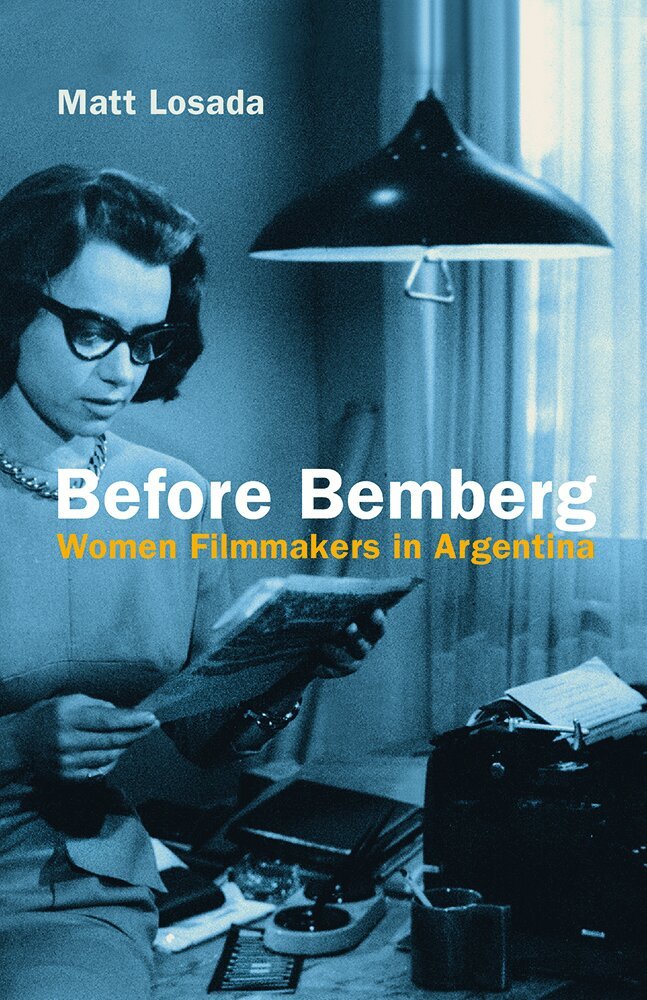
Inbunden, Engelska, 2020
Before Bemberg
Women Filmmakers in Argentina
Av Matt Losada
1788 kr
Beställningsvara. Skickas inom 7-10 vardagar. Fri frakt över 249 kr.
Beskrivning
Produktinformation
- Utgivningsdatum: 2020-09-18
- Mått: 140 x 216 x 18 mm
- Vikt: 4 g
- Format: Inbunden
- Språk: Engelska
- Antal sidor: 196
- Förlag: Rutgers University Press
- ISBN: 9781978814554
Utforska kategorier
Mer om författaren
MATT LOSADA is an associate professor of Hispanic studies at the University of Kentucky, Lexington. He teaches and researches on modern Latin American culture, with a particular interest in 20th-century Argentine film. He is the author of The Projected Nation: Argentina Cinema and the Social Margins (2018).
Recensioner i media
"Losada's contribution to the scholarship of Argentine cinema and Latin American women's cinema is invaluable. Specifically, his archival research into Argentine women directors before Bemberg is instrumental in understanding the true history of women's active participation in Argentine cinema from the very beginning."— The Americas"Before Bemberg excavates a fascinating history of Argentine women filmmakers that have rarely been acknowledged. The book promises to widen the framing of important filmmakers in the Argentine film canon including Maria Luisa Bemberg, Lucrecia Martel and other contemporary women directors. Matt Losada's work presents an important contribution to the lesser known, but equally important women directors from earlier eras that are at last gaining wider recognition."— Tamara Falicov, author of The Cinematic Tango: Contemporary Argentine Film"Film production in Argentina had been very much a male affair until the emergence of María Luisa Bemberg in the 1970s. Losada has undertaken a significant documentary history of Bemberg's predecessors, in a study that contributes to our understanding of both the difficulties women faced in the industry and their contributions to cinema."— David William Foster, author of Queer Issues in Latin American Filmmaking"The book's initial claim to recuperation, one that would allow today's cinephiles and scholars to access a more complete history and acknowledge the past difficulties and possibilities for women', is substantiated by the critical reading of a wide range of primary and secondary sources, combined with impeccable textual analysis. What eventually enables the delivery of the far more complex story' that this study aims to accomplish, is the author's ability to navigate from the macro i.e., the working conditions of women within the industry, during the era of the studio system in Argentina), to the micro (i.e., the detailed examination of how the gendered mechanics of the cinematic apparatus are challenged and de-constructed in the films that form this study's corpus)."— Constanza Burucúa, Bulletin of Spanish Visual Studies"In short, Losada presents us with a text full of information, destined to rewrite the history of the cinematographic directors who preceded Bemberg. Added to the archival work is the wide dissemination of the research carried out by Argentine critics, many of whom are linked in one way or another to AsAECA. Although the analysis of the films is excellent, this reader is left wanting to know more about the time and who marked it, but as long as that is the reaction, Losada has more than fulfilled its objective."— Imagofagia, Magazine of the Argentine Association of Film and Audiovisual Studies
Betyg & recensioner
0 recensioner
Inga recensioner tillgängliga.