• Fri frakt över 249 kr
  • •
  • Snabba leveranser
  • •
  • Billiga böcker
Kundservice

Du är på sajten för privatpersoner.

Företag, bibliotek eller offentlig verksamhet?

Du handlar på classic.bokus.com, där alla dina funktioner finns intakta.
Till classic.bokus.com
Bokus logotyp. Gå till startsidan.
  • Erbjudanden
  • Nyheter
  • Student
  • Topplistor
  • Barn & ungdom
  • Bokus Play
  • E-böcker
  • Pocketböcker
  • Spel & pussel

10% studentrabatt med kod TERM26

Sidfot

Mina sidor

    Hjälp

    • Kundservice
    • Vanliga frågor och svar
    • Frakt och leverans
    • Retur vid ångerrätt
    • Reklamera vara
    • Betalning
    • Köpvillkor
    • Allmänna villkor
    • Information om webbplatsens tillgänglighet

    Om Bokus

    • Om oss
    • Pressrum
    • För studenter
    • För företag
    • För bibliotek och offentlig verksamhet
    • För leverantörer
    • Hållbarhet

    Populärt

    • Aktuella erbjudanden
    • Presentkort
    • Studentlitteratur
    • Nya böcker
    • Topplistor
    • Signerade böcker
    • Engelska böcker

    Inspiration

    • Boktips
    • BookTok
    • Populära bokserier
    • Barnbokskaraktärer
    • Populära författare
    Logotyp för Bokus
    Följ oss på Facebook (extern länk)Följ oss på Instagram (extern länk)Följ oss på YouTube (extern länk)Följ oss på TikTok (extern länk)
    bokus @ CookiesAnpassa cookiesIntegritetspolicyKöpvillkor
    Till Citymail hemsida (extern länk)Till Budbee hemsida (extern länk)Till Postnord hemsida (extern länk)Till Schenker hemsida (extern länk)Till Early Bird hemsida (extern länk)Till Walleys hemsida (extern länk)
    1. Naturvetenskap och teknik
    2. Geovetenskap
    3. Miljövetenskap och miljöpolitik

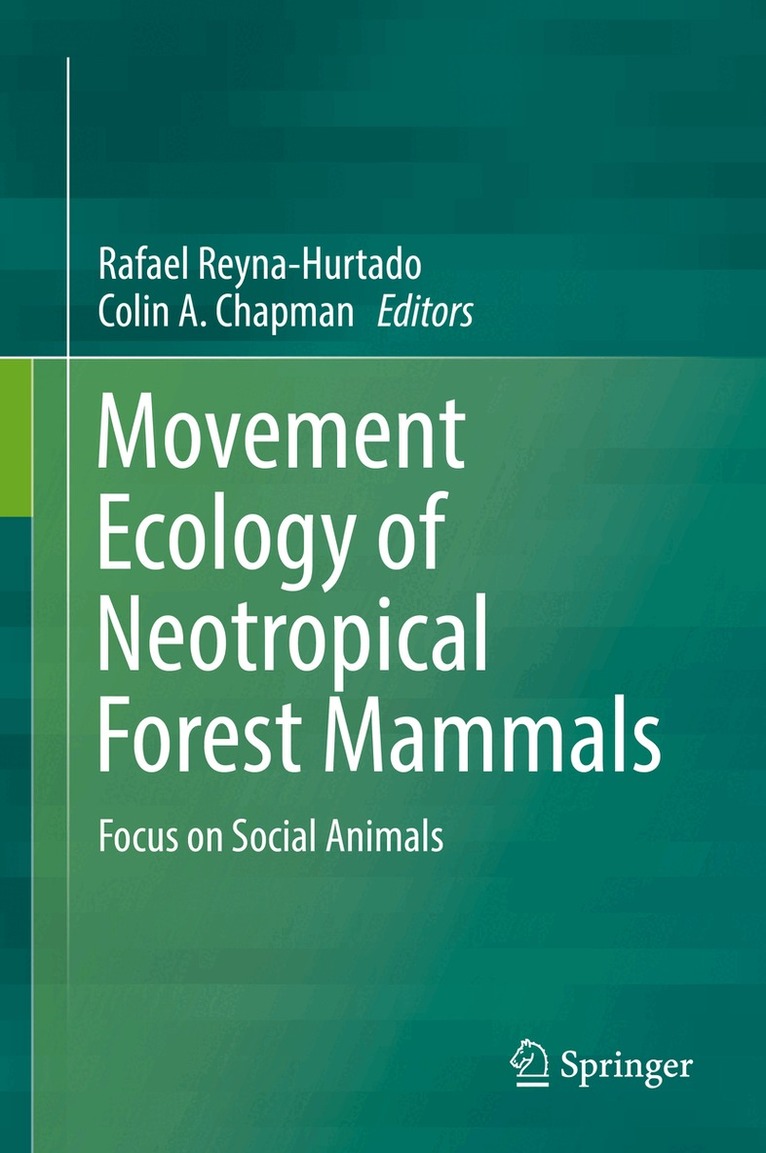
    Movement Ecology of Neotropical Forest Mammals

    Focus on Social Animals

    AvRafael Reyna-Hurtado,Colin A. Chapman

    Inbunden, Engelska, 2019

    1 634 kr

    Beställningsvara. Skickas inom 10-15 vardagar. Fri frakt över 249 kr.

    Beskrivning

    This book brings a unique perspective to animal movement studies because all cases came from tropical environments where the great diversity, either biological and structurally (trees, shrubs, vines, epiphytes), presents the animal with several options to fulfill its live requirements. These conditions have forced the evolution of unique movement patterns and ecological strategies. Movement is an essential process in the life of all organisms. Animals move because they are hungry, thirsty, to avoid being eaten, or because they want to find mates. Understanding the causes and consequences of animal movement is not an easy task for behavioural ecologists. Many animals are shy, move in secretive ways and are very sensible to human presence, therefore, studying the movements of mammals in tropical environments present logistical and methodological challenges that have recently started to be solved by ecologist around the world. In this book we are compiling a set of extraordinarycases where researchers have used some of the modern technology and the strongest methodological approaches to understand movement patterns in wild tropical mammals. We hope this book will inspire and encourage young researchers to investigate wild mammal´s movements in some of the amazing tropical environments of the world.

    Produktinformation

    • Utgivningsdatum:2019-01-18
    • Mått:155 x 235 x 22 mm
    • Vikt:600 g
    • Format:Inbunden
    • Språk:Engelska
    • Antal sidor:274
    • Förlag:Springer Nature Switzerland AG
    • ISBN:9783030034627

    Utforska kategorier

    • Miljövetenskap och miljöpolitik inom Naturvetenskap och teknik
    • Däggdjur inom Naturvetenskap och teknik
    • Däggdjur inom Djur och Natur

    Mer om författaren

    Rafael Reyna-Hurtado is a Mexican biologist that has studied tropical ungulates since 1997 in Mesoamerica and Uganda. Rafael obtained a Master degree and PhD degree in Wildlife Ecology and Conservation in University of Florida. He also conducted a three years postdoctoral study in McGill University, Montreal, Canada with focus in Africa terrestrial mammals. Rafael has published more than 60 articles among scientific papers, book chapters and public contributions. Rafael has focused on the study of the movement ecology of a social species, the white-lipped peccary in the Calakmul forest of Mexico. Rafael is a professor of El Colegio de la Frontera Sur in Campeche city, Southern Mexico where he has formed a team of highly qualified students that are conducting studies in movement patterns of tropical ungulates in all Mesoamerica.  Colin A. Chapman is a professor of Department of Anthropology of McGill University who has published more than 400 scientific papers and has extensively studied primates socio-ecological relationship. Colin has experiences in Costa Rica, Mexico but has focused the last 29 years to studied primates communities of Kibale National Park in Uganda in one of the longest studies in primates ever conducted.

    Recensioner i media

    “This book should serve as both an inspiration and a cautionary tale. … Overall, these studies provide novel insights on movement, space use, and natural history, despite great challenges. … I believe that any biologist wishing to study movement of large mammals in thick forests could benefit from reading this volume … .” (Clinton W. Epps, The Quarterly Review of Biology, Vol. 96 (4), December, 2021)

    Innehållsförteckning

    • Foreword.- 1. Why Movement Ecology Matters.- 2. The Impact of Hurricane Otto on Baird’s Tapir Movement in Nicaragua’s Indio Maíz Biological Reserve.- 3. White-lipped peccary home-range size in the Maya Forest of Guatemala and México.- 4. White-lipped peccary movement and range in agricultural lands of Central Brazil.- 5. Movements of White-Lipped Peccary in French Guiana.- 6. Spatial ecology of a large and endangered tropical mammal: the White-lipped Peccary in Darién, Panama.- 7. Movements of Neotropical Forest Deer, what do we know?.- 8. Daily traveled distances by the white-tailed deer in relation to seasonality and reproductive phenology in a tropical lowland of southeastern Mexico.- 9. Terrestrial locomotion and other adaptive behaviors in howler monkeys (Alouatta pigra) living in forest fragments.- 10. Variation in space use and social cohesion within and between four groups of woolly monkeys (Lagothrix lagotricha poeppigii) in relation to fruit availability and mating opportunities at the Tiputini Biodiversity Station, Ecuador.- 11. Home Range and Daily Traveled Distances of Highland Colombian Woolly Monkeys (Lagothrix lagothricha lugens): Comparing Spatial Data from GPS-collars and Direct Follows.- 12. Ranging responses to fruit and arthropod availability by a tufted capuchin group (Sapajus apella) in the Colombian Amazon.- 13. Insights of the movements of the jaguar in the tropical forests of southern Mexico.- 14.  Movements and home range of Jaguars (Panthera onca) and Mountain lions (Puma concolor) in a tropical dry forest of Western Mexico.- 15. Next moves: The future of Neotropical mammals movement ecology.