• Fri frakt över 249 kr
  • •
  • Snabba leveranser
  • •
  • Billiga böcker
Kundservice

Du är på sajten för privatpersoner.

Företag, bibliotek eller offentlig verksamhet?

Du handlar på classic.bokus.com, där alla dina funktioner finns intakta.
Till classic.bokus.com
Bokus logotyp. Gå till startsidan.
  • Erbjudanden
  • Nyheter
  • Student
  • Topplistor
  • Barn & ungdom
  • Bokus Play
  • E-böcker
  • Pocketböcker
  • Spel & pussel

10% rabatt på allt med kod: NYSTART10 →

Sidfot

Mina sidor

    Hjälp

    • Kundservice
    • Vanliga frågor och svar
    • Frakt och leverans
    • Retur vid ångerrätt
    • Reklamera vara
    • Betalning
    • Köpvillkor
    • Allmänna villkor
    • Information om webbplatsens tillgänglighet

    Om Bokus

    • Om oss
    • Pressrum
    • För studenter
    • För företag
    • För bibliotek och offentlig verksamhet
    • För leverantörer
    • Hållbarhet

    Populärt

    • Aktuella erbjudanden
    • Presentkort
    • Studentlitteratur
    • Nya böcker
    • Topplistor
    • Signerade böcker
    • Engelska böcker

    Inspiration

    • Boktips
    • BookTok
    • Populära bokserier
    • Barnbokskaraktärer
    • Populära författare
    Logotyp för Bokus
    Följ oss på Facebook (extern länk)Följ oss på Instagram (extern länk)Följ oss på YouTube (extern länk)Följ oss på TikTok (extern länk)
    bokus @ CookiesAnpassa cookiesIntegritetspolicyKöpvillkor
    Till Citymail hemsida (extern länk)Till Budbee hemsida (extern länk)Till Postnord hemsida (extern länk)Till Schenker hemsida (extern länk)Till Early Bird hemsida (extern länk)Till Walleys hemsida (extern länk)
    1. Samhälle och politik
    2. Politik och statsskick
    3. Statsvetenskap och politisk teori

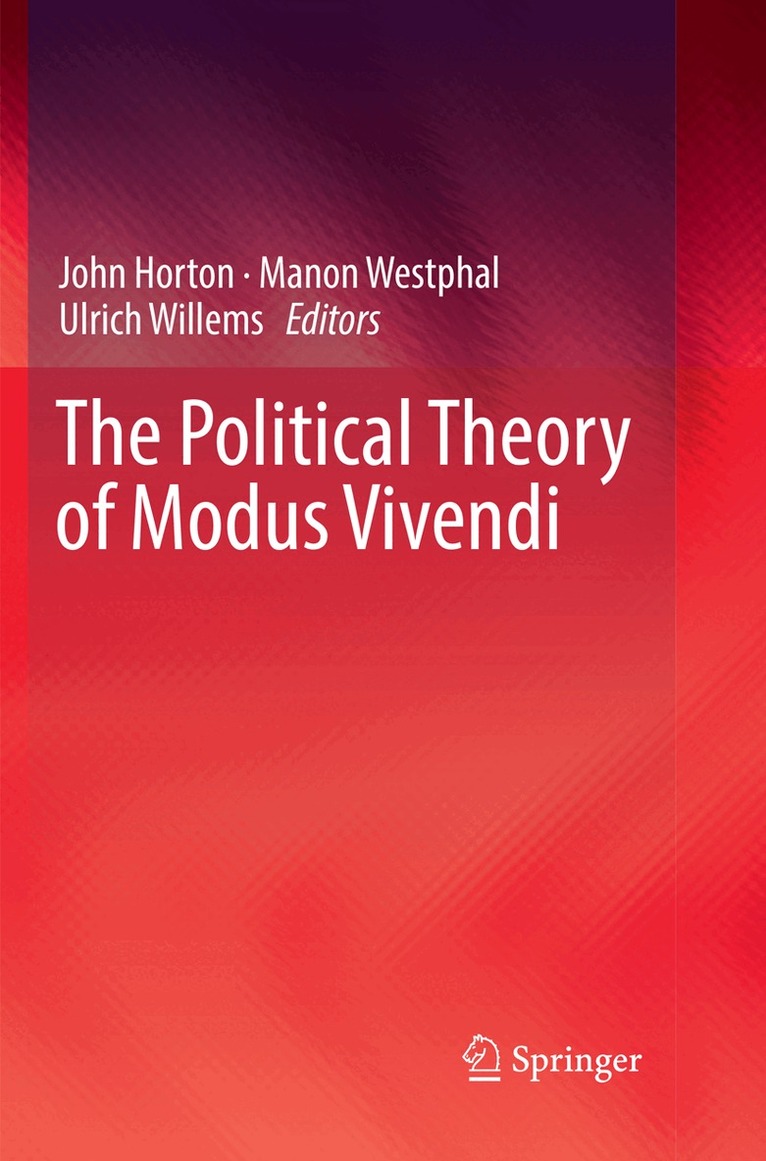
    Political Theory of Modus Vivendi

    AvJohn Horton,Manon Westphal

    Häftad, Engelska, 2019

    1 518 kr

    Beställningsvara. Skickas inom 10-15 vardagar. Fri frakt över 249 kr.

    Beskrivning

    This book focuses on the idea of a modus vivendi as a way of governing political life and addressing problems characterized by pluralism or deep-rooted diversity. The individual essays illustrate both the merits and the limitations of a political theory of modus vivendi; how it might be interpreted and developed; specific challenges entailed by articulating it in a convincing form; what its institutional implications might be; and how it relates to other seminal issues and concepts in political theory; such as legitimacy, toleration, the social contract, etc. The book makes a significant contribution to the discussion on the scope and limits of liberal political theory, and on how to deal politically with deep-rooted diversity.

    Produktinformation

    • Utgivningsdatum:2019-01-19
    • Mått:155 x 235 x 16 mm
    • Vikt:435 g
    • Format:Häftad
    • Språk:Engelska
    • Antal sidor:272
    • Förlag:Springer Nature Switzerland AG
    • ISBN:9783030077211

    Utforska kategorier

    • Statsvetenskap och politisk teori inom Samhälle och politik
    • Filosofiska discipliner inom Filosofi och religion

    Mer om författaren

    John Horton is Emeritus Professor of Political Philosophy at Keele University, UK. Before moving to Keele he taught at the University of York, UK, where he was for many years Director of the Morrell Centre for Studies in Toleration. He is the author of Political Obligation (rev edn 2010) and has edited or co-edited several volumes on toleration and volumes on literature and political theory and the work of Alasdair MacIntyre and of John Gray. He has published numerous articles in contemporary political philosophy, especially on toleration, political obligation and modus vivendi.Manon Westphal is a Research Fellow at the Centre for Advanced Study in Bioethics at the University of Muenster. Her research focuses on political theory and democratic theory. She is particularly interested in pluralism, agonism and the political regulation of normative disagreement. In her doctoral thesis, she examined how agonistic conceptions of politics influenceconsiderations about institutional design. Recent publications include “What bonds citizens in a pluralistic democracy? Probing Mouffe’s notion of a conflictual consensus”, in: Knoll, Manuel/Snyder, Stephen/Șimşek, Nurdane (eds.): Justice Beyond Consensus: Distributive Solutions to the Problems of Pluralism and Conflict. Berlin/Boston: DeGruyter (forthcoming); “Jenseits des Konsens-Ideals: Deliberation in der agonalen Demokratie“, in: Schmalz-Bruns, Rainer/Landwehr, Claudia (eds.): Deliberative Demokratie in der Diskussion. Herausforderungen, Bewährungsproben, Kritik. Baden-Baden: Nomos, 2014, 305-337.Ulrich Willems is Professor of Political Theory at the Department Political Science at the University of Muenster. He is also Principal Investigator at the Cluster of Excellence “Religion and Politics in pre-modern and modern times”, Director of the “Centre for Religion and Modernity” and a member of the “Centre for Advanced Studies in Bioethics”, all located at the University of Muenster. Prior to Muenster he taught at Darmstadt University of Technology and the University of Hamburg. His research interests include political theory, political pluralism, democracy and pluralism, interest groups, politics and religion, and morality policy, especially biopolitics. He is author of Value Conflicts as a Challenge to Democracy (Springer VS 2015, in German) and Development, Interests and Morality: The Development Policy of the Protestant Church of Germany (Leske + Budrich, 1998, in German) as well as co-editor of “Modernity and Religion” (Transcript 2013, in German), Politics and Contingency (Springer VS 2012, in German), Interest Intermediation in Policy Fields (VS 2009, in German) and Interest Groups in Germany (VS 2007, in German).

    Innehållsförteckning

    • Chapter 1: Theorising Modus Vivendi.- Part 1: Modus Vivendi, Liberalism and Realism.- Chapter 2:  Why Theorize Modus Vivendi?.- Chapter 3: Liberal Moralism and Modus Vivendi Politics.- Chapter 4: Modus Vivendi and the Motivations for Compliance.- Chapter 5: Modus Vivendi in a Liberal Framework.- Chapter 6: Can Modus Vivendi Save Liberalism from Moralism? A Critical Assessment of John Gray’s Political Realism.- Chapter 7: Modus Vivendi Beyond the Social Contract: Peace, Justice, and Survival in Realist Political Theory.- Part 2: Modus Vivendi and Legitimacy.- Chapter 8: Modus Vivendi and Political Legitimacy.- Chapter 9: Modus Vivendi as a Global Political Morality.- Chapter 10: Legitimacy and Modus Vivendi Theory.- Chapter 11: Modus Vivendi and Legitimacy: Some Sceptical Thoughts.- Part 3: Modus Vivendi and Political Practice.- Chpater 12: Political Thought between Finality and Indeterminacy.- Chapter 13: Motives and Modus Vivendi.- Chapter 14: Modus Vivendi and Toleration.-Chapter 15: Institutions of Modus Vivendi Politics.