• Fri frakt över 249 kr
  • •
  • Snabba leveranser
  • •
  • Billiga böcker
Kundservice

Du är på sajten för privatpersoner.

Företag, bibliotek eller offentlig verksamhet?

Du handlar på classic.bokus.com, där alla dina funktioner finns intakta.
Till classic.bokus.com
Bokus logotyp. Gå till startsidan.
  • Erbjudanden
  • Nyheter
  • Student
  • Topplistor
  • Barn & ungdom
  • Bokus Play
  • E-böcker
  • Pocketböcker
  • Spel & pussel

10% studentrabatt med kod TERM26

Sidfot

Mina sidor

    Hjälp

    • Kundservice
    • Vanliga frågor och svar
    • Frakt och leverans
    • Retur vid ångerrätt
    • Reklamera vara
    • Betalning
    • Köpvillkor
    • Allmänna villkor
    • Information om webbplatsens tillgänglighet

    Om Bokus

    • Om oss
    • Pressrum
    • För studenter
    • För företag
    • För bibliotek och offentlig verksamhet
    • För leverantörer
    • Hållbarhet

    Populärt

    • Aktuella erbjudanden
    • Presentkort
    • Studentlitteratur
    • Nya böcker
    • Topplistor
    • Signerade böcker
    • Engelska böcker

    Inspiration

    • Boktips
    • BookTok
    • Populära bokserier
    • Barnbokskaraktärer
    • Populära författare
    Logotyp för Bokus
    Följ oss på Facebook (extern länk)Följ oss på Instagram (extern länk)Följ oss på YouTube (extern länk)Följ oss på TikTok (extern länk)
    bokus @ CookiesAnpassa cookiesIntegritetspolicyKöpvillkor
    Till Citymail hemsida (extern länk)Till Budbee hemsida (extern länk)Till Postnord hemsida (extern länk)Till Schenker hemsida (extern länk)Till Early Bird hemsida (extern länk)Till Walleys hemsida (extern länk)
    1. Naturvetenskap och teknik
    2. Matematik och naturvetenskap
    3. Biologi
    4. Biovetenskap

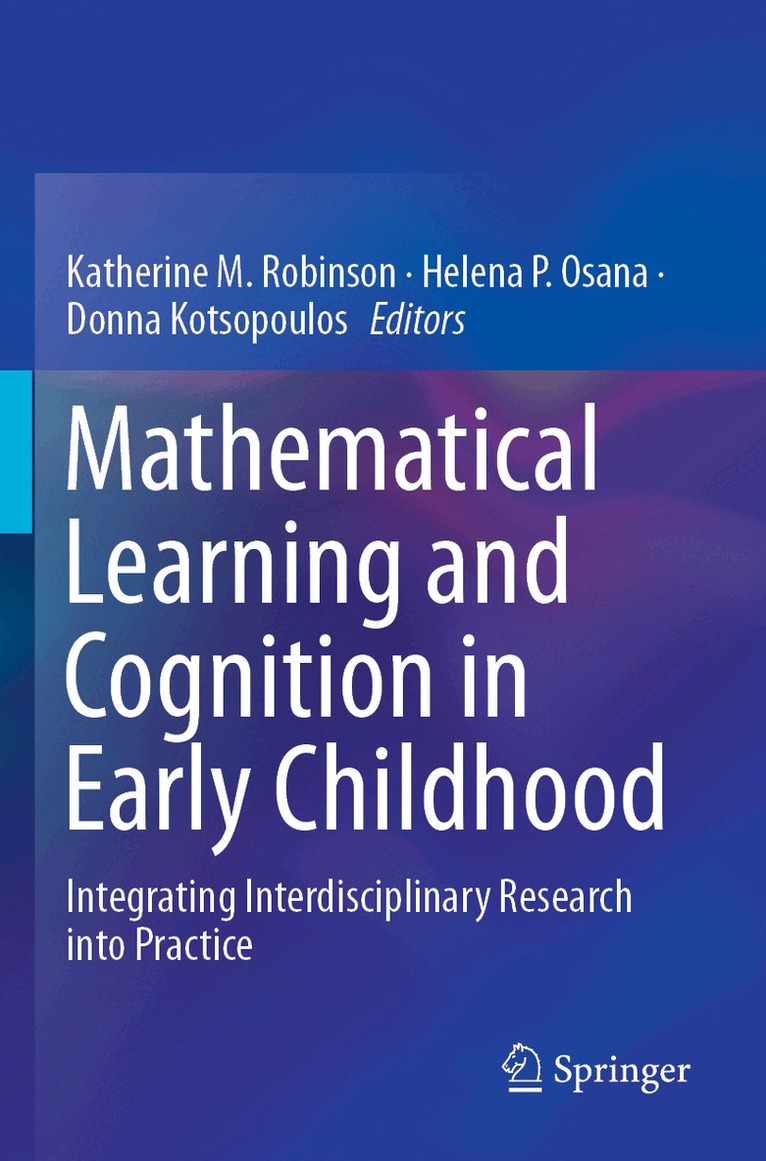
    Mathematical Learning and Cognition in Early Childhood

    Integrating Interdisciplinary Research into Practice

    AvKatherine M. Robinson,Helena P. Osana

    Häftad, Engelska, 2020

    1 634 kr

    Beställningsvara. Skickas inom 10-15 vardagar. Fri frakt över 249 kr.

    Beskrivning

    This book explores mathematical learning and cognition in early childhood from interdisciplinary perspectives, including developmental psychology, neuroscience, cognitive psychology, and education. It examines how infants and young children develop numerical and mathematical skills, why some children struggle to acquire basic abilities, and how parents, caregivers, and early childhood educators can promote early mathematical development. The first section of the book focuses on infancy and toddlerhood with a particular emphasis on the home environment and how parents can foster early mathematical skills to prepare their children for formal schooling. The second section examines topics in preschool and kindergarten, such as the development of counting procedures and principles, the use of mathematics manipulatives in instruction, and the impacts of early intervention. The final part of the book focuses on particular instructional approaches in the elementary school years, such as different additive concepts, schema-based instruction, and methods of division. Chapters analyze the ways children learn to think about, work with, and master the language of mathematical concepts, as well as provide effective approaches to screening and intervention.Included among the topics:The relationship between early gender differences and future mathematical learning and participation.The connection between mathematical and computational thinking.Patterning abilities in young children.Supporting children with learning difficulties and intellectual disabilities.The effectiveness of tablets as elementary mathematics education tools.                           Mathematical Learning and Cognition in Early Childhood is an essential resource for researchers, graduate students, and professionals in infancy and early childhood development, child and school psychology, neuroscience, mathematics education, educational psychology, and social work.

    Produktinformation

    • Utgivningsdatum:2020-08-15
    • Mått:155 x 235 x undefined mm
    • Format:Häftad
    • Språk:Engelska
    • Antal sidor:274
    • Förlag:Springer Nature Switzerland AG
    • ISBN:9783030128975

    Utforska kategorier

    • Biovetenskap inom Naturvetenskap och teknik
    • Barnpsykologi och utvecklingspsykologi inom Psykologi och pedagogik
    • Pedagogisk metodik inom Psykologi och pedagogik

    Mer om författaren

    Katherine M. Robinson, Ph.D., is Professor in the Department of Psychology at Campion College at the University of Regina, Saskatchewan. She received her B.A. from Bishop’s University and M.Sc. and Ph.D. from the University of Alberta. Her research focuses on cognitive development with special emphases on the development of conceptual and procedural knowledge in arithmetic in both children and adults.Helena P. Osana, Ph.D., is Professor in the Department of Education and Research Chair in Mathematical Cognition and Instruction at Concordia University, Montreal, Quebec. She received her B.Sc. from McGill University, M.A. from the University of British Columbia, and Ph.D. from the University of Wisconsin – Madison. She conducts research on the instructional factors that impact children’s mathematical thinking. Her recent work centres on the impacts of external knowledge representations, including manipulatives, on children’s learning and transfer in elementary mathematics. She is a member of the Center for Research in Human Development at Concordia University.Donna Kotsopoulos, Ph.D., is a Professor in the Faculty of Arts and Social Science at Huron University (Western University), London, Canada. She received her B.A. and B.Ed. at York University, and her M.Ed. and Ph.D. at the University of Western Ontario. Her research focuses on early mathematical cognition and learning, and organizational behaviour. Her research has resulted in social innovation with the LittleCounters® program – a community and early child care center, play-based early numeracy program. She is the Director of the Mathematical Brains Laboratory and she is the co-Director of the Mathematics Knowledge Network (Ministry of Education, Ontario).

    Recensioner i media

    “This book may be recommended for education or early childhood researchers looking to broaden their understanding of early mathematical thinking, or perhaps as a text for an interdisciplinary course on early mathematical development. The emphasis on school contexts may make the text also useful for K-5 teachers or mathematics coaches, though the breadth of the articles would likely limit immediate use in the classroom.” (Cristina Runnalls, MAA Reviews, July 22, 2019)

    Innehållsförteckning

    • Section I: Infancy and Preschool.- Chapter 1. Early Mathematical Minds: Interdisciplinary Perspectives on Early Mathematical Learning and Cognition.- Chapter 2. The “Girl Crisis”: The Relationship between Early Gender Differences and Future Mathematical Learning and Participation.- Chapter 3. Spatial Learning and Play with Technology: How Parental Spatial Talk Differs Across Contexts.- Chapter 4. Supporting Mathematics Play in Home Environments: A Feasibility Examination of a Take-Home Bag Intervention.- Section II: The Beginnings of Formal Schooling.- Chapter 5. Early Identification of, and Interventions for, Kindergarten Students at Risk for Mathematics Difficulties.- Chapter 6. Mathematical or Computational Thinking: An Early Years Perspective.- Chapter 7. Supporting Meaningful Use of Manipulative in Kindergarten: The Role of Dual Representation in Early Mathematics.- Chapter 8. Kindergarteners and First-Graders’ Development of Numbers Representing Length and Area: Stories on Measurement.- Chapter 9. Young Children’s Patterning Competencies and Mathematical Development: A Review.- Section III: The Elementary School Years.- Chapter 10. Arithmetic Concepts in the Early School Years.- Chapter 11. An Integrated Approach to Mathematics and Language Theory and Pedagogy.- Chapter 12. Schema Based Instruction: Supporting Children with Learning Difficulties and Intellectual Disabilities.- Chapter 13. Tablets as Elementary Mathematics Education Tools: Are They Effective and Why.- Chapter 14. Early Understanding of Fractions via Early Understanding of Proportion and Division.