• Fri frakt över 249 kr
  • •
  • Snabba leveranser
  • •
  • Billiga böcker
Kundservice

Du är på sajten för privatpersoner.

Företag, bibliotek eller offentlig verksamhet?

Du handlar på classic.bokus.com, där alla dina funktioner finns intakta.
Till classic.bokus.com
Bokus logotyp. Gå till startsidan.
  • Erbjudanden
  • Nyheter
  • Student
  • Topplistor
  • Barn & ungdom
  • Bokus Play
  • E-böcker
  • Pocketböcker
  • Spel & pussel

10% rabatt på allt med kod: NYSTART10 →

Sidfot

Mina sidor

    Hjälp

    • Kundservice
    • Vanliga frågor och svar
    • Frakt och leverans
    • Retur vid ångerrätt
    • Reklamera vara
    • Betalning
    • Köpvillkor
    • Allmänna villkor
    • Information om webbplatsens tillgänglighet

    Om Bokus

    • Om oss
    • Pressrum
    • För studenter
    • För företag
    • För bibliotek och offentlig verksamhet
    • För leverantörer
    • Hållbarhet

    Populärt

    • Aktuella erbjudanden
    • Presentkort
    • Studentlitteratur
    • Nya böcker
    • Topplistor
    • Signerade böcker
    • Engelska böcker

    Inspiration

    • Boktips
    • BookTok
    • Populära bokserier
    • Barnbokskaraktärer
    • Populära författare
    Logotyp för Bokus
    Följ oss på Facebook (extern länk)Följ oss på Instagram (extern länk)Följ oss på YouTube (extern länk)Följ oss på TikTok (extern länk)
    bokus @ CookiesAnpassa cookiesIntegritetspolicyKöpvillkor
    Till Citymail hemsida (extern länk)Till Budbee hemsida (extern länk)Till Postnord hemsida (extern länk)Till Schenker hemsida (extern länk)Till Early Bird hemsida (extern länk)Till Walleys hemsida (extern länk)
    1. Data och IT
    2. Systemvetenskap och AI
    3. Artificiell intelligens

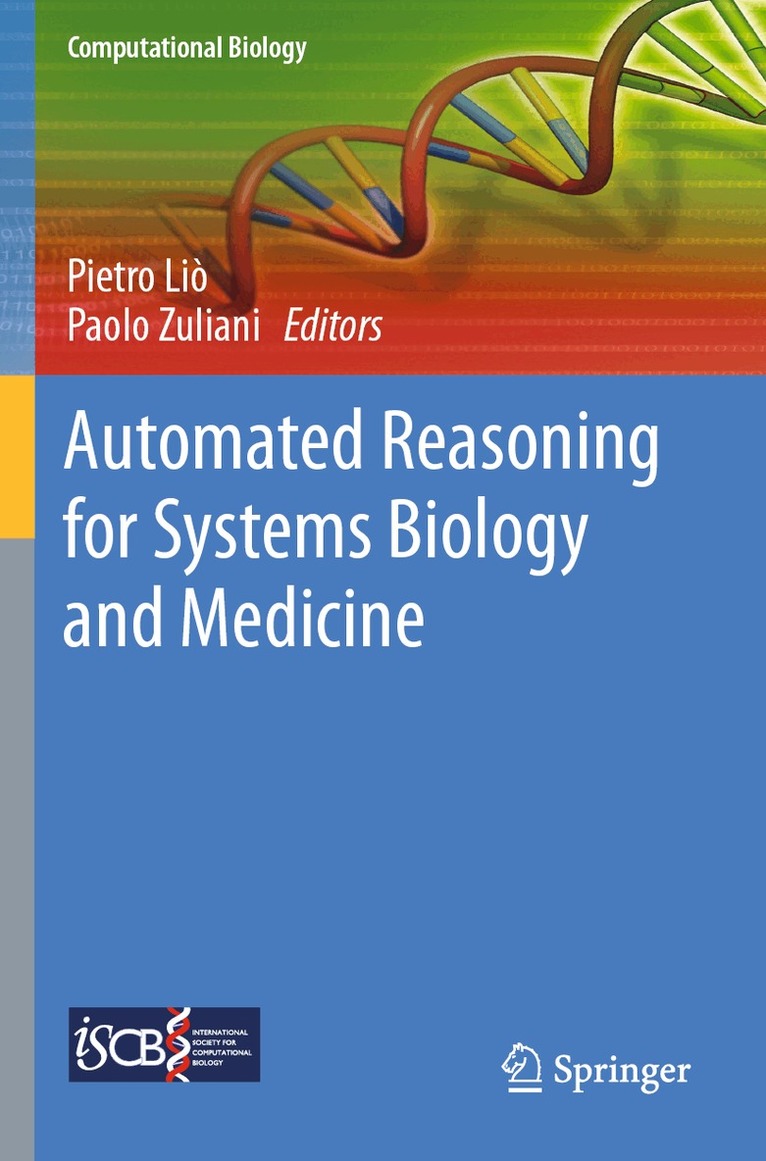
    Automated Reasoning for Systems Biology and Medicine

    AvPietro Liò,Paolo Zuliani

    Häftad, Engelska, 2020

    Del 30 i serien Computational Biology

    1 119 kr

    Beställningsvara. Skickas inom 10-15 vardagar. Fri frakt över 249 kr.

    Beskrivning

    This book presents outstanding contributions in an exciting, new and multidisciplinary research area: the application of formal, automated reasoning techniques to analyse complex models in systems biology and systems medicine. Automated reasoning is a field of computer science devoted to the development of algorithms that yield trustworthy answers, providing a basis of sound logical reasoning. For example, in the semiconductor industry formal verification is instrumental to ensuring that chip designs are free of defects (or “bugs”). Over the past 15 years, systems biology and systems medicine have been introduced in an attempt to understand the enormous complexity of life from a computational point of view. This has generated a wealth of new knowledge in the form of computational models, whose staggering complexity makes manual analysis methods infeasible. Sound, trusted, and automated means of analysing the models are thus required in order to be able to trust their conclusions. Above all, this is crucial to engineering safe biomedical devices and to reducing our reliance on wet-lab experiments and clinical trials, which will in turn produce lower economic and societal costs. Some examples of the questions addressed here include: Can we automatically adjust medications for patients with multiple chronic conditions? Can we verify that an artificial pancreas system delivers insulin in a way that ensures Type 1 diabetic patients never suffer from hyperglycaemia or hypoglycaemia? And lastly, can we predict what kind of mutations a cancer cell is likely to undergo? This book brings together leading researchers from a number of highly interdisciplinary areas, including: · Parameter inference from time series · Model selection · Network structure identification · Machine learning · Systems medicine · Hypothesis generation from experimental data · Systems biology, systems medicine, and digital pathology · Verification of biomedical devices “This book presents a comprehensive spectrum of model-focused analysis techniques for biological systems ...an essential resource for tracking the developments of a fast moving field that promises to revolutionize biology and medicine by the automated analysis of models and data.”Prof Luca Cardelli FRS, University of Oxford

    Produktinformation

    • Utgivningsdatum:2020-08-15
    • Mått:155 x 235 x 25 mm
    • Vikt:835 g
    • Format:Häftad
    • Språk:Engelska
    • Serie:Computational Biology
    • Antal sidor:474
    • Förlag:Springer Nature Switzerland AG
    • ISBN:9783030172992

    Utforska kategorier

    • Artificiell intelligens inom Data och IT
    • Medicinsk utrustning och medicinska tekniker inom Medicin
    • Biovetenskap inom Naturvetenskap och teknik

    Mer om författaren

    Dr. Paolo Zuliani is a Senior Lecturer at the School of Computing at Newcastle University, UK. He received his Laurea degree in Computer Science from the Università degli Studi di Milano, Italy, and his DPhil in Computer Science from the University of Oxford, UK. Dr. Zuliani's areas of expertise include formal and automated reasoning methods for computing systems, with a focus on probabilistic and quantum systems. He is particularly interested in the verification of biological systems, cyber-physical systems, and quantum programs. Pietro Liò is a Professor of Computational Biology at the Department of Computer Science and Technology at the University of Cambridge, UK. He holds a PhD in Complex Systems and Non Linear Dynamics (University of Firenze, Italy) and a PhD in Genetics (University of Pavia, Italy). His research interests include developing methodologies by integrating bioinformatics, machine learning and modelling approaches. In particular, he is interestedin artificial intelligence/machine learning and computational biology methods for biological and health data, predictive models in personalised and precision medicine, machine learning methods for the integration of multi-scale, multi-omics and multi-physics data, and predictive comorbidity models. He is on the steering committee of Cambridge Big Data, the MPhil in Computational Biology and the UK Virtual Physiological Human.

    Innehållsförteckning

    • Part I: Model Checking.- Chapter 1. Model Checking Approach to the Analysis of Biological Systems.- Chapter2. Automated Reasoning for the Synthesis and Analysis of Biological Programs.- Chapter 3. Statistical Model Checking based Analysis Techniques of Biological Networks.- Chapter 4. Models, Devices, Properties and Verification for the Artificial Pancreas.- Chapter 5. Using State Space Exploration to Determine How Gene Regulatory Networks Constrain Mutation Order in Cancer Evolution.- Part II: Formal Methods and Logic.- Chapter 6. Set-based Analysis for Biological Modelling.- Chapter 7. Logic and Linear Programs to Understand Cancer Response.- Chapter 8. Logic-Based Formalization of System Requirements for Integrated Clinical Environments.- Chapter 9. Balancing prescriptions with Constraint Solvers.- Chapter 10. Metastable Regimes and Tipping Points of Biochemical Networks with Potential Applications in Precision Medicine.- Part III:  Stochastic Modelling and Analysis.-Chapter 11. Stochastic Spatial Modelling of the Remyelination Process in Multiple Sclerosis Lesions.- Chapter 12. Approximation Techniques for Stochastic Analysis of Biological Systems.- Chapter 13. A Graphical Approach for the Hybrid Modelling of Intracellular Calcium Dynamics Based on Coloured Hybrid Petri Nets.- Chapter 14. Methods for Personalised Delivery Rate Computation for IV Administered Anesthetic Propofol.- Part IV: Machine Learning and Artificial Intelligence.- Chapter 15. Towards the Integration of Metabolic Network Modelling and Machine Learning for the Routine Analysis of High-Throughput Patient Data.- Chapter 16. Opportunities and Challenges in Applying Artificial Intelligence to Bioengineering.- Chapter 17. Deep Learning with Convolutional Neural Networks for Histopathology Image Analysis.