• Fri frakt över 249 kr
  • •
  • Snabba leveranser
  • •
  • Billiga böcker
Kundservice

Du är på sajten för privatpersoner.

Företag, bibliotek eller offentlig verksamhet?

Du handlar på classic.bokus.com, där alla dina funktioner finns intakta.
Till classic.bokus.com
Bokus logotyp. Gå till startsidan.
  • Erbjudanden
  • Nyheter
  • Student
  • Topplistor
  • Barn & ungdom
  • Bokus Play
  • E-böcker
  • Pocketböcker
  • Spel & pussel

10% rabatt på allt med kod: NYSTART10 →

Sidfot

Mina sidor

    Hjälp

    • Kundservice
    • Vanliga frågor och svar
    • Frakt och leverans
    • Retur vid ångerrätt
    • Reklamera vara
    • Betalning
    • Köpvillkor
    • Allmänna villkor
    • Information om webbplatsens tillgänglighet

    Om Bokus

    • Om oss
    • Pressrum
    • För studenter
    • För företag
    • För bibliotek och offentlig verksamhet
    • För leverantörer
    • Hållbarhet

    Populärt

    • Aktuella erbjudanden
    • Presentkort
    • Studentlitteratur
    • Nya böcker
    • Topplistor
    • Signerade böcker
    • Engelska böcker

    Inspiration

    • Boktips
    • BookTok
    • Populära bokserier
    • Barnbokskaraktärer
    • Populära författare
    Logotyp för Bokus
    Följ oss på Facebook (extern länk)Följ oss på Instagram (extern länk)Följ oss på YouTube (extern länk)Följ oss på TikTok (extern länk)
    bokus @ CookiesAnpassa cookiesIntegritetspolicyKöpvillkor
    Till Citymail hemsida (extern länk)Till Budbee hemsida (extern länk)Till Postnord hemsida (extern länk)Till Schenker hemsida (extern länk)Till Early Bird hemsida (extern länk)Till Walleys hemsida (extern länk)
    1. Naturvetenskap och teknik
    2. Teknik och industri
    3. Biokemisk teknik

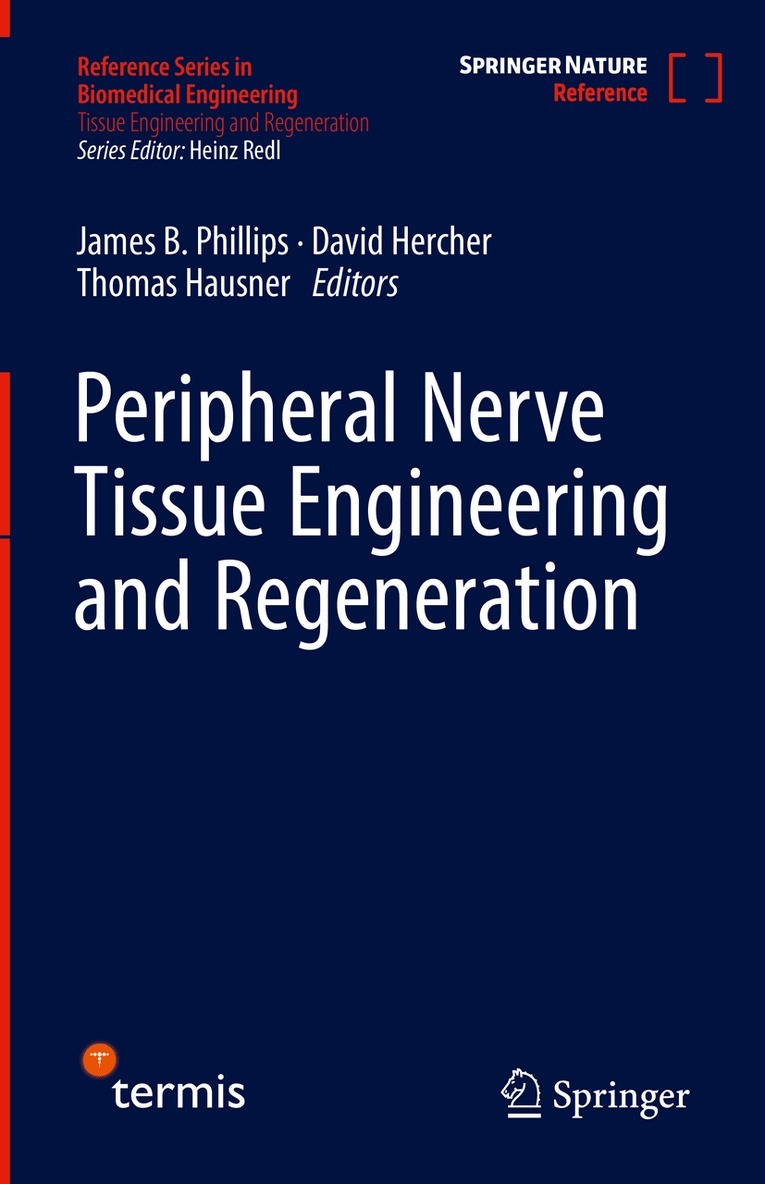
    Peripheral Nerve Tissue Engineering and Regeneration

    AvJames B. Phillips,David Hercher

    Inbunden, Engelska, 2022

    Del i serien Reference Series in Biomedical Engineering

    4 453 kr

    Beställningsvara. Skickas inom 10-15 vardagar. Fri frakt över 249 kr.

    Beskrivning

    This book provides an accessible informative overview of the current state of the art in nerve repair research.The introduction includes history of nerve repair research and establishes key concepts and terminology and is followed by sections that represent the main areas of interest in the field: (1) Biomaterials, (2) Therapeutic Cells, (3) Drug, Gene and Extracellular Vesicle Therapies, (4) Research Models and (5) Clinical Translation. Each section contains 3 - 6 chapters, capturing the full breadth of relevant technology. Bringing together diverse disciplines under one overarching theme echoes the multidisciplinary approach that underpins modern tissue engineering and regenerative medicine. Each chapter is written in an accessible manner that facilitates interest and understanding, providing a comprehensive single reference source. The updatable nature of the work will ensure that it can evolve to accommodate future changes and new technologies. The main readership of this work will be researchers and clinicians based in academic, industrial and healthcare settings all over the world.

    Produktinformation

    • Utgivningsdatum:2022-05-26
    • Mått:155 x 235 x 36 mm
    • Vikt:1 211 g
    • Format:Inbunden
    • Språk:Engelska
    • Serie:Reference Series in Biomedical Engineering
    • Antal sidor:612
    • Förlag:Springer Nature Switzerland AG
    • ISBN:9783030210519

    Utforska kategorier

    • Biokemisk teknik inom Naturvetenskap och teknik
    • Regenerativ medicin inom Medicin
    • Biomedicinsk teknik inom Medicin

    Mer om författaren

    James B. Phillips is Professor of Regenerative Medicine and Vice Dean (Innovation and Enterprise) in the Faculty of Life Sciences at University College London. He is also co-Director of the UCL Centre for Nerve Engineering and Chief Scientific Officer of the UCL spinout company Glialign Ltd. His research focus on translational neuroscience includes construction of living artificial tissues for regenerative medicine; developing novel cell, drug, gene, and biomaterial therapies for neural repair and protection; and advanced 3D co-culture models. Applications include treating and modeling neurodegenerative diseases and traumatic injury to peripheral nerves, the spinal cord, and the brain. His multi-disciplinary research group is based in the Department of Pharmacology at the UCL School of Pharmacy, and uses in silico, in vitro, in vivo, and clinical approaches. Professor Phillips has been involved in nerve tissue engineering and regeneration research for more than 20 years. His lab pioneered Engineered Neural Tissue (EngNT) and is developing other biomaterial and small molecule therapeutics to treat nerve injury, as well as investigating the cellular, molecular, and mechanical properties of nerves.David Hercher obtained his MSc in molecular biology from the University of Vienna and his Dr. scient. med. from the Medical University of Vienna. Since 2017, he is the head of the Neuroregeneration Group at the Ludwig Boltzmann Institute for Traumatology, where he has worked for 12 years in the field of regenerative medicine. His group focuses its research on the investigation of regenerative processes after injuries to the nervous system and the subsequent development of novel treatment options for peripheral and central nervous injuries. Furthermore, the group’s interests lie in the elucidation of modes of action of mechanical stimuli on neuronal/glial cells and tissues as well as non-viral gene therapy and novel imaging modalities and their application in the field of regenerative medicine.Thomas Hausner was born in Salzburg, Austria, in 1965. He is Doctor of Medicine since 1993. His specializations in Medicine are General and Visceral Surgery, Trauma Surgery, and Hand- and Microsurgery. Currently he is Head of AUVA Trauma Center Vienna, Lorenz Böhler, Austria, and Co-Director of Ludwig Boltzmann Institute for Traumatology, located at Trauma Center Lorenz Böhler. Postdoctoral Lecture Qualification for Trauma Surgery at Paracelsus Medical University Salzburg in 2015. His main field of research is regeneration of peripheral nerves after trauma. This includes effects of extracorporeal shock wave therapy on nerve regeneration, bridging nerve defects and neural plasticity after injury to the peripheral nerval system.Especially bridgingnerve defects is a tissue engineering topic, e.g., the development of nerve scaffolds and tubes from silk or different other materials. Furthermore, together with his fellows he is working on various aspects of hand trauma like scaphoid fractures and their delayed healing as well as distal radius fractures. A new field for the research group is the use artificial intelligence through deep learning systems in radiodiagnostic of fractures. Dr. Hausner is also member of the German Nerve Club, an interdisciplinary nerve study group.

    Innehållsförteckning

    • The History of Nerve Repair;- Part I: The Peripheral Nerve Repair Environment;- Part II: Models and Evaluation of Peripheral Nerve Regeneration;- Part III: Biomaterials for Peripheral Nerve Regeneration;- Part IV: Therapeutic Options for Peripheral Nerve Regeneration;- Part V: Clinical Aspects;-