• Fri frakt över 249 kr
  • •
  • Snabba leveranser
  • •
  • Billiga böcker
Kundservice

Du är på sajten för privatpersoner.

Företag, bibliotek eller offentlig verksamhet?

Du handlar på classic.bokus.com, där alla dina funktioner finns intakta.
Till classic.bokus.com
Bokus logotyp. Gå till startsidan.
  • Erbjudanden
  • Nyheter
  • Student
  • Topplistor
  • Barn & ungdom
  • Bokus Play
  • E-böcker
  • Pocketböcker
  • Spel & pussel

10% rabatt på allt med kod: NYSTART10 →

Sidfot

Mina sidor

    Hjälp

    • Kundservice
    • Vanliga frågor och svar
    • Frakt och leverans
    • Retur vid ångerrätt
    • Reklamera vara
    • Betalning
    • Köpvillkor
    • Allmänna villkor
    • Information om webbplatsens tillgänglighet

    Om Bokus

    • Om oss
    • Pressrum
    • För studenter
    • För företag
    • För bibliotek och offentlig verksamhet
    • För leverantörer
    • Hållbarhet

    Populärt

    • Aktuella erbjudanden
    • Presentkort
    • Studentlitteratur
    • Nya böcker
    • Topplistor
    • Signerade böcker
    • Engelska böcker

    Inspiration

    • Boktips
    • BookTok
    • Populära bokserier
    • Barnbokskaraktärer
    • Populära författare
    Logotyp för Bokus
    Följ oss på Facebook (extern länk)Följ oss på Instagram (extern länk)Följ oss på YouTube (extern länk)Följ oss på TikTok (extern länk)
    bokus @ CookiesAnpassa cookiesIntegritetspolicyKöpvillkor
    Till Citymail hemsida (extern länk)Till Budbee hemsida (extern länk)Till Postnord hemsida (extern länk)Till Schenker hemsida (extern länk)Till Early Bird hemsida (extern länk)Till Walleys hemsida (extern länk)
    1. Naturvetenskap och teknik
    2. Matematik och naturvetenskap
    3. Biologi
    4. Biovetenskap

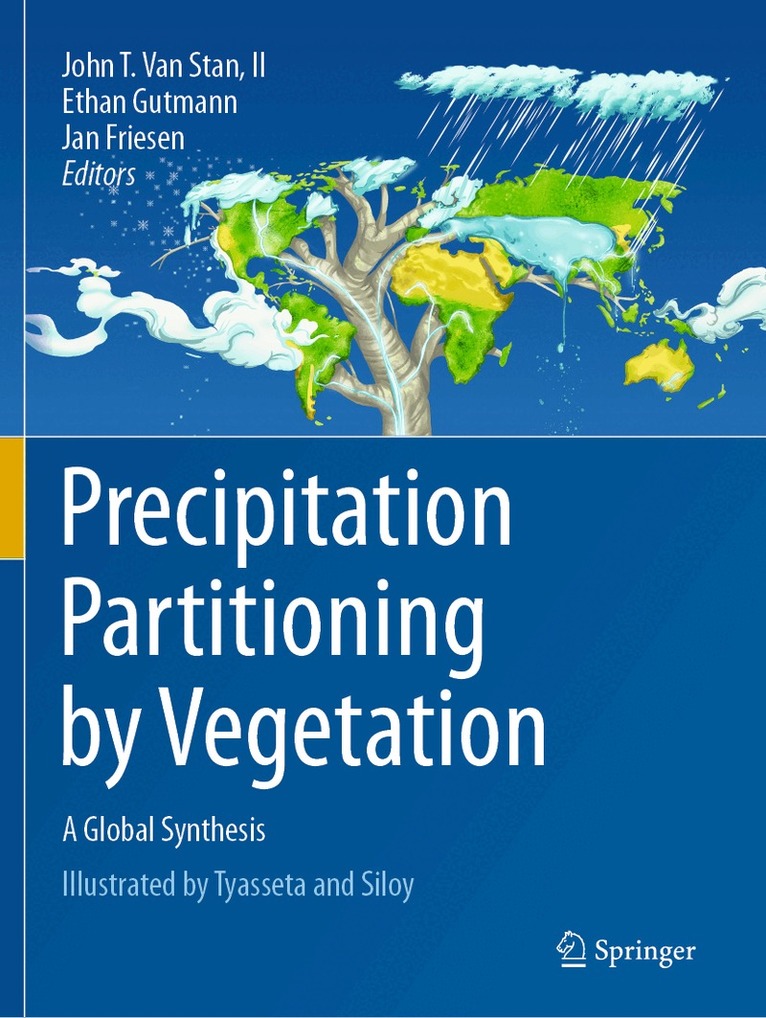
    Precipitation Partitioning by Vegetation

    A Global Synthesis

    AvJohn T. Van Stan, II,Ethan Gutmann

    Häftad, Engelska, 2021

    2 381 kr

    Beställningsvara. Skickas inom 10-15 vardagar. Fri frakt över 249 kr.

    Beskrivning

    This book presents research on precipitation partitioning processes in vegetated ecosystems, putting them into a global context. It describes the processes by which meteoric water comes into contact with the vegetation's canopy, typically the first surface contact of precipitation on land. It also discusses how precipitation partitioning by vegetation impacts the amount, patterning, and chemistry of water reaching the surface, as well as the amount and timing of evaporative return to the atmosphere. Although this process has been extensively studied, this is the first review of the global literature on the partitioning of precipitation by forests, shrubs, crops, grasslands and other less-studies plant types. The authors offer global contextualization combined with a detailed discussion of the impacts for the climate and terrestrial ecohydrological systems. As such, this comprehensive overview is a valuable reference tool for a wide range of specialists and students in the fields of geoscience and the environment.

    Produktinformation

    • Utgivningsdatum:2021-08-26
    • Mått:210 x 279 x 16 mm
    • Vikt:834 g
    • Format:Häftad
    • Språk:Engelska
    • Antal sidor:281
    • Förlag:Springer Nature Switzerland AG
    • Illustratör:A. Bagus Jati Tyasseta
    • ISBN:9783030297046

    Utforska kategorier

    • Biovetenskap inom Naturvetenskap och teknik
    • Geografi inom Naturvetenskap och teknik
    • Hydrologi inom Naturvetenskap och teknik

    Mer om författaren

    Dr. Van Stan is an ecohydrologist at Georgia Southern University in Savannah, Georgia (USA). He enjoys collecting field observations of water and elemental fluxes in vegetated ecosystems during storms—and developing sensors to overcome observational limitations when they arise. He has worked at sites in North and Central America and Europe to improve our understanding of how precipitation partitioning affects other ecosystem processes within, above and below plant canopies. Dr. Gutmann is a hydrologist in the Research Applications Lab at the National Center for Atmospheric Research in Boulder, Colorado (USA). His background in hydrology, geology, and computer science found a happy marriage in remote sensing and hydrological and atmospheric modeling. A passion for the outdoors has taken him to remote corners of the world, climbing mountains in Peru, Nepal and Tanzania. Ethan also enjoys scientific outreach, having dabbled in science blogging at arstechnica and science videography with Earth Initiatives. Dr. Friesen is an ecohydrologist at the Department of Catchment Hydrology, Helmholtz Centre for Environmental Research – UFZ, Leipzig (Germany). His research primarily focuses on forest ecohydrology, remote sensing, and sensor development where he applies and develops new monitoring solutions to bridge the gap between site studies and remote sensing. He has extensive experience in semi-arid and data scarce countries such as Ghana, Burkina Faso, Nigeria, and Oman and his work has a strong connection to water management issues.

    Innehållsförteckning

    • Foreword.- Chapter 1. History of canopy precipitation partitioning.- Chapter 2. Measurement of canopy interception.- Chapter 3. Measurement of throughfall.- Chapter 4. Measurement of stemflow.- Chapter 5. Residence time of precipitation entrained as throughfall and stemflow.- Chapter 6. Dissolved organic matter.- Chapter 7. Dissolved inorganic solutes.- Chapter 8. Isotopic composition.- Chapter 9. Particulate matter (including microbes) .- Chapter 10. Modelling of precipitation partitioning.- Chapter 11. Modelling of canopy exchange.- Chapter 12. Differences among precipitation types (Rain, fog, snow, rime) .- Chapter 13. Differences between plant functional types.- Chapter 14. Differences with stand age and management.- Chapter 15. Global patterns in precipitation partitioning.- Chapter 16. Relevance of precipitation partitioning to the global climate system.- Chapter 17. Precipitation recycling.- Chapter 18. Arboreal epiphytes and hemiparasites.- Chapter 19. Treehole ecosystems.-Chapter 20. Soil erosion.- Chapter 21. Soil physicochemical properties.- Chapter 22. Soil microbial community structure and function.- Chapter 23. Streams.- Chapter 24. Soil and groundwater .- Chapter 25. Reflections & future directions: Research opportunities in canopy precipitation partitioning.- Index.