• Fri frakt över 249 kr
  • •
  • Snabba leveranser
  • •
  • Billiga böcker
Kundservice

Du är på sajten för privatpersoner.

Företag, bibliotek eller offentlig verksamhet?

Du handlar på classic.bokus.com, där alla dina funktioner finns intakta.
Till classic.bokus.com
Bokus logotyp. Gå till startsidan.
  • Erbjudanden
  • Student
  • Topplistor
  • Barn & ungdom
  • Bokus Play
  • E-böcker
  • Ljudböcker
  • Pocketböcker
  • Spel och pussel

5% studentrabatt – använd koden KURSBOK27 →

Sidfot

Mina sidor

    Hjälp

    • Kundservice
    • Vanliga frågor och svar
    • Frakt och leverans
    • Retur vid ångerrätt
    • Reklamera vara
    • Betalning
    • Köpvillkor
    • Allmänna villkor
    • Information om webbplatsens tillgänglighet

    Om Bokus

    • Om oss
    • Pressrum
    • För studenter
    • För företag
    • För bibliotek och offentlig verksamhet
    • För leverantörer
    • Hållbarhet

    Populärt

    • Aktuella erbjudanden
    • Presentkort
    • Studentlitteratur
    • Nya böcker
    • Topplistor
    • Signerade böcker
    • Engelska böcker

    Inspiration

    • Boktips
    • BookTok
    • Barnbokskaraktärer
    • Populära författare
    Logotyp för Bokus
    Följ oss på Facebook (extern länk)Följ oss på Instagram (extern länk)Följ oss på YouTube (extern länk)Följ oss på TikTok (extern länk)
    bokus @ CookiesAnpassa cookiesIntegritetspolicyKöpvillkor
    Till Citymail hemsida (extern länk)Till Budbee hemsida (extern länk)Till Postnord hemsida (extern länk)Till Schenker hemsida (extern länk)Till Early Bird hemsida (extern länk)Till Walleys hemsida (extern länk)
    1. Samhälle och politik
    2. Samhälle och kultur
    3. Kultur och medier
    4. Referensverk och tvärvetenskap

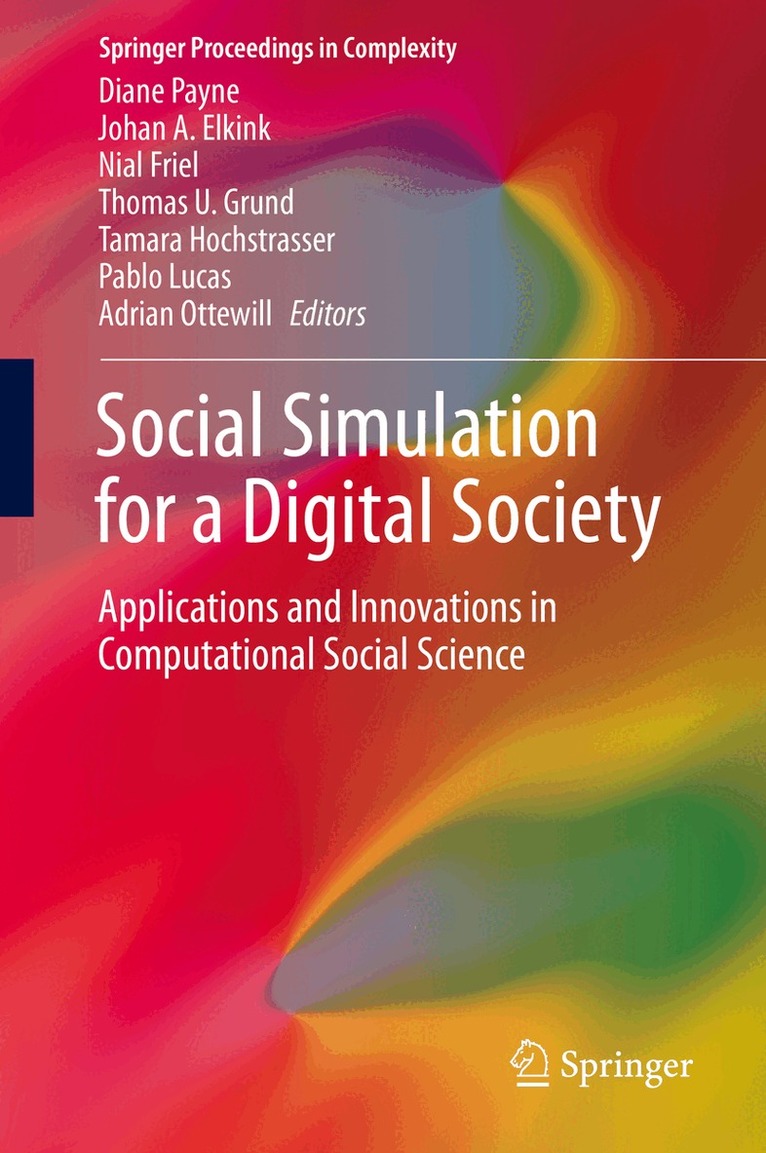
    Social Simulation for a Digital Society

    Applications and Innovations in Computational Social Science

    AvDiane Payne,Johan A. Elkink

    Inbunden, Engelska, 2019

    Del i serien Springer Proceedings in Complexity

    1 078 kr

    Beställningsvara. Skickas inom 10-15 vardagar. Fri frakt över 249 kr.

    Beskrivning

    “Social Simulation for a Digital Society” provides a cross-section of state-of-the-art research in social simulation and computational social science. With the availability of big data and faster computing power, the social sciences are undergoing a tremendous transformation. Research in computational social sciences has received considerable attention in the last few years, with advances in a wide range of methodologies and applications. Areas of application of computational methods range from the study of opinion and information dynamics in social networks, the formal modeling of resource use, the study of social conflict and cooperation to the development of cognitive models for social simulation and many more. This volume is based on the Social Simulation Conference of 2017 in Dublin and includes applications from across the social sciences, providing the reader with a demonstration of the highly versatile research in social simulation, with a particular focus on public policy relevance in a digital society.  Chapters in the book include contributions to the methodology of simulation-based research, theoretical and philosophical considerations, as well as applied work. This book will appeal to students and researchers in the field.

    Produktinformation

    • Utgivningsdatum:2019-12-02
    • Mått:155 x 235 x 18 mm
    • Vikt:512 g
    • Format:Inbunden
    • Språk:Engelska
    • Serie:Springer Proceedings in Complexity
    • Antal sidor:218
    • Förlag:Springer Nature Switzerland AG
    • ISBN:9783030302979

    Utforska kategorier

    • Referensverk och tvärvetenskap inom Samhälle och politik
    • Artificiell intelligens inom Data och IT
    • Sociologi inom Samhälle och politik

    Mer om författaren

    Diane Payne was Associate Professor in Sociology and director of the Dynamics Lab for Computational Social Science at University College Dublin. She obtained her PhD from the University of Groningen and held positions at University of Cambridge and Trinity College Dublin before. Diane passed away in April 2019.Johan A. Elkink is Associate Professor in Social Science Research Methods at University College Dublin. He specialises in quantitative methods in political science, in particular simulation-based research and spatial econometrics. Besides applications in voting behaviour in referendums and national elections, he wrote on the international diffusion of democracy and the evolution of personalist regimes. His work appeared, among other outlets, in the Journal of Politics, Comparative Political Studies, European Journal of Political Research and Electoral Studies.Nial Friel is Professor of Statistics at University College Dublin. His research is broadly focused on statistical network analysis, Bayesian statistics and Monte Carlo methods. He is especially interested in applications at the interface of these areas. He is currently the joint editor of the Journal of the Royal Statistical Society, Series C.Thomas U. Grund is Associate Professor in Sociology at University College Dublin and was Visiting Professor at the Institute of Sociology at University of Zurich and Simon Visiting Professor at the University of Manchester. He studied computer science and sociology at the University of Trier (Diplom), University of Cambridge (MPhil) and the University of Oxford (DPhil) and held postdoctoral positions at ETH Zurich, Universite de Montreal and Linkoping University. His main research interests include social network analysis and analytical sociology.Tamara Hochstrasser is an ecologist. For her doctoral research she has developed an individual-based vegetation model. Since joining UniversityCollege Dublin in 2003, she has contributed to research on modelling of greenhouse gas emissions from agricultural land, ecosystem services and biodiversity management in urban areas. Tamara is convinced that a transdisciplinary approach is needed for creating an effective evidence-base for decisions making. Some of her theoretical considerations about transdisciplinary research are captured in an agent-based model and in a course manual on knowledge creation at the science-practice interface that she uses for teaching and intends to publish.Pablo Lucas is a Lecturer at the University College Dublin, Ireland, with research focused on computational social science, particularly experimental designs using agent-based models and data analysis. His education include reading for a Bachelor of Science in Computer Science (BSc) focused on evolutionary networks, a Master of Philosophy (MPhil) and a Doctor of Philosophy(PhD) focused on agent-based (social) simulations using models of social behaviour.Adrian Ottewill is Full Professor of Mathematical Physics and has been a strong supporter of Computational Social Science research at UCD through his roles as Cluster Leader for Simulation Science of the UCD Complex and Adaptive Systems Laboratory and founding Director of the UCD Institute for Discovery.  Prof Ottewill holds a BA, DPhil and DSc from the University of Oxford and was elected a Member of the Royal Irish Academy in 1997.

    Innehållsförteckning

    • Chapter 1: Social Simulation for a Digital Society: IntroductionPhilosophical and technical considerationsChapter 2: Ontological Politics in a World of Political Ontologies: More Realistic (Human) Agents for the Anthropocene?Chapter 3: The Art of Iterating: Update-Strategies in Agent-Based SimulationChapter 4: Using Parallel Computing to Improve the Scalability of Models with BDI AgentsApplications to norm diffusion and collective actionChapter 5: Information Diffusion as a Mechanism for Natural Evolution of Social NetworksChapter 6: Remarks on the Convergence of Opinion Formation in the Presence of Self-interest and ConformityChapter 7: Inequality: Driver or Inhibitor of Collective Action?Chapter 8: The Venezuelan System of Potato Production: A Simulation Model to Understand Roots of DeficienciesApplications in geographyand urban developmentChapter 9: Governance of Transitions: A Simulation Experiment on Urban TransportationChapter 10: Evaluating the Impact of an Integrated Urban Design of Transport Infrastructure and Public Space on Human Behavior and Environmental Quality: A Case Study in BeijingChapter 11: Prescription for Urban Sprawl: Street Activeness Changes the CityChapter 12: The Greater Dublin Region, Ireland:  Experiences in Applying Urban Modelling in Regional Planning and Engaging between Scientists and StakeholdersChapter 13: Synthesising the Geography of Opportunity in Rural Irish Primary SchoolsChapter 14: Modelling Collaborative Knowledge Creation Processes: An Empirical Application to the Semiconductor Industry