Häftad, Engelska, 2020
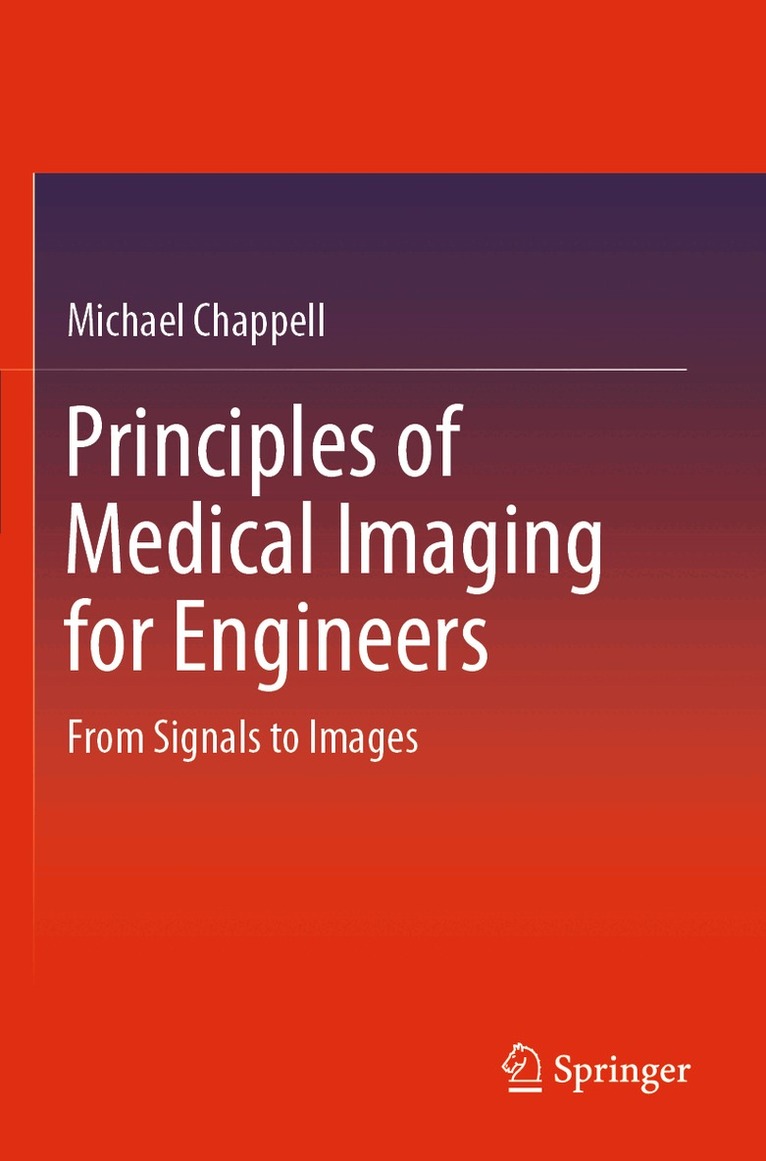
Principles of Medical Imaging for Engineers
741 kr
Beställningsvara. Skickas inom 11-20 vardagar. Fri frakt över 249 kr.
Beskrivning
This introduction to medical imaging introduces all of the major medical imaging techniques in wide use in both medical practice and medical research, including Computed Tomography, Ultrasound, Positron Emission Tomography, Single Photon Emission Tomography and Magnetic Resonance Imaging. Principles of Medical Imaging for Engineers introduces fundamental concepts related to why we image and what we are seeking to achieve to get good images, such as the meaning of 'contrast' in the context of medical imaging. This introductory text separates the principles by which 'signals' are generated and the subsequent 'reconstruction' processes, to help illustrate that these are separate concepts and also highlight areas in which apparently different medical imaging methods share common theoretical principles. Exercises are provided in every chapter, so the student reader can test their knowledge and check against worked solutions and examples.
The text considers firstly the underlying physical principles by which information about tissues within the body can be extracted in the form of signals, considering the major principles used: transmission, reflection, emission and resonance. Then, it goes on to explain how these signals can be converted into images, i.e., full 3D volumes, where appropriate showing how common methods of 'reconstruction' are shared by some imaging methods despite relying on different physics to generate the 'signals'. Finally, it examines how medical imaging can be used to generate more than just pictures, but genuine quantitative measurements, and increasingly measurements of physiological processes, at every point within the 3D volume by methods such as the use of tracers and advanced dynamic acquisitions.
Principles of Medical Imaging for Engineers will be of use to engineering and physical science students and graduate students with an interest in biomedical engineering, and to their lecturers.
Produktinformation
- Utgivningsdatum: 2020-10-17
- Mått: 155 x 235 x undefined mm
- Vikt: 289 g
- Format: Häftad
- Språk: Engelska
- Antal sidor: 169
- Förlag: Springer Nature Switzerland AG
- ISBN: 9783030305130
Utforska kategorier
Betyg & recensioner
0 recensioner
Inga recensioner tillgängliga.