• Fri frakt över 249 kr
  • •
  • Snabba leveranser
  • •
  • Billiga böcker
Kundservice

Du är på sajten för privatpersoner.

Företag, bibliotek eller offentlig verksamhet?

Du handlar på classic.bokus.com, där alla dina funktioner finns intakta.
Till classic.bokus.com
Bokus logotyp. Gå till startsidan.
  • Erbjudanden
  • Nyheter
  • Student
  • Topplistor
  • Barn & ungdom
  • Bokus Play
  • E-böcker
  • Pocketböcker
  • Spel & pussel

10% studentrabatt med kod TERM26

Sidfot

Mina sidor

    Hjälp

    • Kundservice
    • Vanliga frågor och svar
    • Frakt och leverans
    • Retur vid ångerrätt
    • Reklamera vara
    • Betalning
    • Köpvillkor
    • Allmänna villkor
    • Information om webbplatsens tillgänglighet

    Om Bokus

    • Om oss
    • Pressrum
    • För studenter
    • För företag
    • För bibliotek och offentlig verksamhet
    • För leverantörer
    • Hållbarhet

    Populärt

    • Aktuella erbjudanden
    • Presentkort
    • Studentlitteratur
    • Nya böcker
    • Topplistor
    • Signerade böcker
    • Engelska böcker

    Inspiration

    • Boktips
    • BookTok
    • Populära bokserier
    • Barnbokskaraktärer
    • Populära författare
    Logotyp för Bokus
    Följ oss på Facebook (extern länk)Följ oss på Instagram (extern länk)Följ oss på YouTube (extern länk)Följ oss på TikTok (extern länk)
    bokus @ CookiesAnpassa cookiesIntegritetspolicyKöpvillkor
    Till Citymail hemsida (extern länk)Till Budbee hemsida (extern länk)Till Postnord hemsida (extern länk)Till Schenker hemsida (extern länk)Till Early Bird hemsida (extern länk)Till Walleys hemsida (extern länk)
    1. Naturvetenskap och teknik
    2. Geovetenskap
    3. Miljövetenskap och miljöpolitik

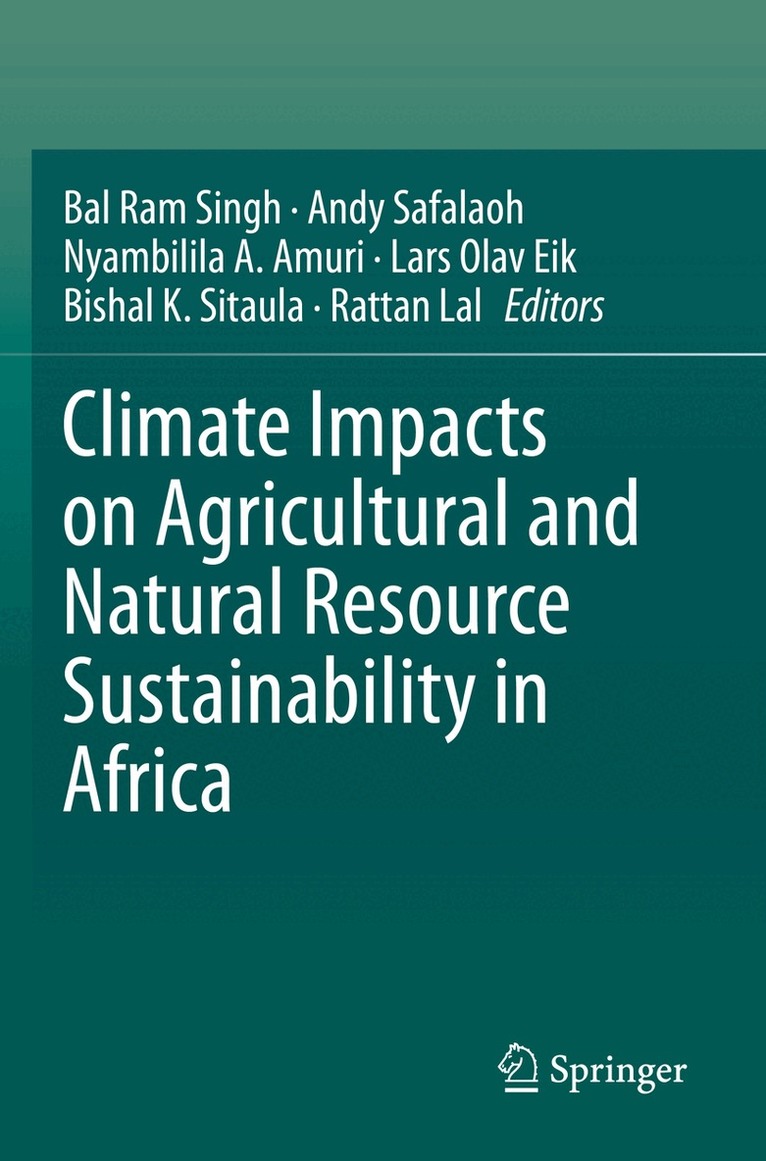
    Climate Impacts on Agricultural and Natural Resource Sustainability in Africa

    AvBal Ram Singh,Andy Safalaoh

    Häftad, Engelska, 2021

    1 634 kr

    Beställningsvara. Skickas inom 10-15 vardagar. Fri frakt över 249 kr.

    Beskrivning

    This book discusses knowledge-based sustainable agro-ecological and natural resource management systems and best practices for sustained agricultural productivity and ecosystem resilience for better livelihoods under a changing climate. With a focus on agriculture in Africa, the book assesses innovative technologies for use on smallholder farms, and addresses some of the key Sustainable Development Goals to guide innovative responses and enhanced adaptation methods for coping with climate change.Contributions are based on 'Capacity Building for Managing Climate Change in Malawi' (CABMACC), a five-year program with an overall goal to improve livelihoods and food security through innovative responses and enhanced capacity of adaptation to climate change. Readers will discover more about sustainable crop production, climate smart agriculture, on-farm energy supply from biogas and the potential of soil carbon sequestration in crop-livestock systems.

    Produktinformation

    • Utgivningsdatum:2021-03-18
    • Mått:155 x 235 x 36 mm
    • Vikt:978 g
    • Format:Häftad
    • Språk:Engelska
    • Antal sidor:637
    • Förlag:Springer Nature Switzerland AG
    • ISBN:9783030375393

    Utforska kategorier

    • Miljövetenskap och miljöpolitik inom Naturvetenskap och teknik
    • Agronomi inom Naturvetenskap och teknik

    Mer om författaren

    Dr. Bal Ram Singh is a Professor Emeritus in the Faculty of Environmental Sciences and Natural Resource Management at the Norwegian University of Life Sciences. Dr. Andy Safalaoh is an Associate Professor in the Department of Animal Science, Faculty of Agriculture, at Lilongwe University of Agriculture and Natural Resources, Malawi. Dr. Nyambilia A. Amuri is a Senior Lecturer in the Department of Soil and Geological Sciences at Sokoine University of Agriculture. Dr. Lars Olav Eik is a Professor in the Department of International Environment and Development Studies at the Norwegian University of Life Sciences. Dr. Bishal Sitaula is a Professor in the Department of International Environment and Development Studies at the Norwegian University of Life Sciences. Dr. Rattan Lal is a Professor in the School of Environment and Natural Resources, Carbon Management and Sequestration Center, at the Ohio State University.

    Innehållsförteckning

    • PartI: Introduction.- Chapter1: Agricultural and Natural Resource Sustainability under changing climate in Africa.- PartII: Conservation Agriculture, carbon sequestration and soil and water management.- Chapter2: The Prospects for Conservation Agriculture in Ethiopia.- Chapter3: Land Use Changes and Sustainable Land Management Practices for Soil Carbon Sequestration in Sub-Saharan African Agro-Ecosystems.- Chapter4:  Gendered adaptation and coping mechanisms to climate variability in Eastern Uganda rice farming systems.- Chapter5: Integrated soil fertility management based on pigeon pea and cowpea cropping systems influences nitrogen use efficiency, yields and quality of subsequent maize on Alfisols in central Malawi.- Chapter6: A Hydrological Assessment of Wetlands in Lilongwe Peri-Urban Areas: A Case of Njewa, Catchment, Lilongwe Malawi.- PartIII: Sustainable crop/livestock/aquaculture/fish production.- Chapter7: Productivity and chemical composition of maize stover and rice straw under smallholder farming systems intensification in Tanzania.- Chapter8: INTENSIFICATION OF SORGHUM AND PEARL MILLET PRODUCTION IN THE SAHEL-SUDANIAN CLIMATIC ZONES OF MALI.- Chapter9: Impact of climate variability on the use and exposure of pesticides in sugarcane production in Malawi.- Chapter10: Yield and profitability of cotton grown under smallholder organic and conventional cotton farming systems in Meatu District, Tanzania.- Chapter11: In Search of Climate-Smart Feeds: The Potential of Pearl Millet (Pennisetum glaucum, L) to replace maize as an energy feed ingredient in broiler diets in Malawi.- Chapter12: Climate Change and Weather Variability Effects on Cattle Production: Perception of Cattle Keepers in Chikwawa, Malawi.- Chapter13: A cohort study of reproductive performance, associated infections and management factorsin Zebu cows from smallholder farms in Malawi.- Chapter14: Effect of dry season supplement feeding of Malawi Zebu cows on reproductive performance, lactation and weight gain in calves.- Chapter15: Effects of concentrate supplementation on the fatty acid composition of fat depots in crossbred goats.- Chapter16: Goat milk quality and possible dairy products  from rural households of Tanzania and Malawi under the Farmers-Processor’s partnership.- Chapter17: The need for farmer support and record keeping to enhance sustainable dairy goats breeding in Tanzania and Malawi.- Chapter18: Stratified livestock production and live animal and meat export from Ethiopia: Lessons from the experience of a donor funded project.- Chapter19: Of ‘white elephants’ in fisheries: A conflict resolution model around the usage of climate-smart fish postharvest  technologies in Lake Malawi .- PartIV: Policy and Institutions for sustainable agriculture and natural resource management.- Chapter20: Policy and Action for food and climate uncertainties in Malawi.- Chapter21: Need for personal transformations in a changing climate: reflections on environmental change and climate-smart agriculture in Africa.- PartV: Value addition options for smallholder market access and integration.- Chapter22: Between the Sun and Fish are People: A Socio-Economic Study of Solar Dryers for Fish Processing in Malawi.- Chapter23: Profitability of supplementary feeding of indigenous cattle in dry areas of Tanzania.- Chapter24: Integrating smallholder farmers to commodity value chains in sub-Saharan Africa: Challenges, prospects and policy issues.- Chapter25: Economic Rationale of Using African Weaver ants, Oecophylla longinoda Latreille (Hymenoptera : Formicidae) for Sustainable Management of Cashew Pests in Tanzania.- PartVI: Upscaling innovative technologies on smallholder farms.- Chapter26: Determinants of ISFM Technology Adoption and Dis-adoption Among Smallholder Maize Farmers in Central Malawi.- Chapter27: Exploiting arbuscular mycorrhizal fungi-rhizobia-legume symbiosis to increase smallholder farmers’ crop production and resilience under a changing climate.- Chapter28: Availability, access and use of weather and climate information by smallholder farmers in the Kilombero River Catchment, Tanzania.- Chapter29: Gender differentiation in the adoption of climate smart agriculture technologies and level of adaptive capacity to Climate Change in Malawi.- Chapter30: Smallholder farming in Mara and Iringa Regions, Tanzania: Current practices, Constraints and Opportunities.- Chapter31: Impact of Farm Input Subsidies vis-à-vis Climate-Smart Technologies on Maize Productivity: A Tale of Smallholder Farmers in Malawi.- Chapter32: Digital storytelling as an agricultural extension communication tool in smallholder farming and fishing communities in Malawi.- Chapter33: Assessing the role of storytelling presentation in knowledge transfer from climate change projects in Tanzania: The case of the EPINAV programme.- PartVII: Conclusion.- Chapter34: Knowledge gaps and research priorities.