• Fri frakt över 249 kr
  • •
  • Snabba leveranser
  • •
  • Billiga böcker
Kundservice

Du är på sajten för privatpersoner.

Företag, bibliotek eller offentlig verksamhet?

Du handlar på classic.bokus.com, där alla dina funktioner finns intakta.
Till classic.bokus.com
Bokus logotyp. Gå till startsidan.
  • Erbjudanden
  • Nyheter
  • Student
  • Topplistor
  • Barn & ungdom
  • Bokus Play
  • E-böcker
  • Pocketböcker
  • Spel & pussel

10% rabatt på allt med kod NYSTART10 →

Sidfot

Mina sidor

    Hjälp

    • Kundservice
    • Vanliga frågor och svar
    • Frakt och leverans
    • Retur vid ångerrätt
    • Reklamera vara
    • Betalning
    • Köpvillkor
    • Allmänna villkor
    • Information om webbplatsens tillgänglighet

    Om Bokus

    • Om oss
    • Pressrum
    • För studenter
    • För företag
    • För bibliotek och offentlig verksamhet
    • För leverantörer
    • Hållbarhet

    Populärt

    • Aktuella erbjudanden
    • Presentkort
    • Studentlitteratur
    • Nya böcker
    • Topplistor
    • Signerade böcker
    • Engelska böcker

    Inspiration

    • Boktips
    • BookTok
    • Populära bokserier
    • Barnbokskaraktärer
    • Populära författare
    Logotyp för Bokus
    Följ oss på Facebook (extern länk)Följ oss på Instagram (extern länk)Följ oss på YouTube (extern länk)Följ oss på TikTok (extern länk)
    bokus @ CookiesAnpassa cookiesIntegritetspolicyKöpvillkor
    Till Citymail hemsida (extern länk)Till Budbee hemsida (extern länk)Till Postnord hemsida (extern länk)Till Schenker hemsida (extern länk)Till Early Bird hemsida (extern länk)Till Walleys hemsida (extern länk)
    1. Djur och Natur
    2. Naturböcker
    3. Växtböcker

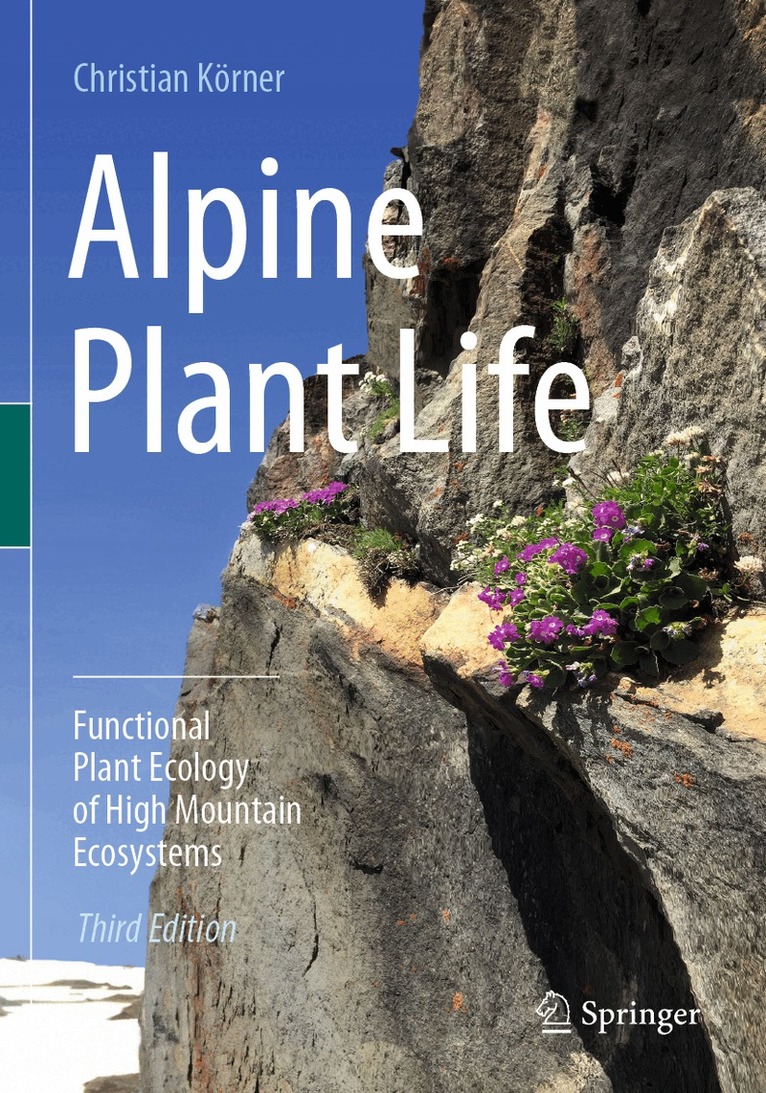
    Alpine Plant Life

    Functional Plant Ecology of High Mountain Ecosystems

    AvChristian Körner

    Inbunden, Engelska, 2021

    1 194 kr

    Beställningsvara. Skickas inom 10-15 vardagar. Fri frakt över 249 kr.

    Fler format och utgåvor

    Häftad

    762 kr

    Beskrivning

    This book is a completely revised, substantially extended treatment of the physical and biological factors that drive life in high mountains. The book covers the characteristics of alpine plant life, alpine climate and soils, life under snow, stress tolerance, treeline ecology, plant water, carbon, and nutrient relations, plant growth and productivity, developmental processes, and two largely novel chapters on alpine plant reproduction and global change biology. The book explains why the topography driven exposure of plants to dramatic micro-climatic gradients over very short distances causes alpine biodiversity to be particularly robust against climatic change. Geographically, this book draws on examples from all parts of the world, including the tropics. This book is complemented with novel evidence and insight that emerged over the last 17 years of alpine plant research. The number of figures – mostly in color – nearly doubled, with many photographs providing a vividimpression of alpine plant life worldwide.Christian Körner was born in 1949 in Austria, received his academic education at the University of Innsbruck, and was full professor of Botany at the University of Basel from 1989 to 2014. As emeritus Professor he is continuing alpine plant research in the Swiss Alps.

    Produktinformation

    • Utgivningsdatum:2021-04-01
    • Mått:178 x 254 x 32 mm
    • Vikt:1 224 g
    • Format:Inbunden
    • Språk:Engelska
    • Antal sidor:500
    • Upplaga:3
    • Förlag:Springer Nature Switzerland AG
    • ISBN:9783030595371
    • Originaltitel:Alpine Plant Life

    Utforska kategorier

    • Växtböcker inom Djur och Natur
    • Botanik inom Naturvetenskap och teknik
    • Miljövetenskap och miljöpolitik inom Naturvetenskap och teknik

    Mer om författaren

    Christian Körner was born in 1949 in Austria, received his academic education at the University of Innsbruck, and was full professor of Botany at the University of Basel from 1989 to 2014. As emeritus Professor he is continuing alpine plant research in the Swiss Alps.

    Recensioner i media

    “For me, the greatest appeal of this book is its strong anchoring in our shared cultural history of scientific research on alpine systems and its more personal, respectful attention towards alpine plants. … Körner’s book provides a valuable reference that points to how we may consider modifying our interactions to support the long-term integrity of life at the edges of the earth. … it provides motivation and tools for improving our responsible stewardship of life beyond the treeline.” (Jill Johnstone,Mountain Research and Development, Vol. 41 (4), 2021)

    Innehållsförteckning

    • PRELIMINARY (ToC of second edition) 1 Plant ecology at high elevations.- The concept of limitation.- A regional and historical account.- The challenge of alpine plant research.- 2 The alpine life zone.- Altitudinal boundaries.- Global alpine land area.- Alpine plant diversity.- Origin of alpine floras.- Alpine growth forms.- 3 Alpine climate.- Which alpine climate.- Common features of alpine climates.- Regional features of alpine climates.- 4 The climate plants experience.- Interactions of relief, wind and sun.- How alpine plants influence their climate.- The geographic variation of alpine climate.- 5 Life under snow: protection and limitation.- Temperatures under snow.- Solar radiation under snow.- Gas concentrations under snow.- Plant responses to snowpack.- 6 Alpine soils.- Physics of alpine soil formation.- The organic compound.- The interaction of organic and inorganic compounds.- 7 Alpine treelines.- About trees and lines.- Current altitudinal positions of climatic treelines.- Treeline-climate relationships.- Intrazonal variations and pantropical plateauing of alpine treelines.- Treelines in the past.- Attempts at a functional explanation of treelines.- A hypothesis for treeline formation.- Growth trends near treelines.- Evidence for sink limitation.- 8 Climatic stress.- Survival of low temperature extremes.- Avoidance and tolerance of low temperature extremes.- Heat stress in alpine plants.- Ultraviolet radiation — a stress factor.- 9 Water relations.- Ecosystem water balance.- Soil moisture at high altitudes.- Plant water relations — a brief review of principles.- Water relations of alpine plants.- Desiccation stress.- Water relations of special plant types.- 10 Mineral nutrition.- Soil nutrients.- The nutrient status of alpine plants.- Nutrient cycling and nutrient budgets.- Nitrogen fixation.- Mycorrhiza.- Responses of vegetation to variable nutrient supply.- 11 Uptake and loss of carbon.- Photosynthetic capacity of alpine plants.- Photosynthetic responses to the environment.- Daily carbon gain of leaves.- The seasonal carbon gain of leaves.- C4 and CAM photosynthesis at high altitudes.- Tissue respiration of alpine plants.- Ecosystem carbon balance.- 12 Carbon investments.- Non-structural carbohydrates.- Lipids and energy content.- Carbon costs of leaves and roots.- Whole plant carbon allocation.- 13 Growth dynamics and phenology.- Seasonal growth.- Diurnal leaf extension.- Rates of plant dry matter accumulation.- Functional duration of leaves and roots.- 14 Cell division and tissue formation.- Cell size and plant size.- Mitosis and the cell cycle.- From meristem activity to growth control.- 15 Plant biomass production.- The structure of alpine plant canopies.- Primary productivity of alpine vegetation.- Plant dry matter pools.- Biomass losses through herbivores.- 16 Plant reproduction.- Flowering and pollination.- Seed development and seed size.- Germination.- Alpine seed banks and natural recruitment.- Clonal propagation.- Alpine plant age.- Community processes.- 17 Global change at high elevation.- Alpine land use.- The impact of altered atmospheric chemistry.- Climatic change and alpine ecosystems.- References (with chapter annotation).- Taxonomic index (genera).- Geographical index.- Color plates.- Plant life forms.- The alpine life zone.- Environmental stress.- The human dimension.