• Fri frakt över 249 kr
  • •
  • Snabba leveranser
  • •
  • Billiga böcker
Kundservice

Du är på sajten för privatpersoner.

Företag, bibliotek eller offentlig verksamhet?

Du handlar på classic.bokus.com, där alla dina funktioner finns intakta.
Till classic.bokus.com
Bokus logotyp. Gå till startsidan.
  • Erbjudanden
  • Nyheter
  • Student
  • Topplistor
  • Barn & ungdom
  • Bokus Play
  • E-böcker
  • Pocketböcker
  • Spel & pussel

10% rabatt på allt med kod NYSTART10 →

Sidfot

Mina sidor

    Hjälp

    • Kundservice
    • Vanliga frågor och svar
    • Frakt och leverans
    • Retur vid ångerrätt
    • Reklamera vara
    • Betalning
    • Köpvillkor
    • Allmänna villkor
    • Information om webbplatsens tillgänglighet

    Om Bokus

    • Om oss
    • Pressrum
    • För studenter
    • För företag
    • För bibliotek och offentlig verksamhet
    • För leverantörer
    • Hållbarhet

    Populärt

    • Aktuella erbjudanden
    • Presentkort
    • Studentlitteratur
    • Nya böcker
    • Topplistor
    • Signerade böcker
    • Engelska böcker

    Inspiration

    • Boktips
    • BookTok
    • Populära bokserier
    • Barnbokskaraktärer
    • Populära författare
    Logotyp för Bokus
    Följ oss på Facebook (extern länk)Följ oss på Instagram (extern länk)Följ oss på YouTube (extern länk)Följ oss på TikTok (extern länk)
    bokus @ CookiesAnpassa cookiesIntegritetspolicyKöpvillkor
    Till Citymail hemsida (extern länk)Till Budbee hemsida (extern länk)Till Postnord hemsida (extern länk)Till Schenker hemsida (extern länk)Till Early Bird hemsida (extern länk)Till Walleys hemsida (extern länk)
    1. Ekonomi och Ledarskap
    2. Ledarskapsböcker

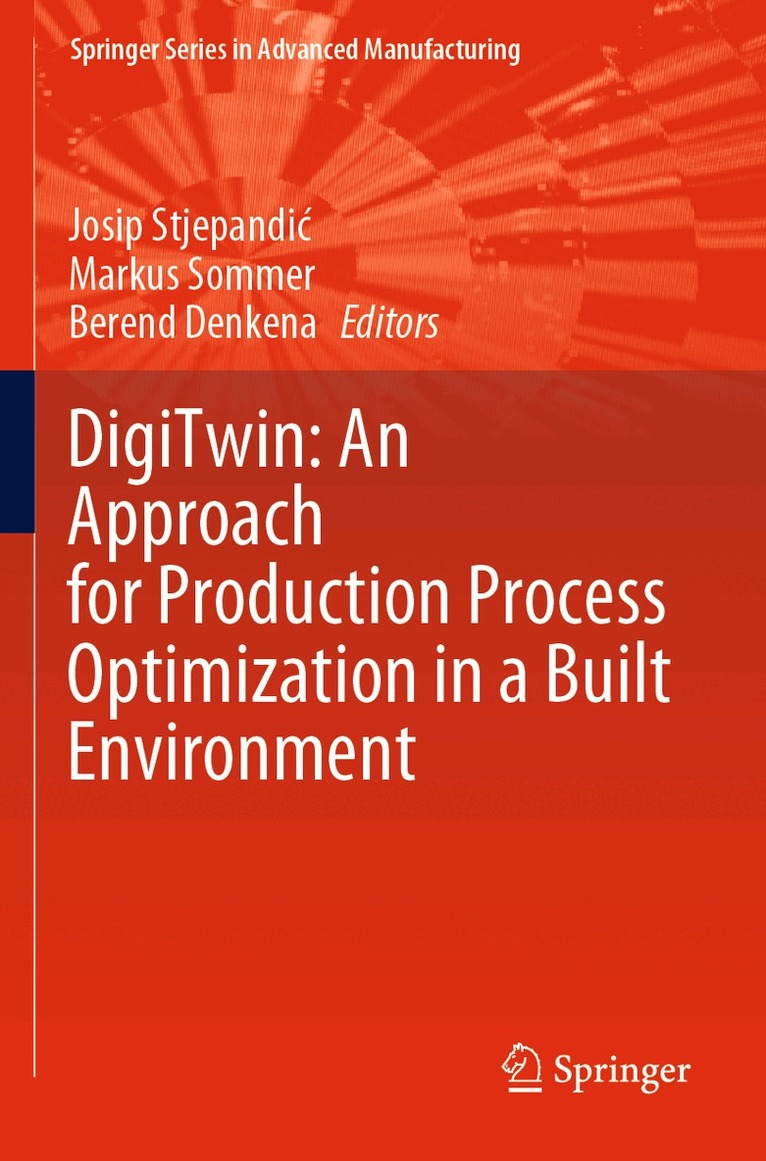
    DigiTwin: An Approach for Production Process Optimization in a Built Environment

    AvJosip Stjepandić,Markus Sommer

    Häftad, Engelska, 2022

    Del i serien Springer Series in Advanced Manufacturing

    1 623 kr

    Beställningsvara. Skickas inom 10-15 vardagar. Fri frakt över 249 kr.

    Beskrivning

    The focus of this book is an application of Digital Twin as a concept and an approach, based on the most accurate view on a physical production system and its digital representation of complex engineering products and systems. It describes a methodology to create and use Digital Twin in a built environment for the improvement and optimization of factory processes such as factory planning, investment planning, bottleneck analysis, and in-house material transport. The book provides a practical response based on achievements of engineering informatics in solving challenges related to the optimization of factory layout and corresponding processes.This book introduces the topic, providing a foundation of knowledge on process planning, before discussing the acquisition of objects in a factory and the methods for object recognition. It presents process simulation techniques, explores challenges in process planning, and concludes by looking at future areas of progression. By providinga holistic, trans-disciplinary perspective, this book will showcase Digital Twin technology as state-of-the-art both in research and practice.

    Produktinformation

    • Utgivningsdatum:2022-08-25
    • Mått:155 x 235 x 15 mm
    • Vikt:417 g
    • Format:Häftad
    • Språk:Engelska
    • Serie:Springer Series in Advanced Manufacturing
    • Antal sidor:259
    • Förlag:Springer Nature Switzerland AG
    • ISBN:9783030775414

    Utforska kategorier

    • Ledarskapsböcker inom Ekonomi och Ledarskap
    • Teknik: allmänt inom Naturvetenskap och teknik
    • Projektledning inom Ekonomi och Ledarskap

    Mer om författaren

    Josip Stjepandić has had nearly a 35 year long career in research and development of complex industrial products and services. Since 1996, he has been working for PROSTEP AG, the leading consultancy for product data integration, where he is in charge of the business unit “3D product creation”. He has conducted many projects on engineering collaboration, supplier integration, CAD data exchange, knowledge-based engineering, intellectual property protection, development of design methods and systems engineering for leading global companies He has published numerous articles, and presented at several conferences.Markus Sommer is Managing Director at isb GmbH, where he is responsible for the business development of the software company. His main focus is on new technologies (digital twin, process optimization using AI). With his degrees in electronics and technical informatics from the University of Applied Sciences Ravensburg-Weingarten, he started his professional career as a software developer for production and logistics. As a certified project manager, he successfully managed projects in electronics development with various activities in bus specification development, process management E/E and test management. Later he returned to his roots as head of the software development department. For many years he successfully led teams developing software for production and production planning.Berend Denkena, born in 1959, is a trained machinist and studied mechanical engineering at the University of Hanover. He worked for Thyssen in Germany and the USA before joining Gildemeister Drehmaschinen in Bielefeld in 1996, where he was head of development and design. Since 2001, Denkena has headed the Insti-tute for Production Engineering and Machine Tools (IFW) at the Production Tech-nology Centre of Leibniz University Hannover. Here, around 80 research assistants work in the fields of machining processes, machine tools, production organisation and CFRP lightweight construction. Berend Denkena is the spokesperson for the Collaborative Research Centre 653 "Intelligent Components in the Life Cycle" and deputy spokesperson for the Collaborative Research Centre 871 "Regeneration of Complex Capital Goods". He also serves on various supervisory and advisory boards. He is a member of the International Academy of Production Engineering (CIRP) and the German Academy of Science and Engineering (acatech), among others.

    Innehållsförteckning

    • Chapter 1. Introduction to the Book.- Chapter 2. Requirements for the Optimization of Processes Using a Digital Twin of Production Systems.- Chapter 3. Digital Twin: A Conceptual View.- Chapter 4. Scan Methods and Tools for Reconstruction of Built Environments as Basis for Digital Twins.- Chapter 5. Machine Learning in Manufacturing in the Era of Industry 4.0.- Chapter 6. Object Recognition Methods in a Built Environment.- Chapter 7. Data Quality Management for Interoperability.- Chapter 8. Object Recognition Findings in a Built Environment.- Chapter 9. Design of Simulation Models.- Chapter 10. The Commercialization of Digital Twin by an Extension of a Business Eco-system.- Chapter 11. Digital Twin: Conclusion and Future Perspectives.