• Fri frakt över 249 kr
  • •
  • Snabba leveranser
  • •
  • Billiga böcker
Kundservice

Du är på sajten för privatpersoner.

Företag, bibliotek eller offentlig verksamhet?

Du handlar på classic.bokus.com, där alla dina funktioner finns intakta.
Till classic.bokus.com
Bokus logotyp. Gå till startsidan.
  • Erbjudanden
  • Nyheter
  • Student
  • Topplistor
  • Barn & ungdom
  • Bokus Play
  • E-böcker
  • Pocketböcker
  • Spel & pussel

10% rabatt på allt med kod NYSTART10 →

Sidfot

Mina sidor

    Hjälp

    • Kundservice
    • Vanliga frågor och svar
    • Frakt och leverans
    • Retur vid ångerrätt
    • Reklamera vara
    • Betalning
    • Köpvillkor
    • Allmänna villkor
    • Information om webbplatsens tillgänglighet

    Om Bokus

    • Om oss
    • Pressrum
    • För studenter
    • För företag
    • För bibliotek och offentlig verksamhet
    • För leverantörer
    • Hållbarhet

    Populärt

    • Aktuella erbjudanden
    • Presentkort
    • Studentlitteratur
    • Nya böcker
    • Topplistor
    • Signerade böcker
    • Engelska böcker

    Inspiration

    • Boktips
    • BookTok
    • Populära bokserier
    • Barnbokskaraktärer
    • Populära författare
    Logotyp för Bokus
    Följ oss på Facebook (extern länk)Följ oss på Instagram (extern länk)Följ oss på YouTube (extern länk)Följ oss på TikTok (extern länk)
    bokus @ CookiesAnpassa cookiesIntegritetspolicyKöpvillkor
    Till Citymail hemsida (extern länk)Till Budbee hemsida (extern länk)Till Postnord hemsida (extern länk)Till Schenker hemsida (extern länk)Till Early Bird hemsida (extern länk)Till Walleys hemsida (extern länk)
    1. Medicin
    2. Medicin: icke kliniska discipliner
    3. Fysiologi

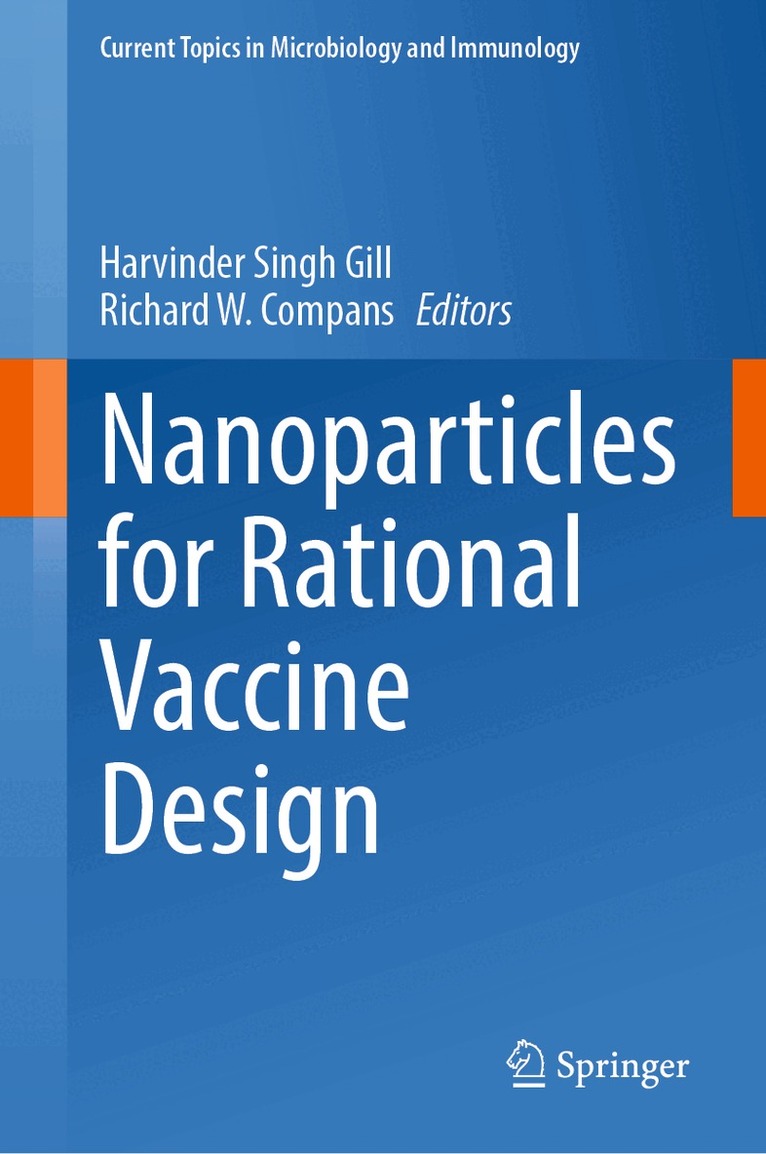
    Nanoparticles for Rational Vaccine Design

    AvHarvinder Singh Gill,Richard W. Compans

    Inbunden, Engelska, 2021

    Del 433 i serien Current Topics in Microbiology and Immunology

    1 118 kr

    Beställningsvara. Skickas inom 10-15 vardagar. Fri frakt över 249 kr.

    Beskrivning

    This book introduces nanoparticles as a powerful platform for vaccine design. Current challenges in vaccine development are discussed and the unique advantages nanoparticles provide in overcoming these challenges are explored. The authors offer fascinating insights into the immunological assets of using nanoparticles as delivery vehicles or adjuvants and present different materials that are being used in nanoparticle-based vaccine development, covering peptides, proteins, polymers, virus-like particles, and liposomes.Its contemporary research insights and practical examples for applications make this volume an inspiring read for researchers and clinicians in vaccinology and immunology. Chapter "Liposome Formulations as Adjuvants for Vaccines" is available open access under a Creative Commons Attribution 4.0 International License via link.springer.com.

    Produktinformation

    • Utgivningsdatum:2021-08-31
    • Mått:155 x 235 x 14 mm
    • Vikt:383 g
    • Format:Inbunden
    • Språk:Engelska
    • Serie:Current Topics in Microbiology and Immunology
    • Antal sidor:130
    • Upplaga:21001
    • Förlag:Springer Nature Switzerland AG
    • ISBN:9783030850661

    Utforska kategorier

    • Fysiologi inom Medicin
    • Teknik: allmänt inom Naturvetenskap och teknik
    • Farmakologi inom Medicin

    Mer om författaren

    Dr. Harvinder Singh Gill is an Associate Professor of Chemical Engineering at Texas Tech University, Lubbock, TX, USA. His research interests are in the fields of drug and vaccine delivery, immunoengineering, and micro-nano medicine. He is amongst the early researchers who contributed to the field of microneedles and has produced some of the seminal work published in the coated microneedle field. He is presently pioneering the use of coated microneedles for the treatment of allergies, and his lab is developing microneedle-based immunotherapies to treat airway allergies such as dust mite allergy, and food allergies such as peanut allergy. He is a co-founder of a startup company called Moonlight Therapeutics, which is commercializing this technology. Besides microneedles, Dr. Gill has expertise in a diverse set of delivery systems such as pollen grains, polymeric micro-nano particles, gold nanoparticles, and elastin-like polypeptides. He is using these systems to develop a universal influenza vaccine, a broadly protective coronavirus vaccine, mucosal vaccination strategies, and allergen immunotherapies.Dr. Gill completed his Bachelor of Engineering in Chemical Engineering with honors and a gold medal from Panjab University, India. After graduation, he worked in the petroleum industry for seven years. Subsequently he obtained his doctoral degree in Bioengineering from Georgia Institute of Technology. Dr. Gill received his postdoctoral training in the field of influenza vaccines at Emory University. For departing from convention and pioneering the idea of harnessing nature’s own pollen grains as a system for oral vaccine delivery, Dr. Gill was awarded the prestigious NIH Director’s New Innovator Award (DP2 award) and Defense Advanced Research Projects Agency (DARPA) Young Faculty Award. He was also inducted as member of the National Academy of Inventors. For his accomplishments and contributions to Biomedical Engineering, he was awarded the Whitacre EndowedChair in Science and Engineering at Texas Tech.Dr. Richard W. Compans is a professor in, and former chair of, the Department of Microbiology and Immunology in the Emory University School of Medicine. Over the four decades of his career, he has made broad and impactful contributions to our understanding of the structure and assembly of influenza and other viruses, and to developing and improving vaccines.Dr. Compans received his PhD from the Rockefeller University in 1968, where he was a National Science Foundation Graduate Fellow studying with Dr. Purnell W. Choppin, one of the virology giants of the era, who is a member of the National Academy of Sciences and went on to serve as President of the Howard Hughes Medical Institute. For his PhD, Dick studied the structural organization and assembly of parainfluenza viruses. He carried out postdoctoral studies at the Australian National University with Dr. Frank Fenner, an eminent virologist, where he began research on influenza viruses.After returning to the Rockefeller as a faculty member from 1969 to 1975, Dr. Compans was recruited to UAB, where he served as Professor of Microbiology from 1975 to 1992.In 1992, Dr. Compans was recruited to Emory as Professor and Chair of Microbiology and Immunology. During 15 years as chair, he recruited 15 new faculty and obtained the initial support from the Georgia Research Alliance to establish the Emory Vaccine Center. In 2007 he became Director of the newly funded Influenza Center. Dr. Compans has continued his work on influenza virus and is exploring the use of virus-like particle-based vaccine antigens to elicit protective immune responses against viral infection. His interests have expanded to include emerging viruses such as Ebola, Lassa, and Marburg viruses, and collaborative projects with Georgia Tech investigating new delivery methods such as vaccine coated microneedle patches.Dr. Compans has authored more than 500 manuscripts and ten books. His work has been cited over 35,000 times. He was the editor of the Virus Research from 1983-2003 and has served and continues to serve on several editorial boards and review committees.

    Innehållsförteckning

    • Preface.- Liposome Formulations as Adjuvants for Vaccines.- Polymeric nanoparticle-based vaccine adjuvants and delivery vehicles.- Virus-like particle vaccines against respiratory viruses and protozoan parasites.- Protein and Peptide Nanocluster Vaccines.