• Fri frakt över 249 kr
  • •
  • Snabba leveranser
  • •
  • Billiga böcker
Kundservice

Du är på sajten för privatpersoner.

Företag, bibliotek eller offentlig verksamhet?

Du handlar på classic.bokus.com, där alla dina funktioner finns intakta.
Till classic.bokus.com
Bokus logotyp. Gå till startsidan.
  • Erbjudanden
  • Nyheter
  • Student
  • Topplistor
  • Barn & ungdom
  • Bokus Play
  • E-böcker
  • Pocketböcker
  • Spel & pussel

10% rabatt på allt med kod NYSTART10 →

Sidfot

Mina sidor

    Hjälp

    • Kundservice
    • Vanliga frågor och svar
    • Frakt och leverans
    • Retur vid ångerrätt
    • Reklamera vara
    • Betalning
    • Köpvillkor
    • Allmänna villkor
    • Information om webbplatsens tillgänglighet

    Om Bokus

    • Om oss
    • Pressrum
    • För studenter
    • För företag
    • För bibliotek och offentlig verksamhet
    • För leverantörer
    • Hållbarhet

    Populärt

    • Aktuella erbjudanden
    • Presentkort
    • Studentlitteratur
    • Nya böcker
    • Topplistor
    • Signerade böcker
    • Engelska böcker

    Inspiration

    • Boktips
    • BookTok
    • Populära bokserier
    • Barnbokskaraktärer
    • Populära författare
    Logotyp för Bokus
    Följ oss på Facebook (extern länk)Följ oss på Instagram (extern länk)Följ oss på YouTube (extern länk)Följ oss på TikTok (extern länk)
    bokus @ CookiesAnpassa cookiesIntegritetspolicyKöpvillkor
    Till Citymail hemsida (extern länk)Till Budbee hemsida (extern länk)Till Postnord hemsida (extern länk)Till Schenker hemsida (extern länk)Till Early Bird hemsida (extern länk)Till Walleys hemsida (extern länk)
    1. Naturvetenskap och teknik
    2. Teknik och industri
    3. Transportteknik
    4. Flyg- och rymdteknik

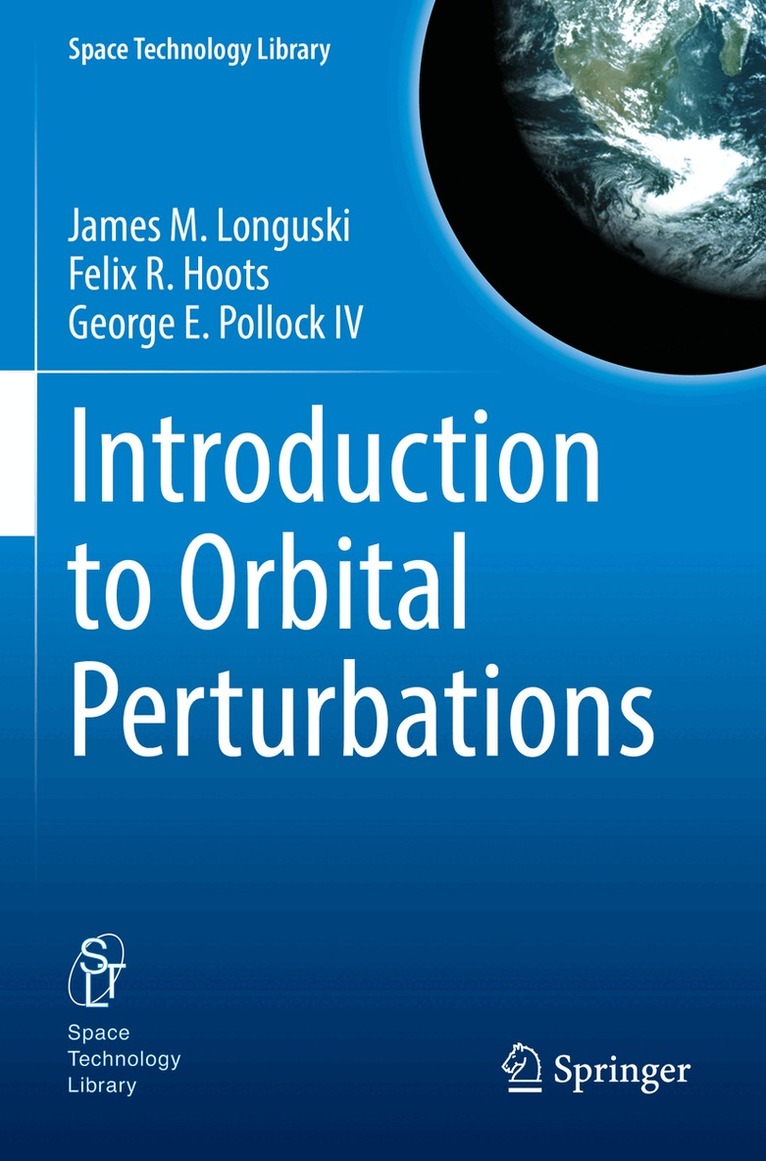
    Introduction to Orbital Perturbations

    AvJames M. Longuski,Felix R. Hoots

    Häftad, Engelska, 2023

    Del i serien Space Technology Library

    495 kr

    Skickas . Fri frakt över 249 kr.

    Fler format och utgåvor

    Inbunden

    923 kr

    Beskrivning

    This textbook provides details of the derivation of Lagrange's planetary equations and of the closely related Gauss's variational equations, thereby covering a sorely needed topic in existing literature. Analytical solutions can help verify the results of numerical work, giving one confidence that his or her analysis is correct. The authors—all experienced experts in astrodynamics and space missions—take on the massive derivation problem step by step in order to help readers identify and understand possible analytical solutions in their own endeavors. The stages are elementary yet rigorous; suggested student research project topics are provided.After deriving the variational equations, the authors apply them to many interesting problems, including the Earth-Moon system, the effect of an oblate planet, the perturbation of Mercury's orbit due to General Relativity, and the perturbation due to atmospheric drag.  Along the way, they introduce several useful techniques such as averaging, Poincaré's method of small parameters, and variation of parameters. In the end, this textbook will help students, practicing engineers, and professionals across the fields of astrodynamics, astronomy, dynamics, physics, planetary science, spacecraft missions, and others.“An extensive, detailed, yet still easy-to-follow presentation of the field of orbital perturbations.”-        Prof. Hanspeter Schaub, Smead Aerospace Engineering Sciences Department, University of Colorado, Boulder“This book, based on decades of teaching experience, is an invaluable resource for aerospace engineering students and practitioners alike who need an in-depth understanding of the equations they use.”-        Dr. Jean Albert Kéchichian, The Aerospace Corporation, Retired“Today we look at perturbations through the lens of the modern computer. But knowing the why and the how is equally important. In this well organized and thorough compendium of equations and derivations, the authors bring some of the relevant gems from the past back into the contemporary literature.”-        Dr. David A Vallado, Senior Research Astrodynamicist, COMSPOC“The book presentation is with the thoroughness that one always sees with these authors. Their theoretical development is followed with a set of Earth orbiting and Solar System examples demonstrating the application of Lagrange’s planetary equations for systems with both conservative and nonconservative forces, some of which are not seen in orbital mechanics books.”-        Prof. Kyle T. Alfriend, University Distinguished Professor, Texas A&M University

    Produktinformation

    • Utgivningsdatum:2023-03-04
    • Mått:155 x 235 x 25 mm
    • Vikt:560 g
    • Format:Häftad
    • Språk:Engelska
    • Serie:Space Technology Library
    • Antal sidor:339
    • Förlag:Springer Nature Switzerland AG
    • ISBN:9783030897604

    Utforska kategorier

    • Flyg- och rymdteknik inom Naturvetenskap och teknik
    • Klassisk mekanik inom Naturvetenskap och teknik
    • Rymdforskning inom Naturvetenskap och teknik

    Mer om författaren

    Professor James Longuski has authored or co-authored over 250 conference and journal papers in the area of astrodynamics on topics that include designing spacecraft trajectories to explore the Solar System and a new idea to test Einstein’s General Theory of Relativity. He also coauthored several papers with Dr. Buzz Aldrin on a human Earth-to-Mars transportation system known as the “Aldrin Cycler.”He has published three books: Advice to Rocket Scientists: A Career Survival Guide for Scientists and Engineers (2004, AIAA), The Seven Secrets of How to Think Like a Rocket Scientist (2007, Springer), and Optimal Control with Aerospace Applications with José J. Guzmán, and John E. Prussing (2014, Springer). In 2008 Dr. Longuski was inducted into Purdue University’s Book of Great Teachers.Dr. George E. Pollock IV is the associate director of the Astrodynamics Department at The Aerospace Corporation. He leads a team of analysts providingspace domain awareness and advanced space mission analyses for the U.S. Space Force, Intelligence Community, and NASA customers. In over a decade of professional engineering practice, Pollock has directly contributed to national security space through innovative mission design, system concept analysis, and architecture studies. Pollock was a member of a team recognized with The Aerospace Corporation’s Innovation Award in 2019. He has twice received Systems Engineering Division Awards for leadership and technical contributions to cislunar space analysis (2017 and 2019), and he was a member of a team that was recognized for Outstanding Contributions to Space-Based Space Surveillance and Space Situational Awareness (2012). The Space and Missile Systems Center’s Space Superiority Systems Directorate honored Pollock as the FFRDC representative of the quarter in December 2014. He received Purdue University’s highest award for graduate student educators in 2010. Pollock holds a bachelor’s degree in aeronautical and astronautical engineering, a master’s degree in aeronautics and astronautics, and a doctoral degree in aeronautical and astronautical engineering, all from Purdue University. Felix Hoots has over 45 years of experience in space surveillance. Prior to joining Aerospace, he worked as an astrodynamicist for the 14th AF and NORAD/ADCOM and then as a Chief Scientist for GRC International. His work as a contractor supported the Air Force and Navy as well as the intelligence community in their space and surveillance activities. He has had 20 publications in international professional journals including two commissioned encyclopedia articles and seven proceedings. He is a coauthor (with George Chao) of Applied Orbit Perturbation and Maintenance.  He has been an invited speaker at NATO and International Astronomical Union conferences and was technical organizer and speaker at a series of US/Russian Space Surveillance Workshops beginning in 1994 and continuing until 2012. Hoots earned a bachelor’s degree in physics and a master’s degree in mathematics from Tennessee Technological University.  He earned a PhD in mathematics with an emphasis in astrodynamics from Auburn University. Hoots is a Fellow of the American Astronautical Society and an Associate Fellow of the American Institute of Aeronautics and Astronautics. He has previously served as an Associate Editor of the AIAA Journal of Guidance, Control, and Dynamics. In 2006 he received the American Association for the Advancement of Science Award for International Scientific Cooperation. In 2016 he received the Brouwer Award from the American Astronautical Society and the Corporate Innovation Award from the Aerospace Corporation.

    Innehållsförteckning

    • Chapter 1. The n-Body Problem.- Chapter 2. General Perturbations .- Chapter 3. Evaluation of Lagrange’s Brackets .- Chapter 4. Lagrange’s Planetary Equations .- Chapter 5. Expansion of the Perturbation Function.- Chapter 6. The Earth-Moon System .- Chapter 7. Potential of an Oblate Spheroid.- Chapter 8. Effects of General Relativity.- Chapter 9. Perturbations due to Atmospheric Drag .- Chapter 10. Periodic Solutions in Nonlinear Oscillations.