• Fri frakt över 249 kr
  • •
  • Snabba leveranser
  • •
  • Billiga böcker
Kundservice

Du är på sajten för privatpersoner.

Företag, bibliotek eller offentlig verksamhet?

Du handlar på classic.bokus.com, där alla dina funktioner finns intakta.
Till classic.bokus.com
Bokus logotyp. Gå till startsidan.
  • Erbjudanden
  • Nyheter
  • Student
  • Topplistor
  • Barn & ungdom
  • Bokus Play
  • E-böcker
  • Pocketböcker
  • Spel & pussel

10% rabatt på allt med kod NYSTART10 →

Sidfot

Mina sidor

    Hjälp

    • Kundservice
    • Vanliga frågor och svar
    • Frakt och leverans
    • Retur vid ångerrätt
    • Reklamera vara
    • Betalning
    • Köpvillkor
    • Allmänna villkor
    • Information om webbplatsens tillgänglighet

    Om Bokus

    • Om oss
    • Pressrum
    • För studenter
    • För företag
    • För bibliotek och offentlig verksamhet
    • För leverantörer
    • Hållbarhet

    Populärt

    • Aktuella erbjudanden
    • Presentkort
    • Studentlitteratur
    • Nya böcker
    • Topplistor
    • Signerade böcker
    • Engelska böcker

    Inspiration

    • Boktips
    • BookTok
    • Populära bokserier
    • Barnbokskaraktärer
    • Populära författare
    Logotyp för Bokus
    Följ oss på Facebook (extern länk)Följ oss på Instagram (extern länk)Följ oss på YouTube (extern länk)Följ oss på TikTok (extern länk)
    bokus @ CookiesAnpassa cookiesIntegritetspolicyKöpvillkor
    Till Citymail hemsida (extern länk)Till Budbee hemsida (extern länk)Till Postnord hemsida (extern länk)Till Schenker hemsida (extern länk)Till Early Bird hemsida (extern länk)Till Walleys hemsida (extern länk)
    1. Samhälle och politik
    2. Politik och statsskick
    3. Centralt styre och förvaltning

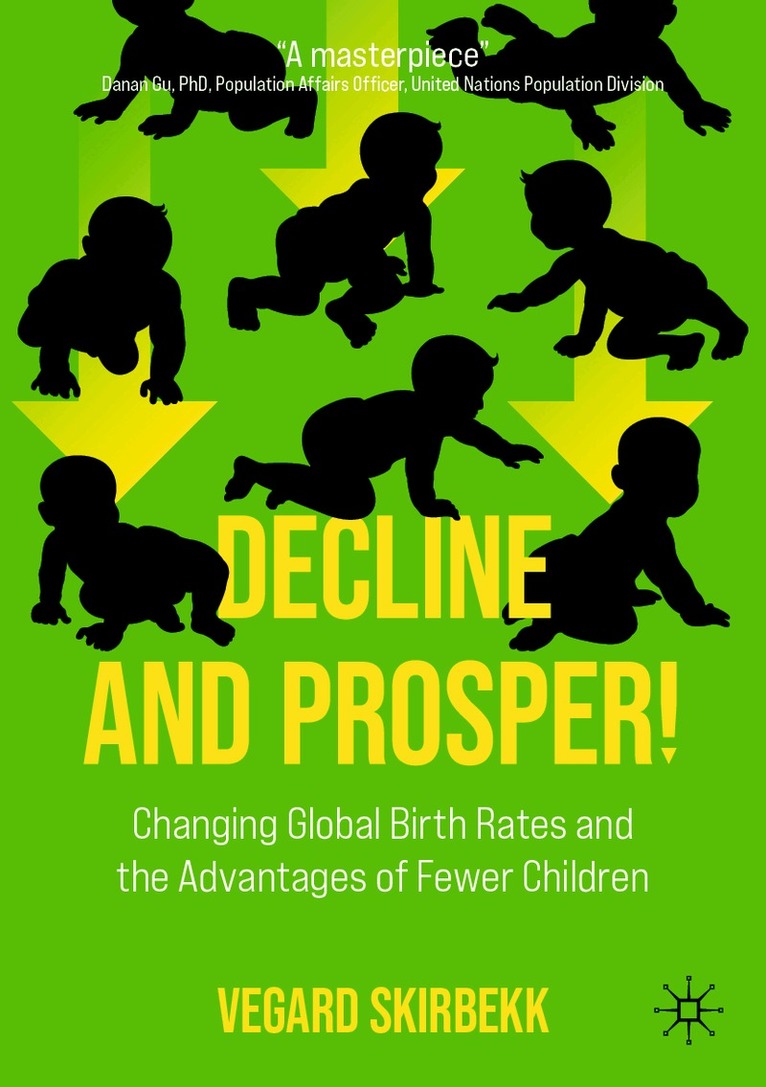
    Decline and Prosper!

    Changing Global Birth Rates and the Advantages of Fewer Children

    AvVegard Skirbekk

    Häftad, Engelska, 2022

    352 kr

    Beställningsvara. Skickas inom 5-8 vardagar. Fri frakt över 249 kr.

    Fler format och utgåvor

    E-bok

    553 kr

    Beskrivning

    Globally, women are having half as many children as they had just fifty years ago. Why have birth rates fallen, and how will low fertility affect our shared future?In Decline and Prosper!, demographic expert Vegard Skirbekk offers readers an accessible, comprehensive and evidence-based overview of human reproduction. Readers learn about the evolution of childbearing across different populations and how fertility is related to (changes in) our reproductive capacity, contraception, education, religion, partnering, policies, economics, assisted reproduction, and catastrophes. Readers will explore the future of family size and its impact on human welfare, women’s empowerment and the environment. Skirbekk argues that low fertility is on the whole a good thing, while recognizing the challenges of population aging and “coincidental” childlessness. A balanced, integrative examination of one of the most important issues of our time, Decline and Prosper! drives home the fact that we must ultimately adapt to a world with fewer children.The book will be invaluable to anyone who is interested in the far-reaching effects of global fertility, including researchers and students of demography, social statistics, medical sociologists, family and childhood studies, human geographers, sociology of culture, social and public policy.

    Produktinformation

    • Utgivningsdatum:2022-04-02
    • Mått:148 x 210 x 32 mm
    • Vikt:560 g
    • Format:Häftad
    • Språk:Engelska
    • Antal sidor:396
    • Förlag:Springer Nature Switzerland AG
    • ISBN:9783030916107

    Utforska kategorier

    • Centralt styre och förvaltning inom Samhälle och politik
    • Sociologi inom Samhälle och politik
    • Socialt arbete och välfärd inom Samhälle och politik

    Mer om författaren

    Vegard Skirbekk is a social scientist and an expert on global demographic change. He has published over 250 scientific articles and frequently presents to policy makers around the world. He is Principal Investigator of the Fertility and Health Research Centre at the Norwegian Institute of Public Health in Oslo, and Professor of Population and Family Health at Columbia University in New York, USA.

    Recensioner i media

    “This book assembles many findings, facts, insights, and opinions related to fertility … . The book is easy to read … .” (Nico Keilman, Journal of Peace Research, March 1, 2023)“Dr. Skirbekk’s prescriptions could help ameliorate some problems young men are experiencing throughout the developed world.” (Jessica Grose, The New York Times, nytimes.com, February 15, 2023)“Vegard Skirbekk’s Decline and Prosper! Changing Global Birth Rates and the Advantages of Fewer Children is a welcome reality check. … ‘… the breadth of this book is, in fact, its great strength.’ And with this, I wholeheartedly agree. Decline and Prosper! is a concise and engaging overview of what we know about low fertility, how we got there, and why it will almost surely persist. And, ultimately, that things will be fine.” (Joshua Wilde, Population and Development Review, September 14, 2022)“It is a valuable resource, presenting much research on fertility around the world. … I recommend it to anyone interested in human fertility and demography.” (Frank Götmark, overpopulation-project.com, September 6, 2022)

    Innehållsförteckning

    • Introduction.- Measuring Fertility.- How Many Children Can Humans Have Biologically?.- Fertility from the Dawn of Humanity through the 19th Century.- The Demographic Transition: Fewer Deaths and Fewer Births, Eventually.-Contemporary Global Fertility.The New Have-Nots: Childlessness in the 21st Century.- More Education, Fewer Children.- An Era of Choice: Childbearing Has Become More Planned.- Fertility Preferences: How Many Children Do People Want?.- Delaying Parenthood, For Better and For Worse.- Finding a Mate: Contemporary Partnership and Conception.- Money Matters: The Economics of Fertility.- Fertility in the Aftermath of Disaster.- New Times, Old Beliefs: Religion and Contemporary Fertility.- Contemporary Fertility from an Evolutionary Perspective: Are the Fittest Still Surviving?.- How Low Will It Go? Projecting Future Fertility.- Fertility, Population Growth and Population Composition.- FertilityPolicies: Past, Present, and Future Directions.- Low – But Not Too Low – Fertility is a Good Thing.