• Fri frakt över 249 kr
  • •
  • Snabba leveranser
  • •
  • Billiga böcker
Kundservice

Du är på sajten för privatpersoner.

Företag, bibliotek eller offentlig verksamhet?

Du handlar på classic.bokus.com, där alla dina funktioner finns intakta.
Till classic.bokus.com
Bokus logotyp. Gå till startsidan.
  • Erbjudanden
  • Nyheter
  • Student
  • Topplistor
  • Barn & ungdom
  • Bokus Play
  • E-böcker
  • Pocketböcker
  • Spel & pussel

10% rabatt på allt med kod: NYSTART10 →

Sidfot

Mina sidor

    Hjälp

    • Kundservice
    • Vanliga frågor och svar
    • Frakt och leverans
    • Retur vid ångerrätt
    • Reklamera vara
    • Betalning
    • Köpvillkor
    • Allmänna villkor
    • Information om webbplatsens tillgänglighet

    Om Bokus

    • Om oss
    • Pressrum
    • För studenter
    • För företag
    • För bibliotek och offentlig verksamhet
    • För leverantörer
    • Hållbarhet

    Populärt

    • Aktuella erbjudanden
    • Presentkort
    • Studentlitteratur
    • Nya böcker
    • Topplistor
    • Signerade böcker
    • Engelska böcker

    Inspiration

    • Boktips
    • BookTok
    • Populära bokserier
    • Barnbokskaraktärer
    • Populära författare
    Logotyp för Bokus
    Följ oss på Facebook (extern länk)Följ oss på Instagram (extern länk)Följ oss på YouTube (extern länk)Följ oss på TikTok (extern länk)
    bokus @ CookiesAnpassa cookiesIntegritetspolicyKöpvillkor
    Till Citymail hemsida (extern länk)Till Budbee hemsida (extern länk)Till Postnord hemsida (extern länk)Till Schenker hemsida (extern länk)Till Early Bird hemsida (extern länk)Till Walleys hemsida (extern länk)
    1. Samhälle och politik
    2. Samhälle och kultur

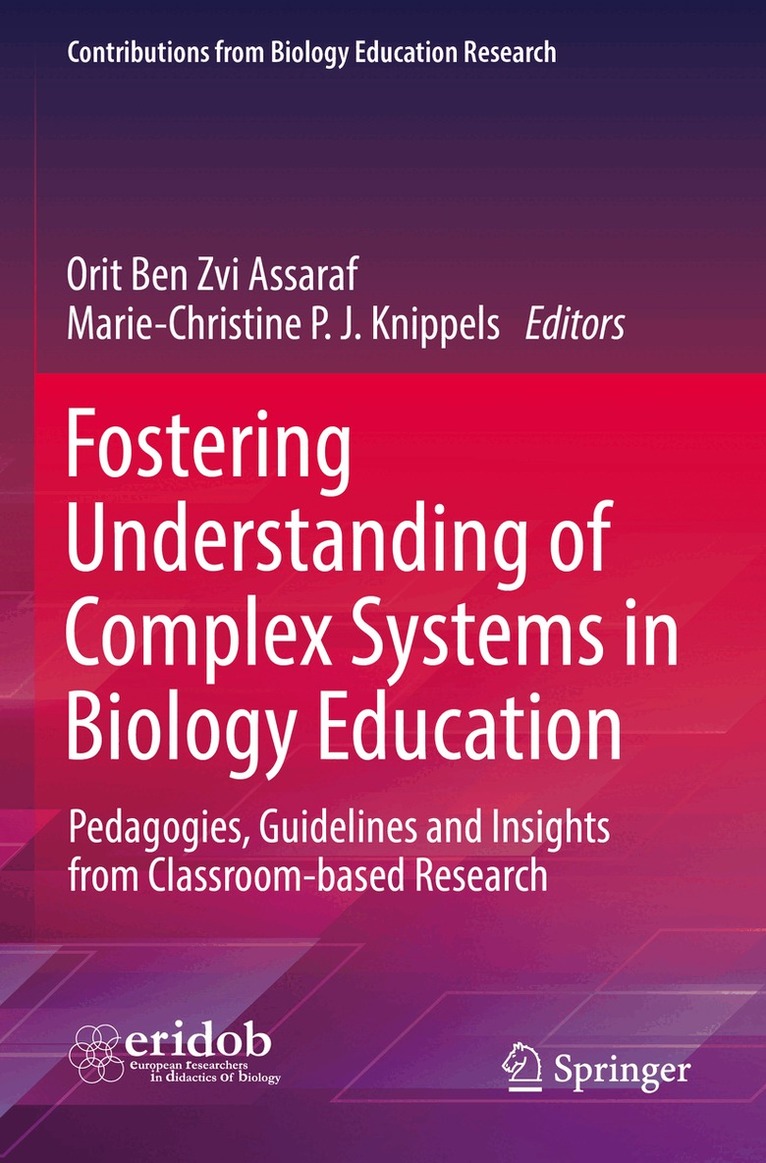
    Fostering Understanding of Complex Systems in Biology Education

    Pedagogies, Guidelines and Insights from Classroom-based Research

    AvOrit Ben Zvi Assaraf,Marie-Christine P. J. Knippels

    Häftad, Engelska, 2023

    Del i serien Contributions from Biology Education Research

    1 518 kr

    Beställningsvara. Skickas inom 10-15 vardagar. Fri frakt över 249 kr.

    Beskrivning

    This book synthesizes a wealth of international research on the critical topic of ‘fostering understanding of complex systems in biology education’. Complex systems are prevalent in many scientific fields, and at all scales, from the micro scale of a single cell or molecule to complex systems at the macro scale such as ecosystems. Understanding the complexity of natural systems can be extremely challenging, though crucial for an adequate understanding of what they are and how they work.The term “systems thinking” has become synonymous with developing a coherent understanding of complex biological processes and phenomena. For researchers and educators alike, understanding how students’ systems thinking develops is an essential prerequisite to develop and maintain pedagogical scaffolding that facilitates students’ ability to fully understand the system’s complexity. To that end, this book provides researchers and teachers with key insights from the current research community onhow to support learners systems thinking in secondary and higher education. Each chapter in the book elaborates on different theoretical and methodological frameworks pertaining to complexity in biology education and a variety of biological topics are included from genetics, photosynthesis, and the carbon cycle to ecology and climate change. Specific attention is paid to design elements of computer-based learning environments to understand complexity in biology education.

    Produktinformation

    • Utgivningsdatum:2023-05-27
    • Mått:155 x 235 x 16 mm
    • Vikt:441 g
    • Format:Häftad
    • Språk:Engelska
    • Serie:Contributions from Biology Education Research
    • Antal sidor:278
    • Upplaga:23001
    • Förlag:Springer Nature Switzerland AG
    • ISBN:9783030981464

    Utforska kategorier

    • Samhälle och kultur inom Samhälle och politik
    • Pedagogisk metodik inom Psykologi och pedagogik
    • Undervisning i specifika ämnen inom Psykologi och pedagogik

    Mer om författaren

    Prof. Orit Ben-Zvi Assaraf is former Chair of the Graduate Program for Science and Technology Education, at the Ben-Gurion University of the Negev Israel. Her work in science education focuses on issues such as: Design of informal outdoor learning environments; Cognitive based research into systems thinking in the field of Biology, Ecology and Earth sciences and development of environmental literacy and nature conservation within science education.Dr. Marie-Christine Knippels is an Associate Professor in Science Education and former head of the Biology education team at the Freudenthal Institute, Utrecht University, the Netherlands. She is a biologist, holds a PhD in Genetics Education and completed a postdoc research project on moral reasoning in genomics-related dilemmas. Her research focuses on fostering metacognitive skills in biology education and promoting scientific literacy and citizenship, through design based research and Lesson study projects. She has (co)authoredarticles on ‘yo-yo thinking’, systems thinking, reasoning with models in biology education and socio-scientific issues. She has been involved in various European projects and networks, and led the EU-FP7 PARRISE project.

    Innehållsförteckning

    • 1. Theoretical Perspectives on Complex Systems in Biology Education.- 2. Long Term Ecological Research as a Learning Environment: Evaluating Its Impact in Developing the Understanding of Ecological Systems Thinking – A Case Study.- 3. Involving teachers in the design process of a teaching and learning trajectory to foster students’ systems thinking.- 4. Supporting university student learning of complex systems: an example of teaching the interactive processes that constitute photosynthesis.- 5. High school students’ causal reasoning and molecular mechanistic reasoning about gene-environment interplay after a semester-long course in genetics.- 6. Systems Thinking in Ecological and Physiological Systems and the Role of Representations.- 7. The Zoom-Map—Explaining Complex Biological Phenomena by Drawing Connections between and in Levels of Organization.- 8. Pre-service teachers’ coual schemata and system reasoning about the carbon cycle and climate change: an exploratory study of a learning framework for understanding complex systems.- 9. Teaching Students to Grasp Complexity in Biology Education using a “Body of Evidence” Approach.- 10. Science teachers' construction of knowledge about simulations and population size via performing inquiry with simulations of growing vs. descending levels of complexity.- 11. Designing Complex Systems Curricula for High School Biology: A Decade of work with the BioGraph Project.- 12. Lessons learned: Synthesizing approaches that foster understanding of complex biological phenomena.