• Fri frakt över 249 kr
  • •
  • Snabba leveranser
  • •
  • Billiga böcker
Kundservice

Du är på sajten för privatpersoner.

Företag, bibliotek eller offentlig verksamhet?

Du handlar på classic.bokus.com, där alla dina funktioner finns intakta.
Till classic.bokus.com
Bokus logotyp. Gå till startsidan.
  • Erbjudanden
  • Nyheter
  • Student
  • Topplistor
  • Barn & ungdom
  • Bokus Play
  • E-böcker
  • Pocketböcker
  • Spel & pussel

Må bättre, för mindre! Upp till 50% rabatt på hälsoböcker

Sidfot

Mina sidor

    Hjälp

    • Kundservice
    • Vanliga frågor och svar
    • Frakt och leverans
    • Retur vid ångerrätt
    • Reklamera vara
    • Betalning
    • Köpvillkor
    • Allmänna villkor
    • Information om webbplatsens tillgänglighet

    Om Bokus

    • Om oss
    • Pressrum
    • För studenter
    • För företag
    • För bibliotek och offentlig verksamhet
    • För leverantörer
    • Hållbarhet

    Populärt

    • Aktuella erbjudanden
    • Presentkort
    • Studentlitteratur
    • Nya böcker
    • Topplistor
    • Signerade böcker
    • Engelska böcker

    Inspiration

    • Boktips
    • BookTok
    • Populära bokserier
    • Barnbokskaraktärer
    • Populära författare
    Logotyp för Bokus
    Följ oss på Facebook (extern länk)Följ oss på Instagram (extern länk)Följ oss på YouTube (extern länk)Följ oss på TikTok (extern länk)
    bokus @ CookiesAnpassa cookiesIntegritetspolicyKöpvillkor
    Till Citymail hemsida (extern länk)Till Budbee hemsida (extern länk)Till Postnord hemsida (extern länk)Till Schenker hemsida (extern länk)Till Early Bird hemsida (extern länk)Till Walleys hemsida (extern länk)
    1. Naturvetenskap och teknik
    2. Matematik och naturvetenskap
    3. Biologi
    4. Biovetenskap

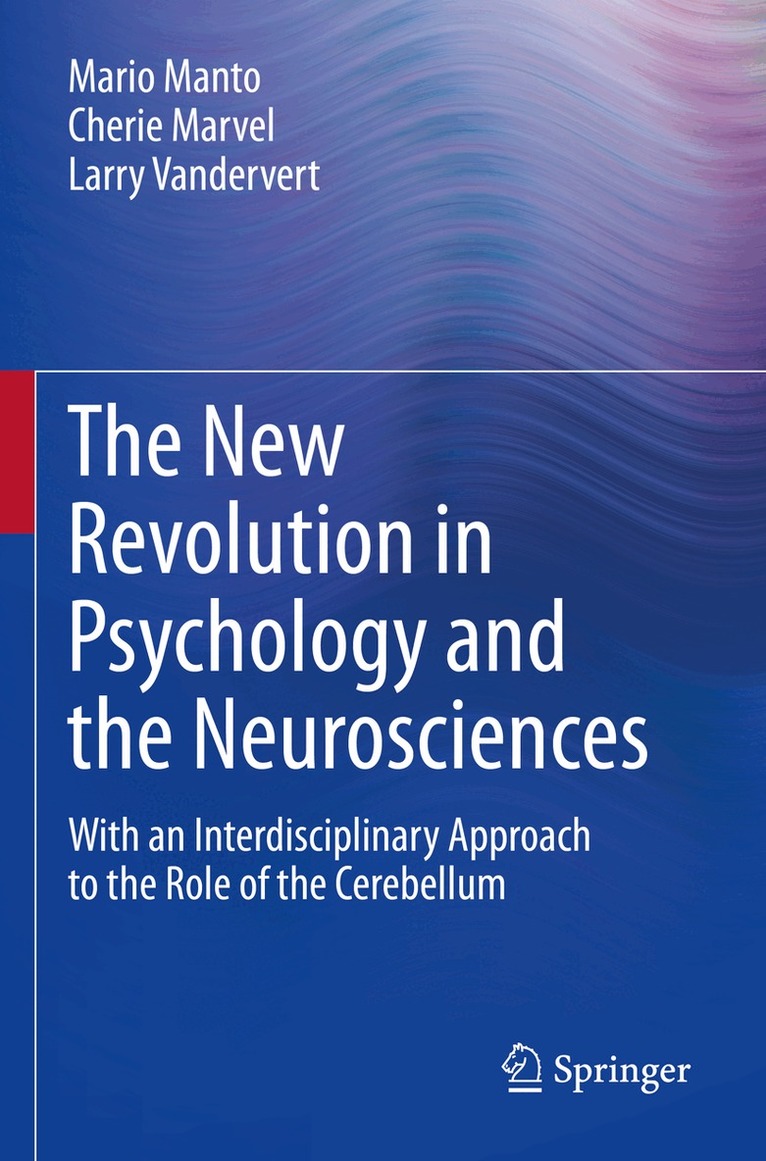
    New Revolution in Psychology and the Neurosciences

    With an Interdisciplinary Approach to the Role of the Cerebellum

    AvMario Manto,Cherie Marvel

    Inbunden, Engelska, 2022

    978 kr

    Beställningsvara. Skickas inom 10-15 vardagar. Fri frakt över 249 kr.

    Fler format och utgåvor

    Häftad

    708 kr

    Beskrivning

    Historically researchers of neuroscience and psychology have believed that the cerebral cortex produces the unique mental capacities of human beings. However, a prevalence of brain-imaging evidence now shows that the cerebral cortex, while the seat of our everyday experience (notably in working memory), is not predominant in actually formulating our amazing capabilities. Rather, the achievements that mark humans as “Homo sapiens” originate in the cerebellum which increased three- to fourfold in size and acquired massive cognitive and social optimization capabilities over the last million years. Thus, through its optimization of experience and skill of the cerebral cortex, it was the cerebellum that was and is predominant in producing culture, language, mathematics, creativity, and extreme levels of skill in all areas from sports to computer science and art. These optimizing functions of the cerebellum are shown in the cases of Albert Einstein, Wolfgang Amadeus Mozart, Maryam Mirzakhani, and the predictive powers of Stonehenge.This book fills a critical role in bringing courses up-to-date with the profound, basic changes this newly understood predominant role of the cerebellum provides for understanding the mechanisms related to all topics in psychology and neuroscience. It is critical that this “new revolution in psychology and the neurosciences” be introduced and reviewed in courses that are part of both undergraduate and graduate studies in psychology and neuroscience. This text might also be of use to courses in anthropology and cross-disciplinary studies as the cerebellum was critically involved in the evolution of cognitive and social behaviour.

    Produktinformation

    • Utgivningsdatum:2022-06-24
    • Mått:155 x 235 x 14 mm
    • Vikt:383 g
    • Format:Inbunden
    • Språk:Engelska
    • Antal sidor:127
    • Upplaga:22001
    • Förlag:Springer International Publishing AG
    • ISBN:9783031060922

    Utforska kategorier

    • Biovetenskap inom Naturvetenskap och teknik
    • Kognitiv psykologi inom Psykologi och pedagogik

    Mer om författaren

    Mario Manto, MD PhDDr. Manto is a clinical neurologist who studies cerebellar disorders, and is the Founding Editor of the journal, The Cerebellum. He is affiliated with both the Unité des Ataxies Cérébelleuses, Service de Neurologie, CHU-Charleroi, Belgium and Service des Neurosciences, Université de Mons, Belgium.Cherie Marvel, PhDDr. Marvel is a cognitive neuroscientist who studies cerebellar motor and non-motor functions in healthy and clinical populations. She is faculty in the Department of Neurology at  the Johns Hopkins University School of Medicine, USA. Larry Vandervert, PhDDr. Vandervert is a retired college professor with published works in the cerbellum’s role in creativity, innovation, child prodigy giftedness, and mathematics.

    Innehållsförteckning

    • Chapter 1: What is the revolutionary conception of the cerebellum-driven working memory and language of Homo sapiens?.- Chapter 2: How, exactly, did this revolutionary concept of the human mind come about?.- Chapter 3: What, exactly, is prominent role of the cerebellum in everyday learning and thinking?.- Chapter 4:How did and how does the cerebellum prominently contribute to the development of the mind of both ancient and modern peoples?.- Chapter 5: Without the contribution of the cerebellum, we could not be creative—the cerebellar origin of sudden insight (the a-ha! phenomenon) in working memory.- Chapter 6: Without the contribution of the cerebellum, we would not have mathematics..- Einstein was smart, but his cerebellum actually guided his super superior thinking.- Chapter 7: How can people play a complex piano piece (in the cerebellum) and carry on an equally complex conversation at the same time?.- Chapter 8: The crucial role of the cerebellum in the development of the signature moves of sports heroes.- Chapter 9: How does the cerebellum make play more skillful, improve personality and make one more creative?.- Chapter 10: What crucial role does the cerebellum play in mental disorders?.