• Fri frakt över 249 kr
  • •
  • Snabba leveranser
  • •
  • Billiga böcker
Kundservice

Du är på sajten för privatpersoner.

Företag, bibliotek eller offentlig verksamhet?

Du handlar på classic.bokus.com, där alla dina funktioner finns intakta.
Till classic.bokus.com
Bokus logotyp. Gå till startsidan.
  • Erbjudanden
  • Nyheter
  • Student
  • Topplistor
  • Barn & ungdom
  • Bokus Play
  • E-böcker
  • Pocketböcker
  • Spel & pussel

10% rabatt på allt med kod: NYSTART10 →

Sidfot

Mina sidor

    Hjälp

    • Kundservice
    • Vanliga frågor och svar
    • Frakt och leverans
    • Retur vid ångerrätt
    • Reklamera vara
    • Betalning
    • Köpvillkor
    • Allmänna villkor
    • Information om webbplatsens tillgänglighet

    Om Bokus

    • Om oss
    • Pressrum
    • För studenter
    • För företag
    • För bibliotek och offentlig verksamhet
    • För leverantörer
    • Hållbarhet

    Populärt

    • Aktuella erbjudanden
    • Presentkort
    • Studentlitteratur
    • Nya böcker
    • Topplistor
    • Signerade böcker
    • Engelska böcker

    Inspiration

    • Boktips
    • BookTok
    • Populära bokserier
    • Barnbokskaraktärer
    • Populära författare
    Logotyp för Bokus
    Följ oss på Facebook (extern länk)Följ oss på Instagram (extern länk)Följ oss på YouTube (extern länk)Följ oss på TikTok (extern länk)
    bokus @ CookiesAnpassa cookiesIntegritetspolicyKöpvillkor
    Till Citymail hemsida (extern länk)Till Budbee hemsida (extern länk)Till Postnord hemsida (extern länk)Till Schenker hemsida (extern länk)Till Early Bird hemsida (extern länk)Till Walleys hemsida (extern länk)
    1. Samhälle och politik
    2. Samhälle och kultur
    3. Sociala och etiska frågor
    4. Migration

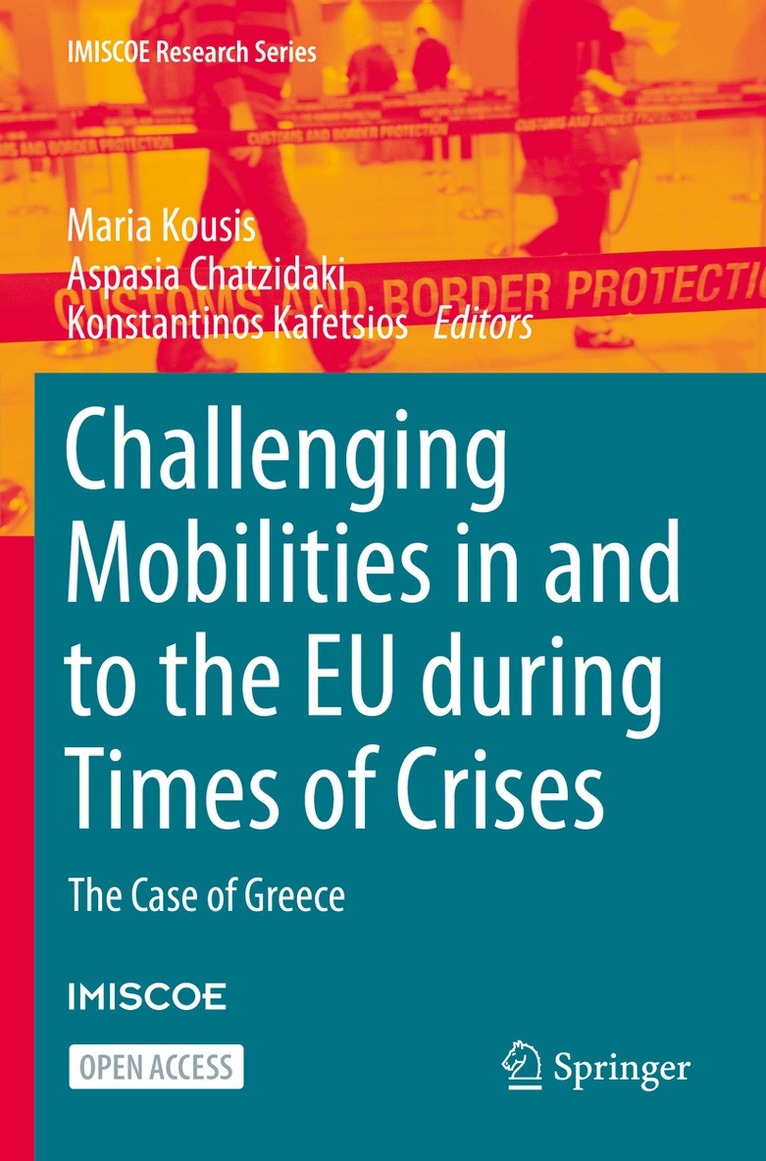
    Challenging Mobilities in and to the EU during Times of Crises

    The Case of Greece

    AvMaria Kousis,Aspasia Chatzidaki

    Inbunden, Engelska, 2022

    Del i serien IMISCOE Research Series

    547 kr

    Beställningsvara. Skickas inom 10-15 vardagar. Fri frakt över 249 kr.

    Beskrivning

    This open access book offers a cross-disciplinary view of challenging mobility issues for migrants and refugees in Europe and particularly Greece during the last decade when the economic and refugee crises coincided. It offers new analyses and data on a diverse range of topics concerning new emigrants as well as refugees and mobilities in Greece. The book covers themes which are not only related to refugee and immigrant integration and governance challenges, but also describes host attitudes, solidarity, political and protest claims in the public sphere, as well as the changing emigration environment in Greece within a European context. With contributions from the fields of philosophy, anthropology, sociology, economics, political science, geography and linguistics, this book provides a unique resource for students and scholars, but also for policy-makers and social scientists working on migration-related issues within and beyond Europe.

    Produktinformation

    • Utgivningsdatum:2022-10-04
    • Mått:155 x 235 x 25 mm
    • Vikt:682 g
    • Format:Inbunden
    • Språk:Engelska
    • Serie:IMISCOE Research Series
    • Antal sidor:319
    • Förlag:Springer International Publishing AG
    • ISBN:9783031115738

    Utforska kategorier

    • Migration inom Samhälle och politik
    • Statsvetenskap och politisk teori inom Samhälle och politik
    • Offentlig förvaltning inom Samhälle och politik

    Mer om författaren

    Maria Kousis (Ph.D, The University of Michigan, 1984) is Professor of Sociology and former director of the University of Crete Research Centre for the Humanities, the Social and Education Sciences (UCRC) (9/2014-11/2021). She was coordinator or partner in European Commission projects including Grassroots Environmental Action, TEA, PAGANINI and MEDVOICES. Her publications consist of 16 edited volumes, books, or special issues, 43 journal articles and 39 book chapters. Recent publications include, Transnational solidarity in times of crises: Citizen organisations and collective learning in Europe, focused on the fields of migration, disability and unemployment (Eds.: C. Lahusen, U. Zschache and M. Kousis, Palgrave, 2021) and Transnational Solidarity Organizations in Times of Crises – Comparative European Perspectives (Eds.: M. Kousis and C. Lahusen, special section of Sociological Research Online, 2021). Her research centres on Social Change, Contentious Politics, Crisis and Society, Environmental Politics, Bioethics and Southern Europe. Recent work focuses on the socio-economic and political dimensions of hard times, especially in the context of the research projects ‘The Greeks, the Germans and the Crisis’ (GGCRISI, Greek-German Ministries Cooperation), ‘Living with Hard Times: How European Citizens Deal with Economic Crises and Their Social and Political Consequences’ (LIVEWHAT, EC, FP7), ‘European Paths to Transnational Solidarity in times of crisis’ (TransSOL, EC, Horizon 2020),  EURYKA (EC, Horizon 2020) and ‘Social and Solidarity Economy, Urban Communities and the Protection of Vulnerable Groups’ (Swiss Network for International Studies). Aspasia Chatzidaki holds a BA in Greek Philology (University of Thessaloniki, Greece), an MA in Theoretical Linguistics (University of Reading, UK), and a Ph.D. in Sociolinguistics (Vrije Universiteit Brussels, Belgium). She is Professor at the Department of Primary Education of the University of Crete and Director of the Centre for Intercultural and Migration Studies of the same Department. In addition, she served as member of the UCRC Board on two separate occasions (7/2012-8/2014, 9/2016-11/2021). Her research interests include the study of sociolinguistic and educational aspects of bilingualism as well as Greek as a second language both in Greece and in diasporic communities. In the past twenty years she has taken part in numerous educational intervention programmes and teacher capacity-building seminars regarding the education of immigrant and refugee students. She is the author of a book (‘Teaching Bilingual Students; theoretical issues and educational approaches,’ Athens, Pedio, 2020) and co-editor of a book on educational aspects of ‘new migration’ from Greece (Panagiotopoulou, A., Rosen, L., Kirsch, C. & Chatzidaki, A. (Eds.) (2019) ‘New’ Migration of Families from Greece to Europe and Canada ‒A ‘New’ Challenge for Education? Springer Verlag) and another one on refugee education (Chatzidaki, A. & Tsokalidou, P. Challenges and Initiatives in Refugee Education: the case of Greece. Cambridge Scholars Publishing, 2020). Her recent research focuses on the reconceptualisation of Greek-language education abroad in the light of recent migration from Greece. Konstantinos Kafetsios (Ph.D. Lancaster University) is a Professor in Social Psychology at Aristotle University in Thessaloniki and visiting Professor in Social and Organizational Psychology at Palacký University in the Czech Republic. He has held research and teaching positions at the University of Cambridge School of Social and Political Sciences, the Department of Psychology at Anglia Ruskin University, and the Department of Psychology at the University of Crete, where he was also a member of the board of the University of Crete Research Center for the Humanities, the Social and Education Sciences (UCRC) (9/2016-9/2019). Research in his lab addresses emotional and social interactionphenomena across cultural and social-organizational contexts. This research has received research funding from the European Commission, EEA, the Hellenic Foundation for Research and Innovation, GACR, and the General Secretariat for Research and Innovation. He currently serves as an Associate Editor for the Journal of Experimental Social Psychology and the European Journal of Social Psychology while on the editorial board of several international journals and as a reviewer for international funding agencies in the social and behavioral sciences

    Innehållsförteckning

    • Chapter 1. Introduction: Challenging Mobilities, Greece and the EU in Times of Crises.- Part Ι: A Crisis driven Third Wave of Greek Emigration.- Chapter 2. Greece’s Emigration During the Crisis Beyond the Brain Drain.- Chapter 3. The ‘Virtual Return’ Option of the Highly Educated Immigrants: The Case of Greek PhD holders.- Chapter 4. Greek State Schools in Germany and the Impact of ‘New’ Migration.- Part II: Crises and Host Attitudes.- Chapter 5. Attitudes Towards Syrian Refugees During the ‘Refugee Crisis’ in Greece.- Chapter 6. Cognitive Maps, Cultural Distances and National Stereotypes in Times of Crises: Comparing Greece and Hungary.- Part III: Solidarity and Claims-making under Crises.- Chapter 7. Political Claims and the so Called ‘Refugee Crisis’ in the Greek Public Sphere.- Chapter 8. An Ephemeral Patriotism:  The Rise and Fall of ‘Solidarity to Refugees’.- Chapter 9. Claiming Cosmopolitan Citizenship: Migrants’ Protests and Border Controls.- Part IV: Mobility Reception Transitions in Times of Crises.- Chapter 10. The Making of Reception as a System. The Governance of Migrant Mobility and Transformations of Statecraft in Greece Since the Early 2000s.- Chapter 11. Governing Migrant (Im)mobility in Greece After the EU-Turkey Statement.- Chapter 12. Crisis Upon Crisis: Theoretical and Political Reflections on Greece's Response to the ‘Refugee Crisis’.- Part V: Perennial Integration Challenges during Consecutive Crises.- Chapter 13. Pathways to Integration and Deintegration: An Assessment of the Greek Immigration Policy for the Inclusion of Immigrants, Applicants and Beneficiaries of International Protection.- Chapter 14. A ‘Wicked Problem’ for the Municipality of Athens. The ‘Refugee Crisis’ from an Insider’s Perspective.- Chapter 15. The COVID-19 Pandemic and Refugees in Greece: A New Challenge for Healthcare Service Provision, Public Health Programmes and Policymaking.