• Fri frakt över 249 kr
  • •
  • Snabba leveranser
  • •
  • Billiga böcker
Kundservice

Du är på sajten för privatpersoner.

Företag, bibliotek eller offentlig verksamhet?

Du handlar på classic.bokus.com, där alla dina funktioner finns intakta.
Till classic.bokus.com
Bokus logotyp. Gå till startsidan.
  • Erbjudanden
  • Nyheter
  • Student
  • Topplistor
  • Barn & ungdom
  • Bokus Play
  • E-böcker
  • Pocketböcker
  • Spel & pussel

10% rabatt på allt med kod: NYSTART10 →

Sidfot

Mina sidor

    Hjälp

    • Kundservice
    • Vanliga frågor och svar
    • Frakt och leverans
    • Retur vid ångerrätt
    • Reklamera vara
    • Betalning
    • Köpvillkor
    • Allmänna villkor
    • Information om webbplatsens tillgänglighet

    Om Bokus

    • Om oss
    • Pressrum
    • För studenter
    • För företag
    • För bibliotek och offentlig verksamhet
    • För leverantörer
    • Hållbarhet

    Populärt

    • Aktuella erbjudanden
    • Presentkort
    • Studentlitteratur
    • Nya böcker
    • Topplistor
    • Signerade böcker
    • Engelska böcker

    Inspiration

    • Boktips
    • BookTok
    • Populära bokserier
    • Barnbokskaraktärer
    • Populära författare
    Logotyp för Bokus
    Följ oss på Facebook (extern länk)Följ oss på Instagram (extern länk)Följ oss på YouTube (extern länk)Följ oss på TikTok (extern länk)
    bokus @ CookiesAnpassa cookiesIntegritetspolicyKöpvillkor
    Till Citymail hemsida (extern länk)Till Budbee hemsida (extern länk)Till Postnord hemsida (extern länk)Till Schenker hemsida (extern länk)Till Early Bird hemsida (extern länk)Till Walleys hemsida (extern länk)
    1. Juridik
    2. Särskilda rättsområden
    3. Författningsrätt och förvaltningsrätt
    4. Polisrätt och vapenlagar

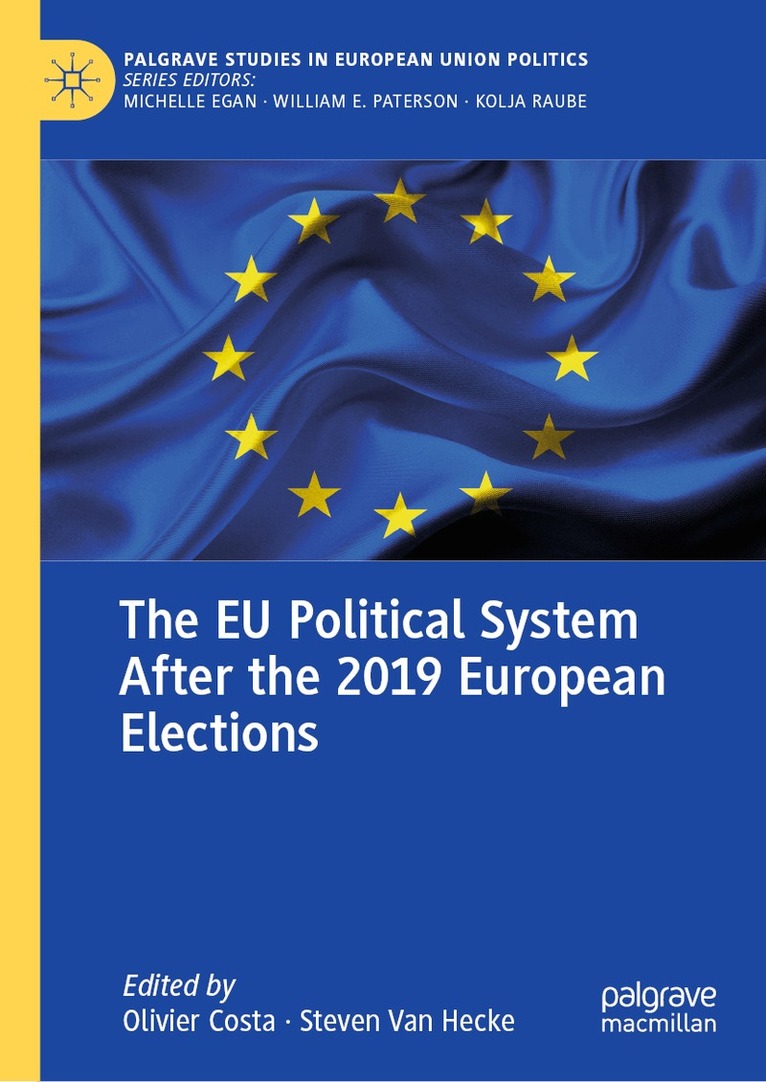
    EU Political System After the 2019 European Elections

    AvOlivier Costa,Steven Van Hecke

    Inbunden, Engelska, 2022

    Del i serien Palgrave Studies in European Union Politics

    1 496 kr

    Beställningsvara. Skickas inom 10-15 vardagar. Fri frakt över 249 kr.

    Beskrivning

    This book assesses the impact of the May 2019 European elections as well as the Covid-19 pandemic on the EU’s politics, institutions, and policies. Special attention is paid to the impact of these events on the different political forces as well as on the Union’s institutional balance, its priorities and the reform of its budget and policies. Because of the many post-electoral uncertainties, the book also takes into account how the relations between the Parliament, the European Council and the new Commission have developed. Furthermore, it analyses the capacity of the von der Leyen Commission to implement an ambitious programme, especially in the context of an unfolding pandemic. The objective of this book is to study the 2019 electoral sequence (parliamentary elections, appointment of EU institutions leaders, investiture of the Commission, new legislative programme) and determine its influence on the main institutional and political challenges for the 2019-2024 legislature. In other words, the volume deals with the question of who holds the EU’s leadership after the 2019 elections and how it handles the 2020-2021 pandemic.

    Produktinformation

    • Utgivningsdatum:2022-11-23
    • Mått:148 x 210 x 35 mm
    • Vikt:836 g
    • Format:Inbunden
    • Språk:Engelska
    • Serie:Palgrave Studies in European Union Politics
    • Antal sidor:519
    • Förlag:Springer International Publishing AG
    • ISBN:9783031123375

    Utforska kategorier

    • Polisrätt och vapenlagar inom Juridik
    • Offentlig förvaltning inom Samhälle och politik
    • Politik och statsskick inom Samhälle och politik

    Mer om författaren

    Olivier Costa is Director of European Political and Governance Studies at the College of Europe, Belgium, and Research Professor in Political Science and EU studies at the Centre National de la Recherche Scientifique, CEVIPOF-Sciences Po, France. He is also Executive Editor of the Journal of European Integration.Steven Van Hecke is Assistant Professor in Comparative and EU Politics at the Public Governance Institute of the KU Leuven, Belgium, and Senior Research Fellow at the Leibniz-Institut für Europäische Geschichte in Mainz, Germany.

    Innehållsförteckning

    • 1. Introduction.- 2. EU Citizen Participation “in the Union’s Democratic Life”: A Policy and Legal Analysis.- 3. Higher turnout at the expense of representativeness? The 2019 European elections against the backdrop of a socio-economically biased voter turnout.- 4. Unpacking legislative turnover in the 2019 European Parliament elections.- 5. The Life and Death of Spitzenkandidaten: What Role is Left for European Political Parties?.- 6. The political regime of the EU through the prism of the confirmation of the von der Leyen Commission by the European Parliament.- 7. Dealing with fragmentation: The new political equilibrium and coalition dynamics in the European Parliament during the 9th legislature.- 8. They are no different, they are much the same? Post-2019 inter-institutional dynamics in the European Union.- 9. The Von Der Leyen Commission: An Early Assessment.- 10. A “geopolitical Commission”: reaching a pointof inflexion?.- 11. Balancing the unbalanced? An ongoing rivalry between European Parliament and European Council.- 12. The European Parliament’s practice in scrutinizing the Commission’s delegated acts before and after the 2019 EP elections.- 13. The empowerment of the General Secretariat of the Council: a growing challenge for rotating presidencies?.- 14. The European Parliament under COVID-19: Institutional adaptation in times of pandemics.- 15. The Evolution of Central Banking in Europe.- 16. The EU budget and Recovery Plan: a chance for EU ambition?.- 17. “A Green European Wave?” Green Electoral Success and the European Green Deal.- 18. How Covid-19 Hit Brussels and Beyond: The EU’s Crisis Management Tested by a Pandemic.- 19. The evolution of enhanced cooperation in the EU: from EnCo to PeSCo (2009-2019).- 20. The End of Enlargement? The EU’s Struggle with the Western Balkans and Eastern Partnership countries.- 21. From the Gulf of Aden to the Mediterranean sea: The institutionalisation of EU-NATO maritime relations.- 22. The EU’s embrace of geopolitics: Insights from the EU-China Relationship.