• Fri frakt över 249 kr
  • •
  • Snabba leveranser
  • •
  • Billiga böcker
Kundservice

Du är på sajten för privatpersoner.

Företag, bibliotek eller offentlig verksamhet?

Du handlar på classic.bokus.com, där alla dina funktioner finns intakta.
Till classic.bokus.com
Bokus logotyp. Gå till startsidan.
  • Erbjudanden
  • Student
  • Topplistor
  • Barn & ungdom
  • Bokus Play
  • E-böcker
  • Ljudböcker
  • Pocketböcker
  • Spel och pussel

5% studentrabatt – använd koden KURSBOK27 →

Sidfot

Mina sidor

    Hjälp

    • Kundservice
    • Vanliga frågor och svar
    • Frakt och leverans
    • Retur vid ångerrätt
    • Reklamera vara
    • Betalning
    • Köpvillkor
    • Allmänna villkor
    • Information om webbplatsens tillgänglighet

    Om Bokus

    • Om oss
    • Pressrum
    • För studenter
    • För företag
    • För bibliotek och offentlig verksamhet
    • För leverantörer
    • Hållbarhet

    Populärt

    • Aktuella erbjudanden
    • Presentkort
    • Studentlitteratur
    • Nya böcker
    • Topplistor
    • Signerade böcker
    • Engelska böcker

    Inspiration

    • Boktips
    • BookTok
    • Barnbokskaraktärer
    • Populära författare
    Logotyp för Bokus
    Följ oss på Facebook (extern länk)Följ oss på Instagram (extern länk)Följ oss på YouTube (extern länk)Följ oss på TikTok (extern länk)
    bokus @ CookiesAnpassa cookiesIntegritetspolicyKöpvillkor
    Till Citymail hemsida (extern länk)Till Budbee hemsida (extern länk)Till Postnord hemsida (extern länk)Till Schenker hemsida (extern länk)Till Early Bird hemsida (extern länk)Till Walleys hemsida (extern länk)
    1. Kultur
    2. Konstböcker

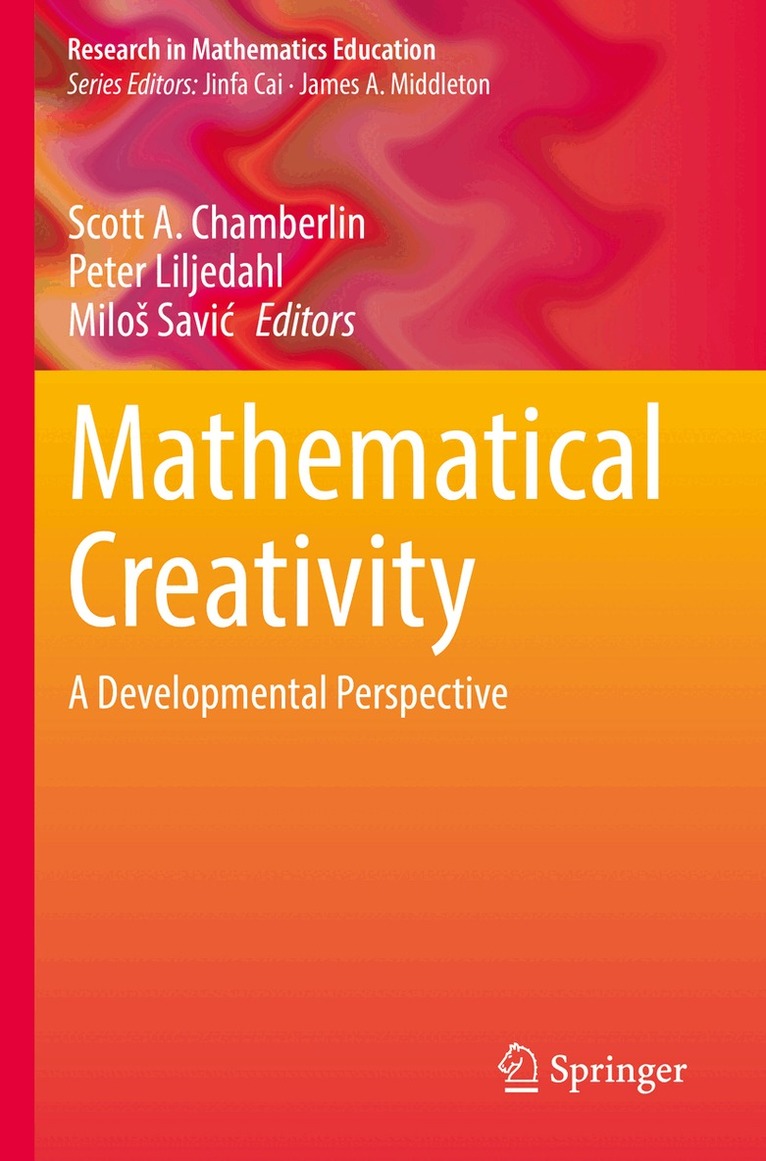
    Mathematical Creativity

    A Developmental Perspective

    AvScott A. Chamberlin,Peter Liljedahl

    Häftad, Engelska, 2023

    Del i serien Research in Mathematics Education

    2 544 kr

    Beställningsvara. Skickas inom 10-15 vardagar. Fri frakt över 249 kr.

    Beskrivning

    This book is important and makes a unique contribution in the field of mathematics education and creativity. The book comprises the most recent research by renowned international experts and scholars, as well as a comprehensive up to date literature review. The developmental lens applied to the research presented makes it unique in the field. Also, this book provides a discussion of future directions for research to complement what is already known in the field of mathematical creativity. Finally, a critical discussion of the importance of the literature in relation to development of learners and accordingly pragmatic applications for educators is provided. Many books provide the former (2) foci, but omit the final discussion of the research in relation to developmental needs of learners in the domain of mathematics. Currently, educators are expected to implement best practices and illustrate how their adopted approaches are supported by research.  The authors and editors of this book have invested significant effort in merging theory with practice to further this field and develop it for future generations of mathematics learners, teachers and researchers.

    Produktinformation

    • Utgivningsdatum:2023-12-02
    • Mått:155 x 235 x 15 mm
    • Vikt:406 g
    • Format:Häftad
    • Språk:Engelska
    • Serie:Research in Mathematics Education
    • Antal sidor:250
    • Förlag:Springer International Publishing AG
    • ISBN:9783031144769

    Utforska kategorier

    • Konstböcker inom Kultur
    • Matematik inom Naturvetenskap och teknik
    • Undervisning i specifika ämnen inom Psykologi och pedagogik

    Mer om författaren

    Scott A. Chamberlin is a mathematics and gifted educator and professor at the University of Wyoming. Having completed his Ph. D. at Purdue University, he invests research and scholarly efforts in student affect and creativity in mathematical problem solving episodes. Of particular importance to him is mathematical modeling given early efforts in his career with Drs. Richard Lesh and Judy Zawojewski. Scott’s most recent book (scheduled to be released in January 2021) pertains to the Five Legs Theory of Creativity in which he and colleague Eric Mann (Hope College) have devoted considerable time in explicating the relationship between mathematical creativity and mathematical affect.Peter Liljedahl is a mathematics educator and professor at Simon Fraser University. Many of his scholarly efforts in recent years have pertained to teacher education, mathematical modeling, mathematical affect and Flow, as well as mathematical creativity. In particular, Peter deeply understands the intricacies of creativity in mathematics as well as the pragmatic effects on student learning. Peter is a former co-editor in the Research in Mathematics series, having worked with Patricio Felmer and Boris Koichu, on a recent (2019) book entitled, Problem Solving in Mathematics Instruction and Teacher Professional Development.Miloš Savić is a mathematics educator and associate professor at the University of Oklahoma. His recent efforts in developing the Creativity in Progress Reflections with the Creativity Research Group (CRG) that will be utilized in this publication. The CRG is known in the mathematical creativity field as leaders in the tertiary level, including in proof-based courses. Their recent National Science Foundation grant has generated substantial understanding about mathematical identity and creativity at the calculus level.

    Innehållsförteckning

    • Chapter 1. Creativity and Mathematics: A Beginning Look.- Chapter 2. Creativity in Mathematics: an Overview of More than 100 Years of Research.- Chapter 3. Mathematical creativity and society.- Chapter 4. Organizational framework for book and conceptions of mathematical creativity.- Chapter 5. Commentary on section.- Chapter 6. Mathematical Creativity Research in the Elementary Grades.- Chapter 7. Literature Review on Empirical Findings on Creativity in Mathematics among Secondary School Students.- Chapter 8. Mathematical Creativity at the Tertiary Level: A Systematic Review of the Literature.- Chapter 9. An introduction and a commentary.- Chapter 10. Now You See It, Now You Don’t: Why the choice of theoretical lens matters when exploring children’s creative mathematical thinking.- Chapter 11. The creative mathematical thinking process.- Chapter 12. Group Creativity.- Chapter 13. “Creativity is Contagious” and “Collective”: Progressions of Undergraduate Students’ Perspectives on Mathematical Creativity.- Chapter 14. The role of creativity in teaching mathematics online.- Chapter 15. Concluding thoughts on research: Application, implications and future directions.