• Fri frakt över 249 kr
  • •
  • Snabba leveranser
  • •
  • Billiga böcker
Kundservice

Du är på sajten för privatpersoner.

Företag, bibliotek eller offentlig verksamhet?

Du handlar på classic.bokus.com, där alla dina funktioner finns intakta.
Till classic.bokus.com
Bokus logotyp. Gå till startsidan.
  • Erbjudanden
  • Nyheter
  • Student
  • Topplistor
  • Barn & ungdom
  • Bokus Play
  • E-böcker
  • Pocketböcker
  • Spel & pussel

10% rabatt på allt med kod NYSTART10 →

Sidfot

Mina sidor

    Hjälp

    • Kundservice
    • Vanliga frågor och svar
    • Frakt och leverans
    • Retur vid ångerrätt
    • Reklamera vara
    • Betalning
    • Köpvillkor
    • Allmänna villkor
    • Information om webbplatsens tillgänglighet

    Om Bokus

    • Om oss
    • Pressrum
    • För studenter
    • För företag
    • För bibliotek och offentlig verksamhet
    • För leverantörer
    • Hållbarhet

    Populärt

    • Aktuella erbjudanden
    • Presentkort
    • Studentlitteratur
    • Nya böcker
    • Topplistor
    • Signerade böcker
    • Engelska böcker

    Inspiration

    • Boktips
    • BookTok
    • Populära bokserier
    • Barnbokskaraktärer
    • Populära författare
    Logotyp för Bokus
    Följ oss på Facebook (extern länk)Följ oss på Instagram (extern länk)Följ oss på YouTube (extern länk)Följ oss på TikTok (extern länk)
    bokus @ CookiesAnpassa cookiesIntegritetspolicyKöpvillkor
    Till Citymail hemsida (extern länk)Till Budbee hemsida (extern länk)Till Postnord hemsida (extern länk)Till Schenker hemsida (extern länk)Till Early Bird hemsida (extern länk)Till Walleys hemsida (extern länk)
    1. Djur och Natur
    2. Naturböcker
    3. Växtböcker

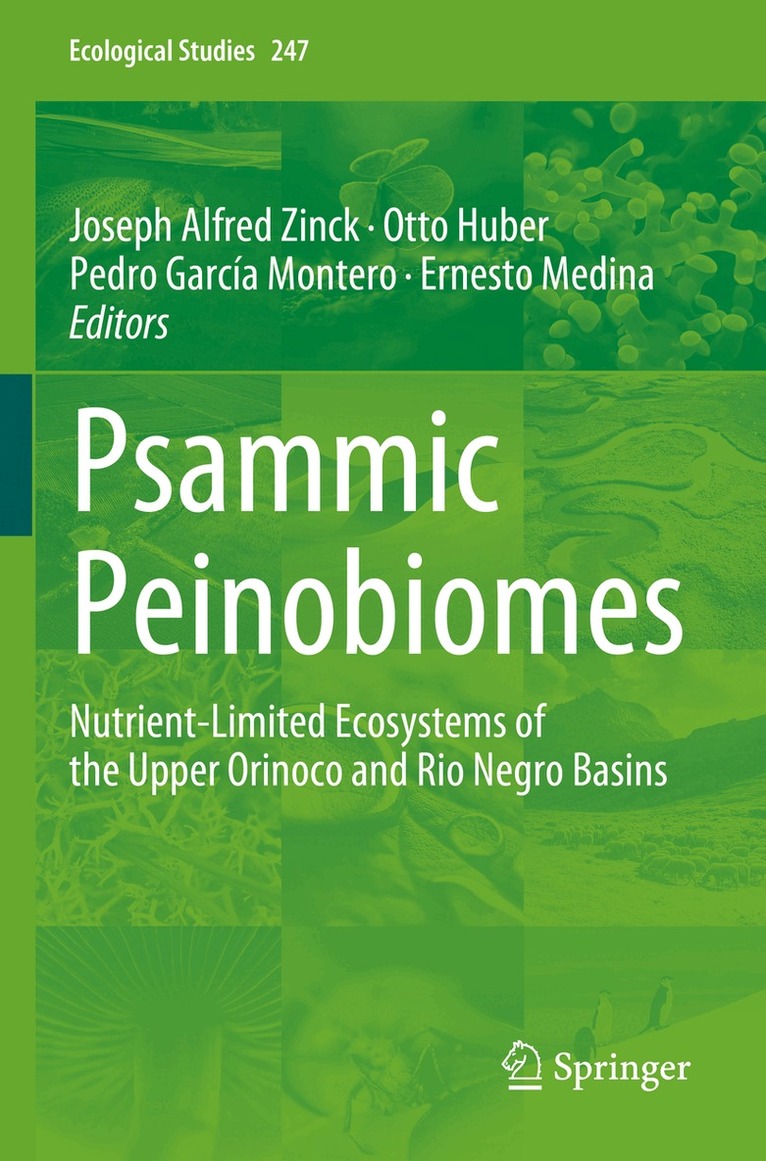
    Psammic Peinobiomes

    Nutrient-Limited Ecosystems of the Upper Orinoco and Rio Negro Basins

    AvJoseph Alfred Zinck,Otto Huber

    Häftad, Engelska, 2024

    Del 247 i serien Ecological Studies

    1 731 kr

    Beställningsvara. Skickas inom 10-15 vardagar. Fri frakt över 249 kr.

    Beskrivning

    The book represents a multidisciplinary approach to understanding soil–landscape–vegetation relationships and, specifically, the ecophysiology of plant communities developing on sandy soils of very low fertility that are subject to seasonal flooding. It provides an overview of the white sand ecosystems within the Amazon basin, and focuses on the forest and herbaceous (meadows) vegetation growing on the dystrophic sandy soils of the upper Negro and Orinoco river basins. Several chapters describe physiographic aspects of the study area using integrated remote sensing and in situ sampling. By doing so they attain a comprehensive description of the origin and evolution of soils and landscapes, an advanced classification of soils, and a mapping of the geographic distribution of psammophilous vegetation. This volume also provides a phytosociological classification of extensive forested areas, and a detailed description of the structure and diversity of little-known herbaceous formations.It targets professionals in the fields of ecology, ecophysiology, geomorphology, soils, vegetation, and the environmental sciences. The information it offers may be of significant use to researchers, protected area planners, and environmental policy makers.

    Produktinformation

    • Utgivningsdatum:2024-08-30
    • Mått:155 x 235 x 30 mm
    • Vikt:832 g
    • Format:Häftad
    • Språk:Engelska
    • Serie:Ecological Studies
    • Antal sidor:541
    • Förlag:Springer International Publishing AG
    • ISBN:9783031208010

    Utforska kategorier

    • Växtböcker inom Djur och Natur
    • Geovetenskap inom Naturvetenskap och teknik
    • Botanik inom Naturvetenskap och teknik

    Mer om författaren

    Alfred Zinck: Bachelor in Geography and Master in Edaphology and Geomorphology, University of Strasbourg, France. Doctorate in Regional Planning, University of Bordeaux, France. Postdoc Soil Science Dept. University of California Berkeley, USA. Emeritus Prof., Faculty of Geo-information Science and Earth Observation (ITC), University of Twente, Enschede, The Netherlands.Otto Huber: Bachelor in Biology (1969) Università degli Studi di Roma, Roma (Italy). Doctor degree in Botany and Geography, Leopold-Franzens- Universität, Innsbruck (Austria) 1976. Specialist in neotropical floristics and phytogeography, (the Guayana region, the Orinoco savannas, and the cloud forest of the coastal range in Venezuela). Ecologist of Ministry for the Environment (MARNR-CODESUR), Amazonas state (1977-1983). Scientific consultant (CVG - EDELCA) and (MARNR) for ecology, and environmental impact (1986-1992)(Venezuela). Coordinator, Deutsche Gesellschaft für Technische Zusammenarbeit (GTZ)/Germany (1992-1994) (project: Amazonian Center for Environmental Research  (CAIAH), Amazonas state, Venezuela). Pedro García Montero: Ing. Agr. Universidad Central de Venezuela (UCV) 1975. Master of Science (Soil Science), University of Florida, USA (1984).Long-term staff member of the governmental electric power company (CVG – EDELCA, Venezuela) and Ministry of the Environment (MARNR). Professor of Soil Science at the Universidad Central de Venezuela (UCV). Environmental Consultant. Member of the Orinoco Group.Ernesto Medina: Bachelor in Biology (1961), Universidad Central de Venezuela (UCV). Doktor Acker, Universität Hohenheim, Germany (1964). Postdoc. Department of Plant Biology, Carnegie Institution of Washington, USA (1970). Emeritus Researcher, Instituto Venezolano de Investigaciones Científicas (IVIC). Adjunct Scientist of the International Institute of Tropical Forestry (USDA), Puerto Rico.

    Innehållsförteckning

    • 1 Introduction.- Part I: Forest and woodland biomes.- 2 White sand ecosystems in the Amazon basin:  geographic distribution, distinctive features, and ecology. An overview.- 3 The forests of the Rio Negro basin in the north-western Amazon: a phytosociological classification.- 4 Amazon caatinga complex: sclerophyllous vegetation on nutrient-poor white sand soils.- Part II: Meadow biomes.- 5 Mapping white-sand ecosystems by integrating Global PALSAR-2 and SENTINEL-1 with NDVI (LANDSAT data).- 6 The study areas: landscapes and soils.- 7 Soil properties, formation, distribution, and classification.- 8 Origin and sources of sand: from highlands to lowlands.- 9 Sand dynamics and distribution: a geo-sedimentological approach.- 10 Features and trends of meadow landscape evolution.- 11 Meadow phytodiversity: flora, endemism, vegetation types, and geographic distribution patterns.- 12 Synthesis: white-sand and meadow-vegetation relationships.