• Fri frakt över 249 kr
  • •
  • Snabba leveranser
  • •
  • Billiga böcker
Kundservice

Du är på sajten för privatpersoner.

Företag, bibliotek eller offentlig verksamhet?

Du handlar på classic.bokus.com, där alla dina funktioner finns intakta.
Till classic.bokus.com
Bokus logotyp. Gå till startsidan.
  • Erbjudanden
  • Nyheter
  • Student
  • Topplistor
  • Barn & ungdom
  • Bokus Play
  • E-böcker
  • Pocketböcker
  • Spel & pussel

10% rabatt på allt med kod: NYSTART10 →

Sidfot

Mina sidor

    Hjälp

    • Kundservice
    • Vanliga frågor och svar
    • Frakt och leverans
    • Retur vid ångerrätt
    • Reklamera vara
    • Betalning
    • Köpvillkor
    • Allmänna villkor
    • Information om webbplatsens tillgänglighet

    Om Bokus

    • Om oss
    • Pressrum
    • För studenter
    • För företag
    • För bibliotek och offentlig verksamhet
    • För leverantörer
    • Hållbarhet

    Populärt

    • Aktuella erbjudanden
    • Presentkort
    • Studentlitteratur
    • Nya böcker
    • Topplistor
    • Signerade böcker
    • Engelska böcker

    Inspiration

    • Boktips
    • BookTok
    • Populära bokserier
    • Barnbokskaraktärer
    • Populära författare
    Logotyp för Bokus
    Följ oss på Facebook (extern länk)Följ oss på Instagram (extern länk)Följ oss på YouTube (extern länk)Följ oss på TikTok (extern länk)
    bokus @ CookiesAnpassa cookiesIntegritetspolicyKöpvillkor
    Till Citymail hemsida (extern länk)Till Budbee hemsida (extern länk)Till Postnord hemsida (extern länk)Till Schenker hemsida (extern länk)Till Early Bird hemsida (extern länk)Till Walleys hemsida (extern länk)
    1. Ekonomi och Ledarskap
    2. Nationalekonomi

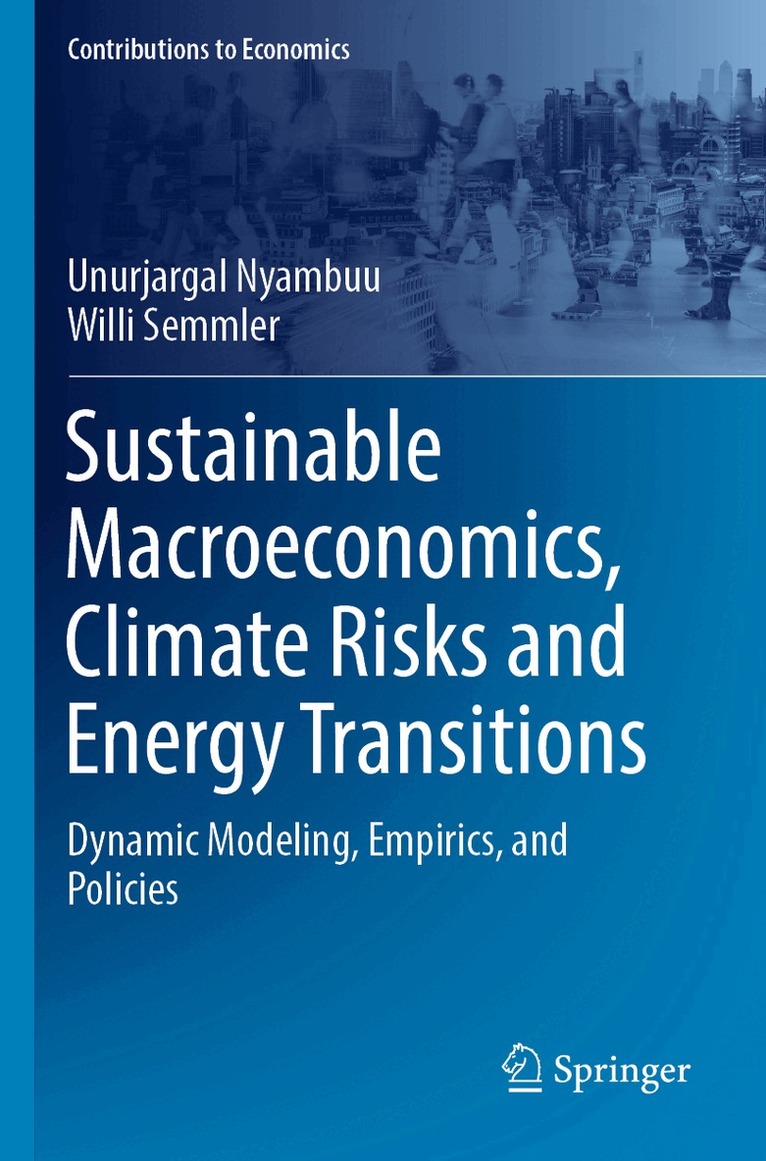
    Sustainable Macroeconomics, Climate Risks and Energy Transitions

    Dynamic Modeling, Empirics, and Policies

    AvUnurjargal Nyambuu,Willi Semmler

    Häftad, Engelska, 2024

    Del i serien Contributions to Economics

    547 kr

    Beställningsvara. Skickas inom 10-15 vardagar. Fri frakt över 249 kr.

    Fler format och utgåvor

    Inbunden

    708 kr

    Beskrivning

    Given the industrialized world’s historical dependence on fossil fuel-based energy resources and the now-realized perils of moving beyond the earth’s carbon budget, this book explores the myriad challenges of climate change and in reaching a low-carbon economy. Reconciling the medium-term competing, yet frequently complementary, needs for transition policies, the book provides guidelines for complex and often conflicting climate policy tasks.The book presents empirical trends in the use of carbon-emitting resources and evaluates market-driven short-termism and its adverse impact on resource use and the environment; it emphasizes a medium-term macroeconomic perspective for the transition. The authors attempt a paradigm shift towards a framework of sustainable macroeconomics. They survey relevant historical models, conduct empirical and numerical analyses ofthe climate change-relevant dynamic models, provide empirical illustrations, and evaluate diverse policy options and implementations together with their historical evolution. New analytical issues are also  considered, e.g., strategic behavior in the energy and resource sectors, energy competition and the dynamics of market shares in new energy  technology, and supporting policies for dealing with the tipping points encountered in climate change. The authors suggest a multitude of market-based strategies and public fiscal, monetary, and financial policies, and longer-run planning for resource extraction -all suitable for driving sustainable growth and a transformation of the energy sector. The book also examines the multiple delaying forces slowing the transition to a low-carbon economy; these typically arise from short-termism, lock-ins, irreversibility, leakages, non-cooperative games, and other political strategies. Thus, they explain the snail’s pace evolution of current national and global climate policies.   The book will appeal to scholars and students of economics and environmental science. It is also relevant for policymakers and practitioners in multilateral institutions, research institutions as well as governments and ministries of countries interested in alternative energy sources, climate economists, and those who study the implementation of sustainable and low carbon-based policies.

    Produktinformation

    • Utgivningsdatum:2024-05-31
    • Mått:155 x 235 x 12 mm
    • Vikt:335 g
    • Format:Häftad
    • Språk:Engelska
    • Serie:Contributions to Economics
    • Antal sidor:195
    • Förlag:Springer International Publishing AG
    • ISBN:9783031279843

    Utforska kategorier

    • Nationalekonomi inom Ekonomi och Ledarskap
    • Miljövetenskap och miljöpolitik inom Naturvetenskap och teknik
    • Energiindustri inom Ekonomi och Ledarskap

    Mer om författaren

    Unurjargal Nyambuu is an economist and professor in the Department of Social Science, the New York City College of Technology, CUNY (USA). She is also a research fellow in Finance and Risk Engineering at NYU’s Tandon School. Dr. Nyambuu previously served as an economist with the Central Bank of Mongolia. Willi Semmler is the Henry Arnhold Professor of International Cooperation and Development at the New School for Social Research in New York (USA). There, he directs the Schwartz Center for Economic Policy Analysis’ Economics of Climate Change project. He is also a senior researcher at IIASA, Laxenburg (Austria), a research fellow at La Sapienza University (Rome) and affiliated with the University of Bielefeld (Germany).

    Innehållsförteckning

    • Chapter 1 – Introduction.- Chapter 2 -Sustainable Growth, Welfare and Short-termism.- Chapter 3 - Non-Sustainable Growth, Resource Extraction, and Boom-Bust Cycles.- Chapter 4 - Fossil Fuel Resources, Environment and Climate Change.- Chapter 5 - Limits on the Extraction of Fossil Fuels,- Chapter 6 - Fossil Fuel Resource Depletion, Backstop Technology, and Renewable Energy.- Chapter 7 - Transition to a Low Carbon Energy System.- Chapter 8 - The Private Sector – Energy Transitions and Financial Market.- Chapter 9 - The Public Sector – Energy Transition and Fiscal and Monetary Policies.- Chapter 10 - Delaying Forces and Climate Negotiation – Games, Lock-ins, Leakages, and Tipping Points.- Chapter 11 - Climate Risks, Sustainable Finance, and Climate Policy.- Chapter 12 - Concluding Remarks.