• Fri frakt över 249 kr
  • •
  • Snabba leveranser
  • •
  • Billiga böcker
Kundservice

Du är på sajten för privatpersoner.

Företag, bibliotek eller offentlig verksamhet?

Du handlar på classic.bokus.com, där alla dina funktioner finns intakta.
Till classic.bokus.com
Bokus logotyp. Gå till startsidan.
  • Erbjudanden
  • Nyheter
  • Student
  • Topplistor
  • Barn & ungdom
  • Bokus Play
  • E-böcker
  • Pocketböcker
  • Spel & pussel

10% rabatt på allt med kod: NYSTART10 →

Sidfot

Mina sidor

    Hjälp

    • Kundservice
    • Vanliga frågor och svar
    • Frakt och leverans
    • Retur vid ångerrätt
    • Reklamera vara
    • Betalning
    • Köpvillkor
    • Allmänna villkor
    • Information om webbplatsens tillgänglighet

    Om Bokus

    • Om oss
    • Pressrum
    • För studenter
    • För företag
    • För bibliotek och offentlig verksamhet
    • För leverantörer
    • Hållbarhet

    Populärt

    • Aktuella erbjudanden
    • Presentkort
    • Studentlitteratur
    • Nya böcker
    • Topplistor
    • Signerade böcker
    • Engelska böcker

    Inspiration

    • Boktips
    • BookTok
    • Populära bokserier
    • Barnbokskaraktärer
    • Populära författare
    Logotyp för Bokus
    Följ oss på Facebook (extern länk)Följ oss på Instagram (extern länk)Följ oss på YouTube (extern länk)Följ oss på TikTok (extern länk)
    bokus @ CookiesAnpassa cookiesIntegritetspolicyKöpvillkor
    Till Citymail hemsida (extern länk)Till Budbee hemsida (extern länk)Till Postnord hemsida (extern länk)Till Schenker hemsida (extern länk)Till Early Bird hemsida (extern länk)Till Walleys hemsida (extern länk)
    1. Naturvetenskap och teknik
    2. Geovetenskap
    3. Geovetenskap

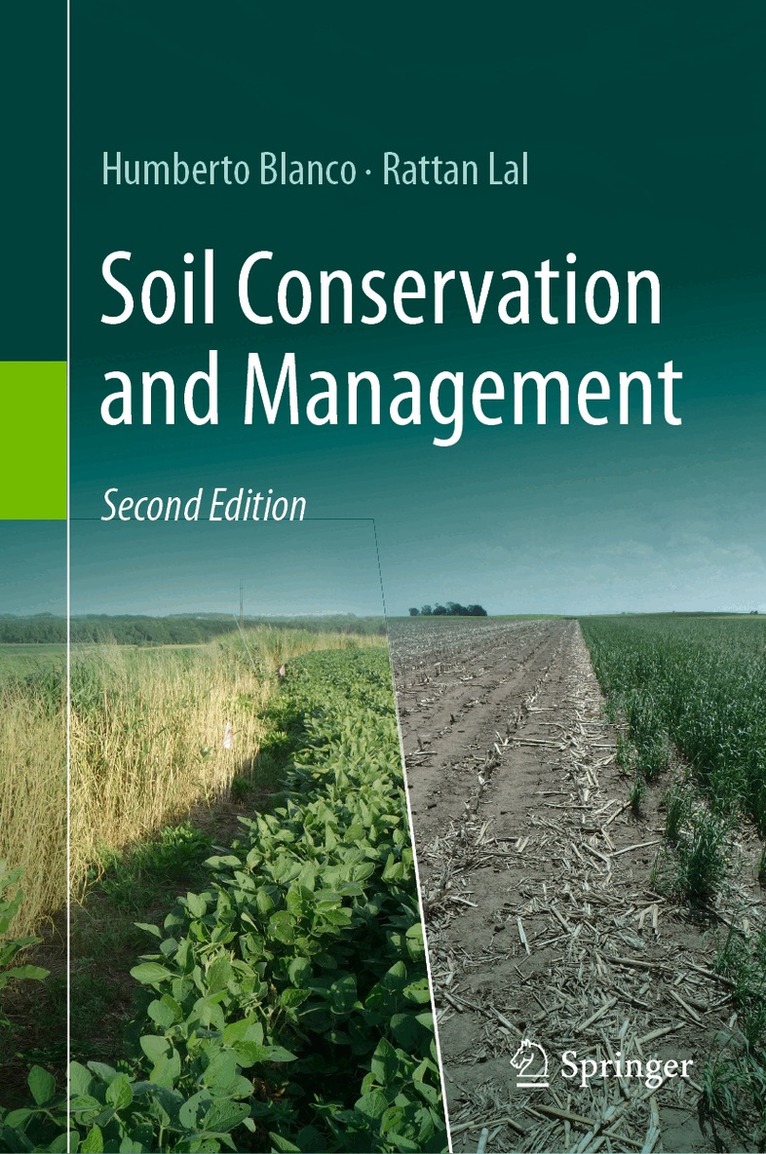
    Soil Conservation and Management

    AvHumberto Blanco,Rattan Lal

    Inbunden, Engelska, 2023

    1 410 kr

    Beställningsvara. Skickas inom 10-15 vardagar. Fri frakt över 249 kr.

    Fler format och utgåvor

    Häftad

    1 086 kr

    Beskrivning

    This updated and expanded second edition textbook, describes all main aspects of soil management, to address the serious problems of soil erosion and the attendant environmental pollution. The global high demands for food, fiber, feed, and fuel put a constant strain on the environment, which can only be mitigated by soil conservation.This edition incorporates new concepts and provides an up-to-date review of soil management principles and practices. The authors also added new chapters on cover crops, crop residues, soil water management, nutrient management, perennials in crop rotations and organic amendments. All practices have a clear perspective on addressing soil erosion, physical and chemical problems, carbon dynamics and sequestration as well as non-point source pollution. The restorative nature of many practices, also consider water conservation as a main pillar of sustaining a healthy soil.This textbook is valuable for students and professionals in soil science, agronomy, agricultural engineering, hydrology, and management of natural resources.

    Produktinformation

    • Utgivningsdatum:2023-09-15
    • Mått:155 x 235 x 42 mm
    • Vikt:1 108 g
    • Format:Inbunden
    • Språk:Engelska
    • Antal sidor:611
    • Upplaga:2
    • Förlag:Springer International Publishing AG
    • ISBN:9783031303401

    Utforska kategorier

    • Geovetenskap inom Naturvetenskap och teknik
    • Miljövetenskap och miljöpolitik inom Naturvetenskap och teknik
    • Biovetenskap inom Naturvetenskap och teknik

    Mer om författaren

    Humberto Blanco is a Professor of Soil Management and Applied Soil Physics in the Department of Agronomy and Horticulture, University of Nebraska-Lincoln. He got his B.Sc. in Soil Science from the Technical Univ. of Oruro, Bolivia in 1990. Then, he received his M.Sc. in 1995 and Ph.D. in 2003 in Soil Conservation and Applied Soil Physics from the Univ. of Missouri, Columbia. He worked at the Ohio State Univ. as a Research Scientist from 2004 to 2007. In 2008, he accepted a faculty position at Kansas State University. In 2012, he moved to the Univ. of Nebraska at Lincoln. His appointment is 60% research and 40% teaching. He teaches Soil Management and Applied Soil Physics. His research work focuses on the characterization of soil processes and properties, water and wind erosion, water quality parameters, soil water management, soil-water-nutrient-plant relationships, soil C sequestration and C dynamics, and greenhouse gas emissions under different management practices. Such practices include cover crops, cover crop grazing, conservation tillage (e.g., no-till, reduced till), cropping systems, organic farming, crop residue removal for livestock and biofuel production, inorganic fertilization, conservation buffers, dedicated biofuel crops (e.g., perennial warm-season grasses), biochar, and others. He has published over 150 peer-reviewed articles and four books. His h-index is 53. His research work frequently appears in the CSA News. He was an invited speaker to several countries (Germany, Canada, Ukraine, Brazil, and Argentina). He is a Fellow of the Soil Science Society of America. He has received several awards including the Shirley Phillips No-till Award (Univ. of Kentucky), Best Paper Awards, Young Scholar Award of the Soil Science Society of America (SSSA), and others. He served as Chair of the Soil and Water Management and Conservation Division of SSSA. He is currently a Technical Editor for Agronomy Journal and he has served as an Associate Editor forvarious journals. Rattan Lal, Ph.D., is a Distinguished University Professor of Soil Science and Director of the CFAES Rattan Lal Center for Carbon Management and Sequestration at The Ohio State University. He received B.Sc. from PAU, Ludhiana (1963); M.Sc. from IARI, New Delhi (1965);and  Ph.D. from OSU, Columbus, Ohio (1968). He was Sr. Research Fellow at University of Sydney (1968-69),soil Physicist at IITA, Ibadan, Nigeria (1970-87), and Professor of Soil Science at OSU (1987 to date). He has authored/co-authored over 1000 refereed journal articles and 550 book chapters, and written and edited/co-edited 100 books. He received an Honoris Causa degree from 9 universities throughout Europe, USA, South America, and Asia; the Medal of Honor from UIMP, Santander, Spain (2018); the Distinguished Service Medal of the IUSS (2018); and is fellow of 5 professional societies. Dr. Lal has mentored 117 graduate students and 185visiting scholars. He was President of the WASWC(1987-1990), ISTRO (1988-1991), SSSA (2006-2008), and IUSS (2017-2018). He holds the Chair in Soil Science and is the Goodwill Ambassador for Sustainability Issues for IICA, and member of the 2021 U.N. Food System Summit Science Committee and Action Tracks 1 & 3. Dr. Lal is laureate of the GCHERA World Agriculture Prize (2018), Glinka World Soil Prize (2018), Japan Prize (2019), U.S. Awasthi IFFCO Prize (2019), Arrell Global Food Innovation Award (2020), World Food Prize (2020), India’s Padma Shri Award (2021).He is an honorary member of the Moldova Academy of Sciences (2022) , and a member of the Academia Europaea(2022).He received the   Presidential Award of SSSA(2022), and the IPCC-Nobel Peace Prize Certificate (2007).The  PAU ,Ludhiana, named its Soil Science and Agronomy building as Rattan Lal Laboratories in 2020.He was listed in the “Greetings Friends” poem published in 26 December 2022 issue of New Yorker.

    Innehållsförteckning

    • Chapter 1: Soil And Water Management.- Chapter 2: Water Erosion.- Chapter 3: Modeling Water Erosion.- Chapter 4: Wind Erosion.- Chapter 5: Wind Erosion Modeling.- Chapter 6: Tillage Erosion.- Chapter 7: Tillage Systems.- Chapter 8: Cropping Systems.- Chapter 9: Crop Residue Management.- Chapter 10: Cover Crops.- Chapter 11: Perennial Plants And Soil Management.- Chapter 12: Soil Amendments.- Chapter 13: Mechanical Structures And Engineering Techniques.- Chapter 14: Restoration And Management Of Degraded Soils.- Chapter 15: Soil Fertility Management.- Chapter 16: Nutrient Erosion And Hypoxia Of Aquatic Ecosystems.- Chapter 17: Soil Water Management.- Chapter 18: Management Of Grazing Lands.- Chapter 19: Soil Management And Carbon Dynamics.- Chapter 20: One Health.- Chapter 21: Soil Resilience.- Chapter 22: Food, Water, And Climate.- Chapter 23: The Way Forward.